
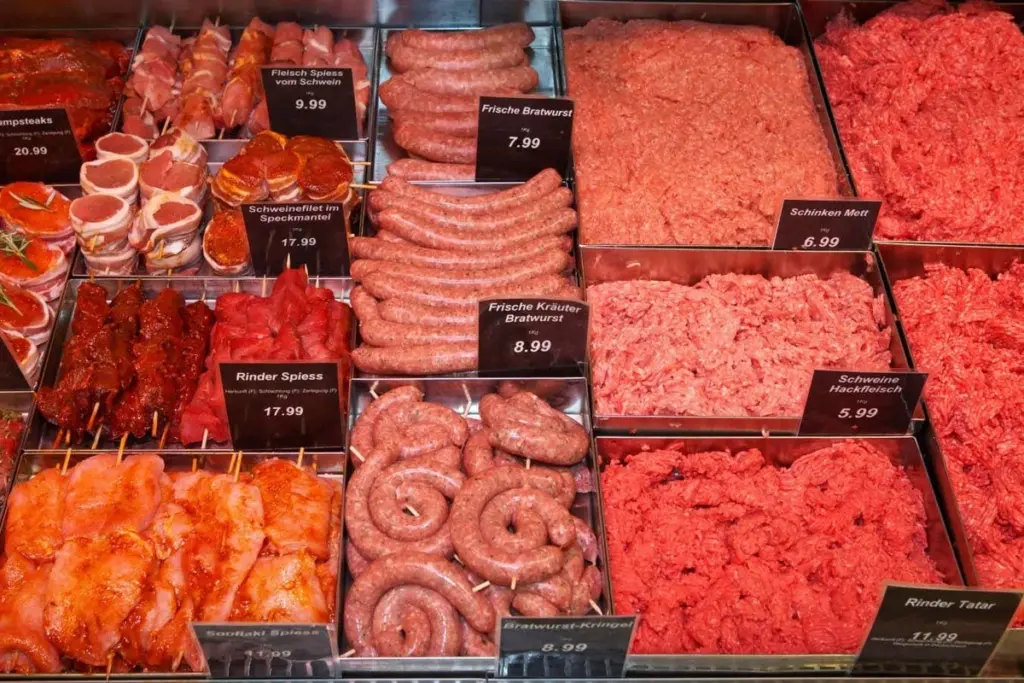
A recent announcement from the US government regarding its new dietary guidelines has sparked considerable discussion. Notably, the updated guidance places a significant emphasis on red meat, visibly featuring it in the most prominent section of the food pyramid. This positioning suggests that beef and other animal-based proteins should constitute a substantial element of a balanced diet.
This new directive marks a significant departure from public health recommendations of the past several decades, which had consistently advised on limiting the consumption of red meat. Sara Bleich, a professor at Harvard University who previously served at the US Department of Agriculture (USDA) during the Biden administration, commented on the confusion this creates for consumers. “When you see that image—with a large piece of steak included—it’s natural for people to think, ‘Great! I can eat all the steak I want,'” she noted.
The apparent comeback of beef is not an isolated event; it has been developing over several years. Social media platforms are active with discussions and endorsements of the carnivore diet. Influencers are actively promoting beef tallow for culinary uses. Even Robert F. Kennedy Jr., a prominent public health figure in the US, publicly shared his method of cooking Thanksgiving turkey in beef fat. He explained in a social media video, referring to his “Make America Healthy Again” initiative, “This is how we cook the MAHA way—beef tallow,” promoting the consumption of “real food.” However, the definition of what constitutes “real food” can be subjective.
Despite these trends, the scientific understanding of red meat’s health implications has remained largely consistent over recent decades. It continues to be recognized as one of the most environmentally impactful food sources. Furthermore, numerous studies consistently link its consumption to less favorable health outcomes, including heart disease and certain cancers. Reinforcing past recommendations, the American Heart Association, in March, released its own dietary guidelines advocating for reduced red meat intake and a preference for plant-based protein sources.
The resurgence of beef’s popularity might be better understood through a cultural perspective, reflecting a broader societal focus on protein intake and a perceived return to more traditional eating habits. The considerable influence of the beef and dairy industries likely also played a role in this shift.
The Shifting Landscape of Red Meat Consumption
Historically, in Western societies, meat was typically considered a secondary component of meals rather than the primary focus. This perception began to change around the 19th century. Industrialization, the development of refrigeration technologies, and increased disposable incomes made meat more accessible. Other parts of the world gradually adopted similar trends.
In the United States, per capita annual beef consumption reached a peak in 1976, standing at nearly 43 kilograms, or approximately 94 pounds. The European Union experienced its highest consumption level about a decade later, reaching 25 kilograms per person annually. Consumption then began to decline as concerns grew regarding saturated fats and their potential connection to heart disease. Concurrently, white-meat options like chicken and turkey began appearing in supermarkets, marketed as healthier, leaner alternatives to red meat. For context, one serving of ground beef contains nearly 7 grams of saturated fat, while a similar serving of ground chicken has less than 2 grams. This trend was so pronounced that the US National Pork Board launched a campaign in 1987 to position pork as “the other white meat,” despite its saturated fat content being comparable to beef and its classification as red meat.
Beef’s public image suffered another significant blow in 2015. The World Health Organization (WHO) assembled 22 researchers from 10 countries to evaluate the evidence linking red meat consumption to cancer. Their comprehensive review, which analyzed over 800 studies, classified processed meats, such as bacon and ham, as carcinogens. The findings indicated that consuming 50 grams of processed meat daily—equivalent to about one sausage—increases the risk of colorectal cancer by approximately 18 percent. Kurt Straif of Boston College, who participated in the WHO research group, likened this risk increase to that associated with second-hand smoke.
The expert panel also categorized red meat as a probable carcinogen. This classification was based on studies observing a positive correlation between its consumption and colorectal cancer. However, Straif mentioned that the evidence for unprocessed red meat was not as consistent as for processed varieties, and other factors contributing to colorectal cancer in meat-eaters could not be ruled out. Nevertheless, the analysis suggested that consuming 100 grams of red meat daily—approximately the size of a deck of cards—was associated with a 17 percent greater risk of colorectal cancer.
While individual risk increases may appear modest, their aggregate effect at a population level is substantial. The WHO estimates that processed meat consumption contributes to approximately 34,000 cancer deaths globally each year. If the association with unprocessed red meat is proven to be causal, it could be linked to around 50,000 cancer deaths annually.
Also in 2015, an advisory committee commissioned by the USDA recommended updating the national dietary guidelines to promote plant-based diets, partly due to environmental concerns surrounding meat production. The committee referenced a 2012 study which projected that doubling the number of vegetarians in the UK could reduce greenhouse gas emissions by nearly 28 million tonnes annually, representing about 3 percent of total emissions. Considering the adverse health impacts of climate change, such as increased rates of heart disease, respiratory illnesses, and premature death, this shift would have also had public health benefits. However, the USDA ultimately did not adopt this recommendation.
Despite these considerations, around a decade ago, annual US beef consumption reached its lowest point, around 25 kilograms (54 pounds) per person. This figure was comparable to the levels recorded in 1909, the first year for which the government began collecting such data.
Health Risks Associated with Red Meat
Since that period, the body of evidence detailing the potential health detriments of red meat has continued to expand. For instance, a 2024 study involving nearly 149,000 adults found that individuals consuming two or more servings of processed red meat per day faced a 29 percent higher risk of heart disease compared to those eating less than one serving weekly. Similarly, participants who ate two or more servings of unprocessed red meat daily showed a 14 percent increased risk of heart disease relative to those consuming less than one serving per week. These participants were monitored for an average of four years and were initially free from heart disease, cancer, and diabetes.
While saturated fats in red meat were once considered the primary driver of these health associations, current research suggests this may not be the sole or primary factor. A 2022 study of approximately 4,000 US adults aged 65 and over indicated that a higher intake of unprocessed red meat was linked to a 15 percent greater risk of atherosclerosis, a condition characterized by the hardening of arteries which elevates the likelihood of heart attack and stroke. Significantly, the study also highlighted that trimethylamine N-oxide (TMAO), a substance produced by gut bacteria, played a crucial role in mediating this association.
TMAO is generated as gut bacteria break down compounds abundant in red meat, such as choline and L-carnitine. This compound is known to cause inflammation in blood vessels and impede the body’s mechanisms for preventing cholesterol buildup in arteries. TMAO has also been implicated in the development of colorectal cancer. This connection may help explain the findings of a 2025 analysis of 60 studies, which reported that red meat consumption was associated with a 15 percent greater risk of colorectal cancer, and processed meat consumption with a 21 percent greater risk.
“All these biological pathways are entirely separate from saturated fat,” stated Dariush Mozaffarian of Tufts University in Massachusetts, a co-author of the 2022 study. “Consequently, we may have been incorrectly advising people to consume lean red meat, when in fact, other components within red meat are the actual source of the problem.”
Beef’s Resurgence and Cultural Influences
Despite the increasingly clear health risks associated with red meat, its consumption is experiencing a notable revival. Between 2015 and 2021, the most recent period for which data is available, US beef consumption increased by nearly 9 percent. This trend is expected to continue, particularly given the country’s revised dietary guidelines. Simultaneously, in Australia, approximately 25 percent of the population reported an increase in red meat consumption in 2025, a substantial rise from less than 10 percent in 2013. While red meat consumption has seen a steady decline in the UK since 1980, certain demographics, such as young men, have recently indicated an increase in their intake. The precise factors driving this shift are not fully understood, but evolving cultural and political environments undoubtedly contribute. One notable example is the emergence of the “manosphere,” a subculture that challenges feminist perspectives and emphasizes traditional notions of masculinity.
“In certain communities, red meat is viewed as a means to assert strength, dominance, and independence—qualities often associated with masculinity,” explained Elina Vrijsen of the University of Antwerp in Belgium. Her research, conducted with colleagues, suggests that young men frequently use meat as a way to communicate and solidify their masculine identity, which could account for the rising consumption among Gen Z men. A 2024 survey conducted by the UK environmental non-profit Hubbub found that males aged 16 to 24 were nearly three times more likely than the general population to report an increase in meat consumption over the past year.
Another significant factor is the pervasive cultural emphasis on protein intake. This is exemplified by the US government’s updated dietary guidelines, which nearly doubled the advised daily protein intake from 0.8 grams per kilogram of body weight to 1.6 grams. “This substantial increase lacks a scientific basis,” argued Bleich. “From a health standpoint, our current protein intake is generally sufficient, so this recommended doubling appears unnecessary.”
The USDA’s revised guidelines were issued after the government rejected recommendations from an independent advisory committee tasked with reviewing nutritional science. This committee, which had undergone a vetting process for potential conflicts of interest, had advocated for a more plant-centric diet. However, the administration under President Donald Trump departed from established procedures and established its own committee, partly in response to concerns about the promotion of plant-based diets. At least four of the nine members of this new committee had reported financial ties to the beef and dairy industries.
“Finally, we are realigning our food system to support American farmers, ranchers, and companies that cultivate and produce wholesome food,” stated US Secretary of Agriculture Brooke Rollins. “Farmers and ranchers are vital to the solution, and this means incorporating more protein, dairy, fruits, vegetables, healthy fats, and whole grains into American diets.” This approach, however, appears to overlook the extensive scientific evidence linking red meat to heart disease and cancer, not to mention its significant environmental footprint.
For individuals seeking to maintain a healthy diet, the present evidence regarding beef consumption raises important questions. According to Straif, there is likely no safe level of consumption for processed red meat, and the same may hold true for unprocessed varieties. While this may seem stark, statistical data supports this conclusion. However, red meat does provide essential nutrients like iron, vitamin B12, and zinc, making context crucial. Mozaffarian offered a nuanced perspective: “Highly processed foods rich in starch, sugar, and salt—eating red meat would be a preferable option compared to those. On the other hand, numerous healthier alternatives exist beyond red meat, but this does not inherently render red meat the worst possible choice.”
It is reasonable to conclude that most individuals already consume adequate protein levels without needing to increase their red meat intake. The average person could likely benefit from reducing their consumption of burgers and steaks. Furthermore, deep-frying a turkey in beef tallow is an unnecessary practice.