
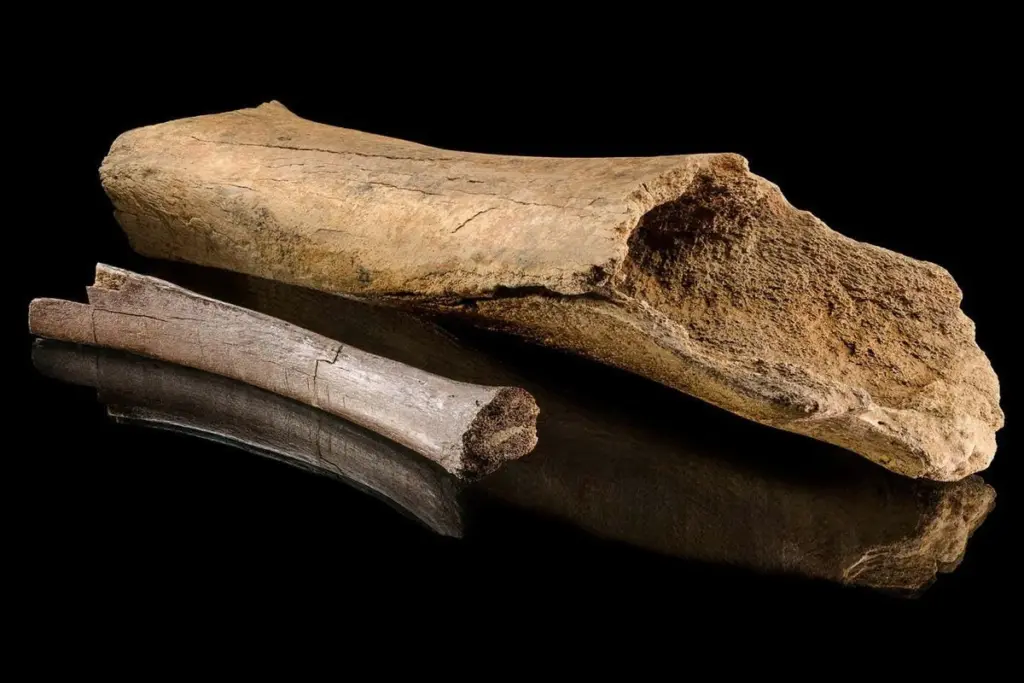
Hidden away in the archives of Germany’s Schöningen Research Museum, a significant archaeological puzzle has been slowly surfacing from stacks of old, mismatched cardboard boxes. These containers, originating from Lehringen, a small locality 150 kilometers distant, hold the key to a find that was once poised to revolutionize our understanding of early human capabilities.
The story begins in 1948 with the discovery of remains belonging to a 125,000-year-old straight-tusked elephant, scientifically known as Palaeoloxodon antiquus. Unearthed in an ancient lakebed at Lehringen, these bones, while substantial, were remarkable for a specific detail: a formidable 2.3-meter-long spear embedded deep between its ribs.
At the time of its discovery, this yew thrusting lance represented the oldest complete spear ever found. Previous to this, only a partial spear from the UK’s Clacton-on-Sea offered earlier evidence. The Lehringen spear, however, remained unique as the sole example found still lodged within the skeleton of an extinct animal. Given that Neanderthals were the sole human inhabitants of Europe during this epoch, the find offered compelling, seemingly irrefutable evidence of their prowess as active big-game hunters rather than mere scavengers. This discovery should have cemented its status as a world-renowned archaeological treasure.
Challenges and Obscurity
However, the circumstances surrounding the excavation and subsequent handling of the Lehringen find were far from ideal. The initial excavation was conducted by Alexander Rosenbrock, a local school principal with a passion for amateur archaeology and the curator of the museum in nearby Verden. The mining operation responsible for uncovering the bones had already removed approximately half of the remains before Rosenbrock could arrange transportation to the site, accompanied by his daughter and a group of volunteers.
Upon Rosenbrock’s arrival, some of the bones had already been lost or removed. Crucially, he lacked a camera to document the site. He also failed to create a detailed sketch of the unearthed elements within the lake deposits, particularly their spatial relationships and the precise positioning of the spear. What followed was a protracted seven-year legal dispute concerning the ownership and location of these significant finds. Rosenbrock ultimately prevailed, securing the right to keep the artifacts in Verden. This protracted legal battle, coupled with the teacher’s death in the 1950s before he could publish his findings, arguably contributed to their subsequent obscurity.
Renewed Scrutiny and Modern Analysis
Over the subsequent 75 years, significant doubts began to emerge regarding the Lehringen discovery. Researchers questioned whether the spear and the elephant bones had merely been found together by chance. While the artifacts had been examined on two previous occasions, the assumption was that the elephant bones had already been thoroughly investigated and found to be free of any marks indicating butchery.
The narrative shifts to 2025, when Ivo Verheijen, the resident bone expert at the Schöningen center, began a re-evaluation of the Lehringen materials. Verheijen initially anticipated handling only a small quantity of artifacts. However, upon retrieving the collection, he discovered it comprised a substantially larger amount, filling a veritable truckload and stored in the museum’s attic.
The Schöningen center itself is situated a mere 300 meters from an archaeological excavation site that has been active since the mid-1990s. This location is particularly noteworthy for yielding ten spears, estimated to be around 300,000 years old, close to the edge of a former quarry. Including the Clacton spear and the Lehringen spear, these are among the only definitively identified spears from the Paleolithic Age, a period spanning from 3.3 million years ago to 12,000 years ago.
Verheijen’s prior experience with ancient elephant bones, including the recovery of a complete elephant skeleton at the Schöningen site in 2017, provided him with valuable expertise for his current investigation into the Lehringen finds.
A Cold Case Unravelled
Verheijen recounted an anecdote involving a salvaged soap box used for storing freshwater shells from the Lehringen dig. He revealed that the accompanying “finds label” was, in fact, a discarded 50 million mark banknote from the era of hyperinflation following World War I, a testament to the resourceful albeit unconventional methods employed in earlier documentation. The repurposing of the notes’ blank side for labels highlighted the era’s economic conditions.
This project has indeed evolved into something of a cold-case investigation for Verheijen and his colleagues. Fortunately, the extensive collection of boxes contained not only elephant bones and remnants of other species uncovered at the site, alongside flint tools, but also crucial written records detailing Rosenbrock’s work. These records were later continued by his daughter, Waltraut Deibel-Rosenbrock, after his passing, providing a more complete historical context.
Evidence of Butchery and Neanderthal Behavior
It did not take Verheijen long to conclude that the Lehringen elephant had indeed been subjected to butchery. He reported encountering “super clear” cut marks with a degree of ease that led him to express surprise that these had not been identified previously.
Contrary to earlier reports from the 1940s, the elephant was not an elderly animal. It died in its prime, estimated to be around 30 years old. Analysis suggests it was likely a male, standing over 3.5 meters tall at the shoulder. Verheijen posits this makes sense, as solitary male elephants would have presented a more accessible target for hunters compared to females, which tend to move in herds.
The butchery was evident both externally and internally, indicating the removal of organs. This practice strongly suggests the animal was freshly deceased when Neanderthals processed it. Consequently, it reinforces the likelihood that the elephant died with the spear still in its side, making the co-occurrence of its bones and the weapon a deliberate outcome rather than a random event.
The Neanderthals selectively harvested usable portions of the carcass, employing simple flint flakes for the task. The remaining parts were left for scavengers, which is consistent with the observation that not all bones bear butchery marks. Artifacts recovered from the site also included bones from bears, beavers, and aurochs. These also showed signs of butchery for both meat and hides, indicating a regular pattern of hunting and processing animals by Neanderthals at the lakeside.
Verheijen theorizes that modern elephants, when injured, often seek out water. Therefore, it is plausible that the speared animal instinctively moved towards the lakeside. He suggests that multiple spears may have been employed by the hunters, who then tracked the injured elephant until it succumbed to its wounds. The team’s current hypothesis is that when the elephant collapsed, it inadvertently crushed one of the spears beneath its weight, leaving it at the scene. The spear itself is slated for further re-examination by the team.
Even at its midway stage of re-evaluation, this project has already yielded one of the most vivid and detailed depictions of Neanderthal hunting strategies ever uncovered. Verheijen is currently working to ensure the preservation of the Lehringen bones, with the aim of eventually displaying them to the public. He describes the site as one of Germany’s most important Neanderthal locations, which, despite having been overlooked, is now being given the recognition it warrants.