
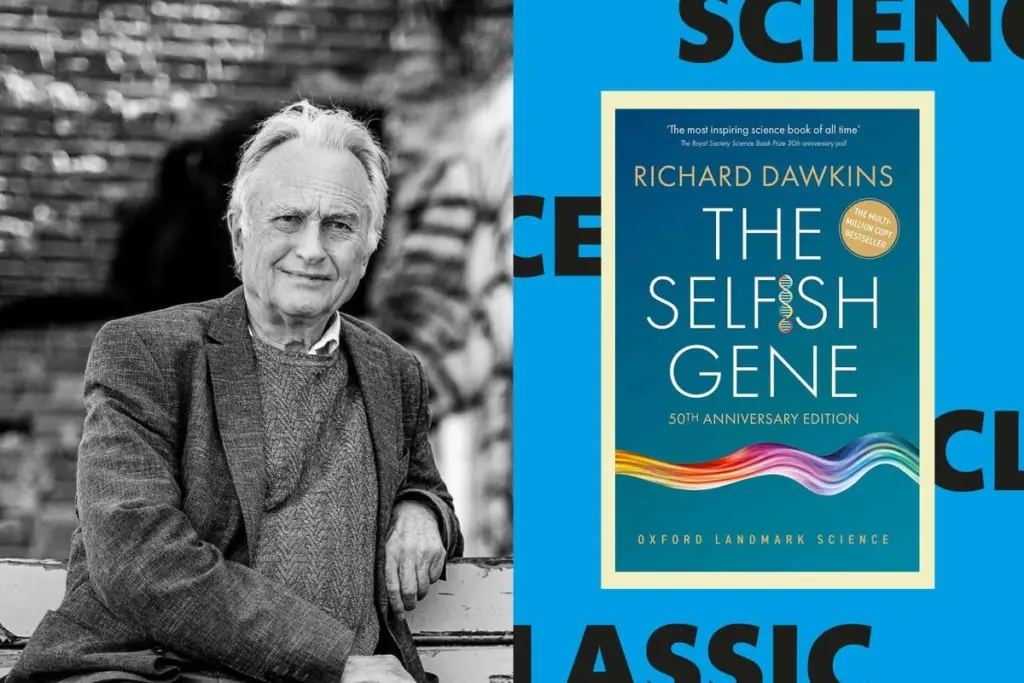
In 1976, Richard Dawkins unveiled a book that would redefine popular understanding of evolution. Titled after an idea conceived during a lecture on animal behavior for his PhD supervisor, “The Selfish Gene” emerged as a powerful scientific metaphor. The book achieved global bestseller status and remains one of the most compelling introductions to evolutionary science ever written.
While fifty years have passed since its initial publication, the core message of “The Selfish Gene” retains its relevance. The concept of selfish genes functions not merely as a captivating meme—a term Dawkins himself introduced at the book’s conclusion—but as a profound framework for comprehending evolutionary processes. The metaphor encourages readers to adopt a gene’s-eye perspective, effectively modernizing and democratizing evolutionary biology, making it accessible to a broader audience.
This shifted perspective allows for clearer explanations of phenomena such as why vampire bats share blood, why orchids mimic bees, and why a cold virus induces coughing. It provides a coherent explanation for the appearance and behavior of living organisms.
Revisiting Darwin’s Foundations and the Rise of Modern Synthesis
Charles Darwin’s theory of natural selection was grounded in the observation that individual organisms compete for resources. He proposed that traits enhancing survival and reproduction would be passed on; individuals, Darwin posited, should act in their own self-interest, not for the benefit of others. This model effectively explained much of the natural world, yet it encountered difficulties when confronted with behaviors in social insects. In societies of ants, wasps, and bees, sterile workers dedicate their lives to aiding a queen’s reproduction or defending the nest, seemingly at the expense of their own welfare.
Darwin’s proposed solution involved redefining the “individual” in these social contexts. He argued that the family unit, rather than the singular insect, was the effective entity. Thus, sterile workers aiding the colony were, in essence, indirectly promoting their own genetic lineage. While this was a considerable simplification, it pointed towards a crucial underlying principle.
The mid-20th century witnessed a significant reevaluation of evolutionary biology. The “modern synthesis” integrated genetics with evolutionary theory, leading biologists to mathematically describe evolution as changes in the frequency of genetic variants. George Williams and W.D. Hamilton, in particular, made significant contributions by demonstrating how adaptations—traits and behaviors that enhance an organism’s survival—could be understood as serving the interests of the gene. From a gene’s perspective, a worker ant forgoing personal reproduction to assist her mother in raising offspring is a logical strategy, as it facilitates the propagation of her own genes into the subsequent generation.
Dawkins’s Contribution: Bridging Theory and Public Understanding
Though Darwin lacked an understanding of DNA or genes, his intuition had grasped the fundamental dynamic. Dawkins, however, brought the mathematical underpinnings and theoretical framework to life with exceptional clarity. His work offered a departure from Lamarckian “just-so” narratives, such as the idea that elephants developed long trunks from inherited stretching efforts. It also moved away from the notion that organisms evolved for the good of their species, presenting instead a comprehensible biological model that harmonized with genetic principles.
Some have criticized Dawkins’s work, suggesting he merely popularized existing theories developed by others like Williams and Hamilton. However, “The Selfish Gene” served as a crucial catalyst, birthing a concept that profoundly influenced not only generations of biologists but also the public imagination.
Addressing Criticisms and Nuances
Further critiques question the book’s depiction of gene function and DNA. It’s argued that DNA does not operate in isolation; cellular components interact in complex ways to produce a phenotype. The defining characteristic of a gene, it is suggested, lies not in its executive control but in its temporal stability and the persistence of its genetic sequence. Dawkins was aware of this, noting he considered, but ultimately rejected, the title “The Immortal Gene.”
A prominent challenge for contemporary readers stems from the book’s popularization of genetic animism—the idea that DNA directly commands cells and organisms. Dawkins described humans as “gigantic lumbering robots,” survival machines “blindly programmed to preserve the selfish molecules known as genes.” This portrayal, at its most benign, is a literary oversimplification. At its worst, it can reinforce an inaccurate view of genetic determinism, the belief that certain behaviors are rigidly dictated by our genes. This perspective reappeared during the Human Genome Project, with the notion of specific genes being responsible for conditions ranging from heart disease to intelligence. This is a misunderstanding of how genes actually function.
Reading “The Selfish Gene” today also highlights how the metaphor of selfishness might underrepresent the pervasive roles of cooperation and symbiosis in life’s intricate tapestry. While Dawkins does address these aspects within the text, the potency of his central metaphor inevitably tends to overshadow them.
The Enduring Impact of an Ethologist’s Perspective
Despite these perceived limitations, Dawkins’s genius lay in his vivid and evocative description of animal behavior from the gene’s viewpoint. This approach was the cornerstone of the book’s profound influence. It is often forgotten that Dawkins’s primary background was not in genetics but in ethology—the study of the evolutionary basis of animal behavior. This very focus was what initially captivated the author, inspiring his own career as a behavioral ecologist. This foundational aspect, for many, overrides other criticisms and explains why, even with certain dated elements, the metaphor continues to resonate.
Rowan Hooper’s book “Togetherness: Symbiosis and the Hidden Story of Life’s Greatest Collaborations,” is scheduled for publication in June.