
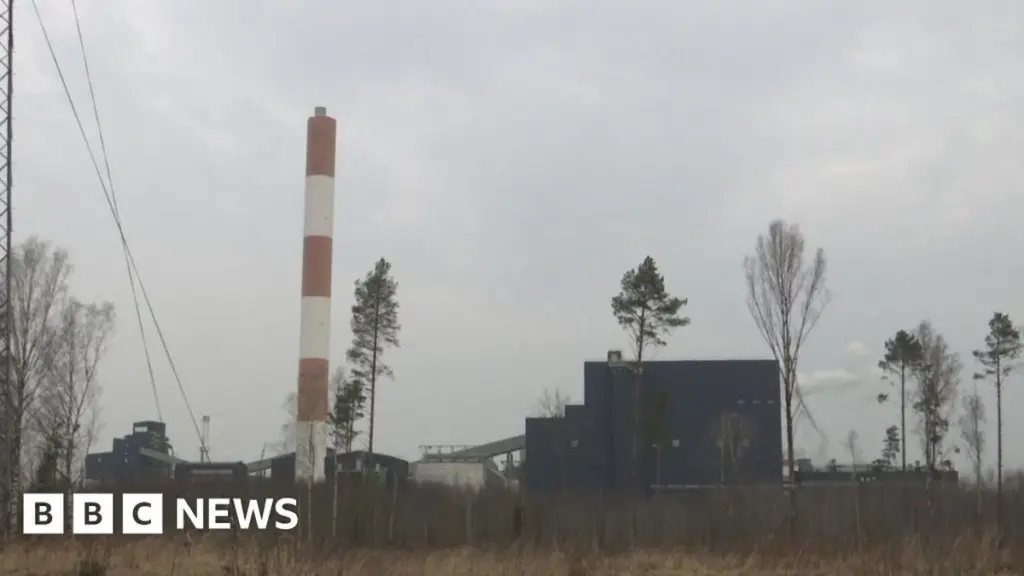
Overnight incursions into Estonian and Latvian airspace by drones originating from Russia have prompted official statements from both Baltic nations. The incidents involved drones entering the respective airspaces from Russian territory, with one striking infrastructure and another impacting land.
In Estonia, a drone reportedly hit the chimney of a power plant located in Auvere. Simultanously, a separate drone detonated in the southern Kraslava region of Latvia. Fortunately, initial reports indicate no significant damage or injuries resulted from these events.
These occurrences coincided with Ukraine’s extensive drone assault on the Russian port of Ust-Luga, situated on the Baltic Sea. This Russian port is approximately 25 kilometers from the Estonian border.
Estonian Prime Minister Kristen Michal reported that the Ust-Luga facility was subjected to attacks in three distinct waves, commencing around 03:00 and concluding by 08:00 local time. The Baltic air patrol was subsequently activated, and citizens in Estonia received mobile alerts warning of a “drone threat.”
The chief of Estonia’s security police, Margo Palloson, suggested that the drone’s deviation from its intended course might have been influenced while it was over Russian airspace. He stated, “it was a Ukrainian drone that deviated from its course, which was possibly affected in Russian airspace.”
Latvian Prime Minister Edgars Rinkevics corroborated that the drone impacting Latvian territory was indeed of Ukrainian origin. Following this incident, Latvia’s Defence Minister, Andris Spruds, concluded a visit to Ukraine ahead of schedule to return to his home country.
Egils Lescinskis, the deputy chief of Latvia’s Joint Staff, provided further context, noting that the drone “most likely veered off course or was affected by electromagnetic warfare measures protecting some technically important objects.” He elaborated on the potential for drones to miss their targets due to interference with their GPS signals by jamming systems.
When questioned about residents’ safety, Lescinskis acknowledged that complete security is unattainable “when military operations are taking place in neighbouring countries.” He refrained from assigning direct blame to Ukraine for the misplacement of the drone. Instead, he characterized the incident at the power plant’s chimney as “one of the effects of Russia’s full-scale war of aggression.”
Estonian security police official Palloson issued a cautionary statement, suggesting that the country should anticipate “more such incidents.” Prime Minister Michal emphasized the practical difficulties of completely securing the border, stating, “it is pointless to create the illusion that we can build a wall on the border with Russia.”
A comparable event occurred on the preceding Monday night in Lithuania, where a Ukrainian attack drone crashed and exploded near the Belarusian border. Lithuanian authorities subsequently confirmed that the drone was part of that night’s operational activities targeting Russia and indicated that the situation would be discussed with Ukraine.
Lithuanian Foreign Minister Kestutis Budrys highlighted the sensitivity of these border regions, stating, “This is a very sensitive and important area for us… All countries must ensure airspace security and inform other countries if they see risks. Belarus does the same.”
The attack on Ust-Luga, a significant oil export terminal, resulted in a fire that was later brought under control by local emergency services. Earlier in the week, Ukraine had also targeted the Primorsk port on the Baltic Sea, as part of ongoing drone strikes on Russian energy infrastructure, including refineries, ports, and tankers.
These recent events follow a night in which Ukraine reportedly launched nearly 400 drones towards various Russian regions, including Moscow. Conversely, between Monday and Tuesday, Russia conducted what is described as its largest attack within a single 24-hour period on Ukraine, deploying 948 drones and causing casualties.