
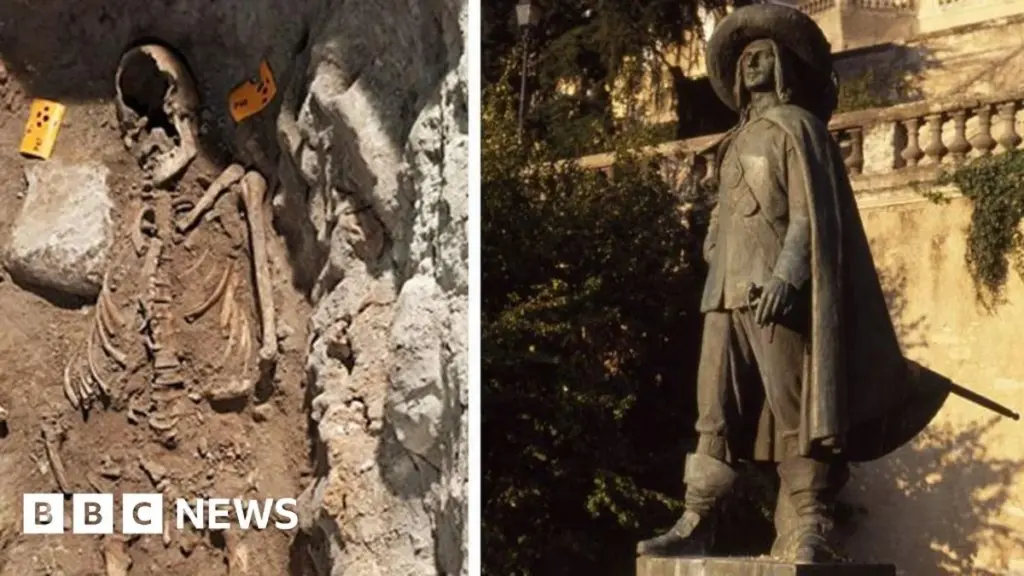
Over three and a half centuries after the demise of the fabled French musketeer d’Artagnan, skeletal remains have been discovered beneath the floor of a Dutch church. These findings are strongly believed to be his.
Jos Valke, a deacon at St Peter and Paul Church in Maastricht, was involved in the excavation of the skeleton. He expressed a near-absolute certainty, stating “99%” confidence that the remains belong to Charles de Batz de Castelmore. This historical figure was a close confidant of France’s “Sun King,” Louis XIV, and was widely known by the title Count d’Artagnan.
D’Artagnan met his end during the Siege of Maastricht in 1673. His story, however, achieved legendary status through the adventure novels of Alexandre Dumas, where he was depicted as a companion to the Three Musketeers. For years, there were persistent rumors suggesting his burial within this specific church, but concrete evidence remained elusive until this recent discovery.
Deacon Valke recounted to the BBC that the area beneath the church floor had never been excavated previously. The decision to investigate arose when several tiles were found to be broken. Initially, a wall was uncovered, prompting the use of a brush for further digging.
At this juncture, an archaeologist was summoned to the site. This expert subsequently located the skeleton buried directly beneath the spot where the altar table had stood approximately two centuries prior.
“We fell quite silent when we found the first bone,” Valke remarked. He further elaborated that several indicators pointed towards the skeleton being that of the Sun King’s principal aide.
“He was interred in sacred ground, directly below the altar’s former position. We discovered the projectile that ended his life. Additionally, within his grave, we found a coin dating from 1660, issued by the bishop who officiated Mass for Louis XIV,” Valke explained.
The archaeologist who participated in this excavation has adopted a more reserved stance. Wim Dijkman, speaking to regional broadcaster Omroep Limburg, stated, “I am a scientist, but my expectations are substantial.” He indicated a preference to await DNA confirmation to definitively identify the skeleton.
A sample from the unearthed remains is currently undergoing analysis in Germany. Concurrently, a selection of the bones has been transported to Deventer, a Dutch city, for assessment. These examinations aim to determine the skeleton’s age, origin, and sex.
“My research into d’Artagnan’s grave has spanned 28 years already. This discovery could represent the absolute pinnacle of my professional career,” Dijkman commented.
Historical accounts suggest d’Artagnan was struck in the throat by a musket ball during Louis XIV’s campaign to capture Maastricht. The French military command, deeming it mid-summer, decided to conduct a local burial. Their encampment at the time was situated close to the church in the Wolder district, an area now comprising the southwestern part of Maastricht.
While d’Artagnan himself was based on a historical figure, the characters of the Three Musketeers are entirely fictional. It is theorized that these fictional characters might have drawn inspiration from three real individuals who served in an elite guard unit, responsible for the king’s protection and participation in military actions.