
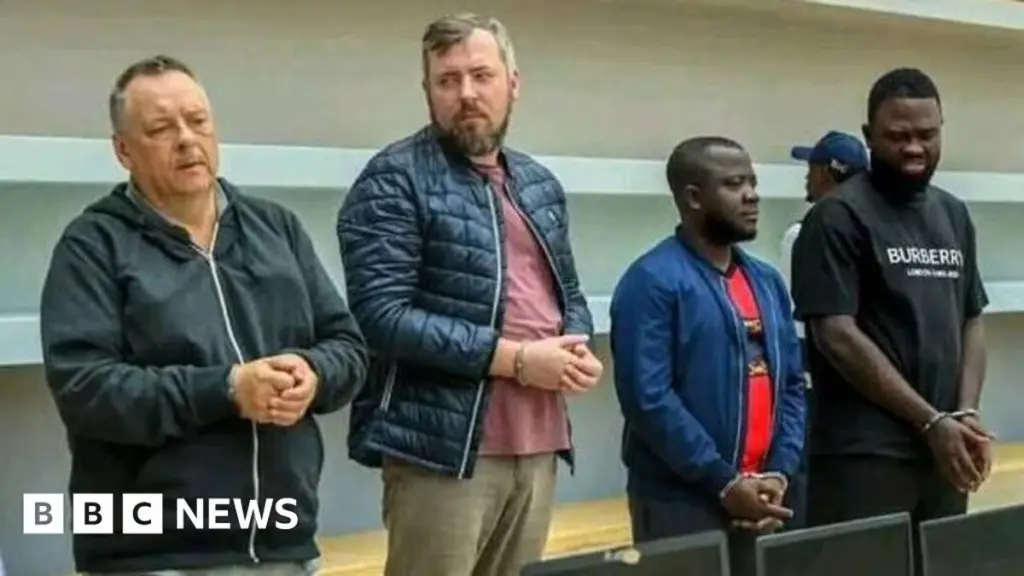
Two Russian individuals are facing trial in Angola, accused of orchestrating anti-government demonstrations, orchestrating a disinformation campaign, and attempting to influence the upcoming presidential election. Igor Ratchin, a political consultant, and Lev Lakshtanov, a translator, were apprehended last August.
The indictment against them encompasses eleven charges, including terrorism, espionage, and influence peddling. The BBC has obtained a copy of this legal document, which details an alleged operation aimed at altering Angola’s political trajectory. However, the defense attorneys for the Russian defendants have challenged the indictment, asserting a lack of “concrete and objective facts.”
According to the prosecution, Ratchin and Lakshtanov were acting on behalf of Africa Politology. This organization is described as a clandestine network of operatives and intelligence officers operating in Africa, with origins tracing back to the now-disbanded Wagner Group. Yevgeny Prigozhin, the founder of the Wagner Group, died in a plane crash in 2023.
For over a decade, political operatives linked to the Wagner Group have been active across various African nations, notably in the Central African Republic, Mali, and Madagascar. In contrast, the defense team for the accused Russians maintains that their clients have no affiliation with Africa Politology or the Wagner Group. They assert that the Russians were not acting on behalf of the Russian state. Instead, their stated intention was to establish a cultural initiative named “Russian House” in Luanda.
Angola holds significant importance as a major African producer of oil and exporter of diamonds. Its abundant natural resources and strategic geographical placement make it a region of ongoing interest for Moscow. Despite historical ties dating back to the Cold War, Angola has gradually been shifting away from Russia’s sphere of influence.
This shift is evident in actions such as the departure of the Russian diamond mining company Alrosa and the bank VTB from Angola. These withdrawals were necessitated by international sanctions imposed on Russia due to the conflict in Ukraine. Angolan President João Lourenço has reoriented his country’s foreign policy towards Western nations. His engagements with Russian President Vladimir Putin have been limited, with no meeting held since 2019.
The prosecution claims that the Russian operatives involved were venturing into new territory by targeting Angola. Alex Vines, Africa programme director at the think-tank European Council on Foreign Relations, suggests that this move reflects “Russian anxiety regarding the direction of travel of Angola under the Lourenço administration.” He further posits that “there’s clearly an element of Russian disinformation to try and build up more sympathy towards the Russian Federation.”
In addition to the two Russian nationals, two Angolan citizens are also slated to stand trial. They are accused of playing a role in the Russian-linked influence operation. The prosecution alleges that the Russians enlisted the services of sports journalist Amor Carlos Tomé and political activist Francisco Oliveira to carry out their activities within the country.
Tomé faces nine charges, while Oliveira is accused of five, encompassing terrorism, espionage, and influence peddling. The legal representatives for the Angolan defendants contend that there is insufficient evidence against them, stating that “the accusation is based on mere conjecture.”
Allegations of a Disinformation Campaign and Financial Transactions
According to prosecutors, the initial contingent of Russian operatives arrived in Angola’s capital, Luanda, in 2024. Their stated purpose was to establish a Russian cultural center, a project that ultimately failed to materialize. Among these initial arrivals was Maxim Shugalei, a prominent political operative associated with the Wagner Group. He has been sanctioned by the European Union (EU) for his involvement in overseeing disinformation campaigns. His activities in Africa were reportedly documented in a film trilogy, seemingly funded by Prigozhin.
Shugalei was accompanied by his long-time translator, Samer Suaifan. Both individuals have been contacted by the BBC. While Suaifan acknowledged knowing the defendants, Shugalei has denied any acquaintance with them. The indictment alleges that between 2024 and 2025, the defendants made numerous payments to local journalists and experts. The purpose of these payments was to promote propaganda and disinformation across local media outlets, with the stated objective of “provoking political change.” The total sum of these payments is reported to exceed $24,000.
Angolan authorities interpret this alleged campaign as part of a broader influence operation designed to erode trust in Western partners and undermine President Lourenço’s foreign policy initiatives. An individual with prior experience working with Prigozhin on African ventures reportedly characterized these efforts as amateurish. A political strategist, speaking to the BBC anonymously, described the situation by stating, “This year [2025] they handed the whole African topic over to some complete idiots. It feels like they were just picked up at the Sadovod market [a street market in Moscow]. And right before New Year they really wanted publications in Angolan media. But I told them all to go to hell.” This strategist declined to name the employers.
Prosecutors cite specific publications as evidence of the disinformation campaign allegedly conducted by the two Russian men. For instance, a Facebook post from January 2025, published on a page that mimicked the local news site Angola 24 Horas while identifying itself as satirical, warned of Angola being drawn into the conflict in Ukraine. In December 2024, a post on the same satirical page criticized the Lobito Corridor project. This Western-backed rail initiative aims to transport minerals from central Africa to Angolan ports.
The post claimed that foreign firms were gaining extensive access to Angola’s mineral wealth. The BBC reached out to the satirical page Angola 24 Horas but received no response. A day after its appearance on the satirical page, a similar post concerning the Lobito Corridor surfaced on the news website Lil Pasta News. Another article published on this site speculated whether the country had “signed a pact with the Devil” by participating in the project. Lil Pasta News informed the BBC that the articles in question were not produced by their staff but were received through an intermediary. The news outlet stated that it had no direct contact with the author and was not compensated for the publication.
Defense Arguments and Accusations of Political Motivation
The legal team representing the Russian defendants contends that there is no evidence to suggest that Ratchin commissioned any of the disputed articles. Angolan prosecutors characterize the group as a small but effective network, with Ratchin allegedly at its core. Ratchin had previously been involved in several regional election campaigns within Russia, which he claimed, in a video seen by the BBC, resulted in victories for his candidates.
Lakshtanov has a history of working as a translator in Angola since the Soviet era. Prosecutors believe he played a supporting role in the alleged operation, primarily functioning as an interpreter. The local connection was reportedly facilitated by Francisco “Buka Tanda” Oliveira, a youth leader for Angola’s main opposition party, Unita. Having studied chemical engineering in Russia between 2015 and 2019, Oliveira is fluent in Russian. Prosecutors claim he was tasked with introducing Angolan politicians to the defendants.
“He [Oliveira] doesn’t know this organisation [Politology] and any activity related to this organisation. All he knows is that they wanted to create Russian culture house,” states Pedro Cangombe, a defense lawyer for Oliveira. Tomé, a sports journalist for the Angolan state television channel TPA, is accused of collecting information on the country’s political landscape and potential presidential candidates. He is also alleged to have assisted in producing and publishing content linked to the supposed influence operation. The defense for Tomé argues that “none of the subjective or objective elements” of the alleged crimes are “minimally” demonstrated in the indictment.
The indictment also names six additional Russian individuals implicated in the network, who allegedly entered and exited Angola at various times during 2024 and 2025. Angolan authorities further claim in the indictment that Lakshtanov and Ratchin met with several senior political figures from both the ruling MPLA party and Unita. These meetings reportedly involved offering support and funding for campaigning activities.
Among the most significant allegations, prosecutors claim the Russians met with MPLA heavyweight General Higino Carneiro and Unita’s leader Adalberto Costa Junior. Both individuals are considered potential presidential candidates for the upcoming election. Prosecutors assert that the Russians offered Carneiro up to $15 million in campaign support, along with security assistance, strategic advice, and intelligence gathering. However, the indictment that has been reviewed by the BBC contains no evidence supporting this alleged offer.
“I don’t know whether such a meeting took place,” commented Elizeu Nguiniti, the lawyer representing Ratchin and Lakshtanov. Jonas Mulato, a Unita representative, told the BBC that allegations linking the party’s leader to a foreign influence operation are false. He added that it has become “increasingly evident” that judicial proceedings are being employed for political purposes. The BBC requested a statement from General Carneiro but received no response.
Protests, Scapegoating, and Disputed Evidence
In July of the previous year, Angola witnessed its deadliest protests since the conclusion of its civil war between Unita and the MPLA in 2002. What began as a peaceful demonstration by taxi drivers in Luanda rapidly escalated into nationwide unrest that turned violent. Protesters encountered what activists describe as “excessive” police force.
The prosecution alleges that the defendants were involved in orchestrating these protests. As evidence, they point to notes found on their mobile phones regarding the demonstrations, as well as photographs taken by Ratchin. In legal documents presented to the BBC, Ratchin’s lawyers argued that he took these images for security purposes, to have evidence in case of an attack. The BBC has not independently verified the content of these photographs or notes.
Many Angolan journalists and activists strongly dispute the notion that the protests were not spontaneous. They suggest that Angolan authorities may be utilizing the Russian individuals as scapegoats. The World Bank estimates that approximately 40% of Angolans may be living below the international poverty line of $3 per day. Sheila Nhancale, an Angola researcher at Human Rights Watch, stated, “People were protesting because of their living conditions, not because someone from another country told them to.”
The indictment itself has faced criticism for containing misspellings and apparent factual inaccuracies. For example, prosecutors state that the Russian operation commenced on October 9, 2024, with the arrival of Maxim Shugalei and others. However, Shugalei was arrested in Chad on September 19, 2024, and was returned to Moscow on November 16, 2024. The BBC has sought clarification from the Angolan prosecution regarding this and other inconsistencies but has not received a response.
Rui Verde, a legal expert and research associate at the University of Oxford’s African Studies Centre, notes that a significant challenge for the prosecution will be to demonstrate that the acts listed in the indictment constitute a deliberate and intentional pattern aimed at subversion. According to several sources, if convicted, the Russian individuals could potentially be repatriated to their home country. However, Russian authorities do not appear to be actively involved in offering assistance.
A source close to the Russian diplomatic community informed the BBC that “the logic is simple: these people were not carrying out official state tasks, they were just contractors. Russia’s position in the country is already weak, so there’s no point making things worse.” The source concluded, “Let these remnants of Prigozhin’s operation sort it out themselves.”