
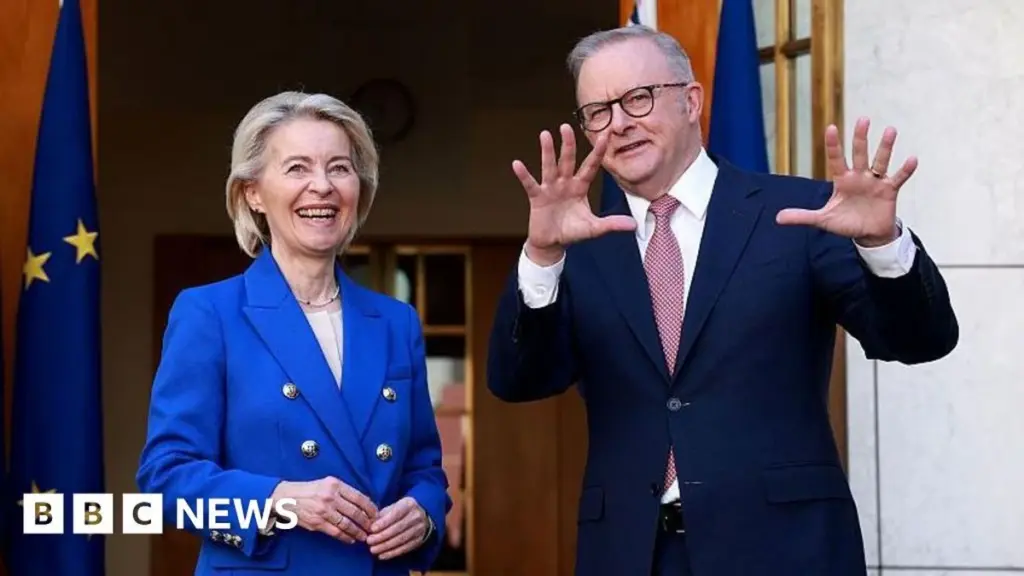
A significant free trade agreement has been reached between Australia and the European Union, poised to increase the flow of Australian beef to European tables. This pact substantially reduces export tariffs on a wide array of Australian products.
The agreement, with an estimated value of approximately A$10 billion (roughly $7 billion USD or £5.2 billion), was finalized on Tuesday. Both Australia’s Prime Minister and the head of the European Commission characterized the deal as a mutually beneficial outcome.
Navigating Food and Drink Naming Rights
A specific aspect of the deal addresses the contentious issue of food and drink nomenclature. Italian-style sparkling wine produced in Australia will continue to be marketed domestically as prosecco. However, its use in export markets will be phased out over a ten-year period.
Australian producers will also be able to retain the use of names like ‘parmesan’. The use of ‘feta’, however, will be governed by “grandfathering provisions and extended phase-out schedules,” to comply with stringent EU regulations concerning geographical indications and naming conventions.
Agricultural Sector Gains and Consumer Impact
The comprehensive trade agreement, developed over eight years, will see the elimination of nearly all EU tariffs on Australian agricultural goods. This includes significant categories such as wine, fruits and vegetables, olive oil, seafood, most dairy products, and essential grains like wheat and barley.
The Australian government estimates that this tariff reduction will translate into a saving of approximately A$37 million for domestic wine producers and their export operations.
Conversely, Australian consumers are likely to benefit from more affordable European imports. The deal is expected to lead to lower prices for European wines, spirits, biscuits, chocolates, and pasta available within Australia.
Geographical Indications: A Sensitive Balance
Food naming rights represent a sensitive point for both European and Australian stakeholders. With this agreement, Australia becomes the sole nation outside of Italy to have received explicit EU authorisation to use the ‘prosecco’ designation.
Reflecting on this aspect, Australian Prime Minister Anthony Albanese highlighted the nation’s development, which is fundamentally shaped by immigration.
“This is why, whether it’s Greeks establishing feta here, Italians producing parmesan, or people from Eastern Europe creating kransky sausages – it signifies a strong connection with Europe,” Albanese stated.
European Commission President Ursula von der Leyen described Australia and the EU as partners sharing a “unique relationship,” built with a long-term perspective.
She characterized the trade agreement as achieving a “perfect balance,” facilitating easier export conditions for Australians into the EU while simultaneously increasing the availability of EU-manufactured goods in the Australian market.
Meat Exports: A Point of Contention
However, Andrew McDonald of Meat and Livestock Australia expressed reservations regarding the provisions for meat exports. He suggested that the agreement did not represent an equitable outcome for Australian farmers, who had advocated for an annual quota of at least 50,000 tonnes. The current deal permits approximately 30,000 tonnes, a notable increase from the previous 3,389 tonnes.
“This is undeniably a missed opportunity for Australia’s red meat producers, processors, and exporters,” McDonald commented.
Broader Partnership: Security and Defence Cooperation
Beyond trade, Australia and the EU have also formalized a new security and defence partnership. This collaboration aims to enhance mutual cooperation across various sectors, including the defence industry, counter-terrorism efforts, space exploration, and maritime security.
Von der Leyen framed these agreements as being centered on fostering “collective resilience” in an era of significant global transformation.
“We live in a world where major powers are employing tariffs as leverage and exploiting supply chains as vulnerabilities within their strategies,” she observed, adding that “trust holds greater significance than simple transactions.”
Furthermore, the EU Commission President announced an expansion in joint collaboration on several key critical minerals projects involving Australia, specifically mentioning lithium and tungsten. She also commended Australia for its “trailblazing” policy concerning social media, which prohibits individuals under the age of 16 from establishing accounts on ten designated platforms.