
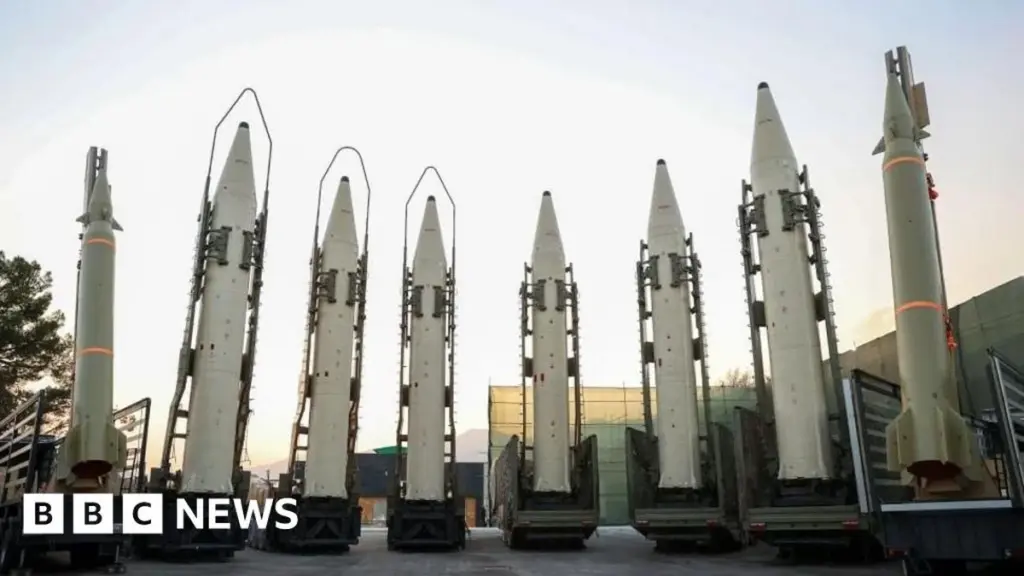
Recent events have brought the potential range of Iranian missiles into sharp focus, particularly after an attempted strike on the joint US-UK military base on Diego Garcia in the Indian Ocean. Two missiles were launched, with one failing and the other being intercepted, according to UK Defence Secretary John Healey. This incident, occurring nearly 4,000 kilometers from Iran, has ignited concerns about the country’s missile capabilities and the possibility of subsequent targeting of European cities, including London.
Despite the alarming implications, there remain significant questions surrounding Iran’s capacity to strike targets at such extreme distances. Nevertheless, the missile that failed managed to traverse approximately 3,000 kilometers from its launch point, prompting a closer examination of the actual threat posed by Iran.
Monitoring Missile Trajectories
It is highly probable that the US and UK possessed prior intelligence regarding Iran’s intention to strike Diego Garcia, and they would have closely monitored the missiles during their flight. The US Space Force maintains the capability to detect every missile launch originating from Iran, with tracking systems centered at Buckley Space Force Base in Colorado. Access granted to the BBC previously allowed for filming within a control center where the trajectories of global missile launches are observed.
This surveillance relies on a network of satellites in orbit and sophisticated ground-based radar installations, such as RAF Fylingdales in the UK. These systems collectively enable the tracking of missiles from their initial launch phase through to their intended target.
Iran’s Long-Range Missile Potential
The recent, albeit unsuccessful, launch suggests a potential lack of transparency from Tehran regarding its missile development program. Iran has historically stated that its missiles are capped at a 2,000-kilometer range. However, Israel now asserts that Iranian missiles could possess double this range, extending up to 4,000 kilometers. Such a capability would place Diego Garcia well within its reach, as well as a considerable portion of mainland Europe.
Even before this incident, Iran was known to possess short-range ballistic missiles with a maximum reach of 3,000 kilometers. These are the types of missiles Iran has frequently deployed against Israel and neighboring Gulf nations in recent weeks. Prior to the current conflict, Iran was estimated to hold over 2,000 short-range ballistic missiles in its arsenal. Despite efforts by the US and Israel to target these munitions, their deployment continues.
The status of Iran’s intermediate-range ballistic missile program, with ranges between 3,000 and 5,500 kilometers, is less clear. Sidharth Kaushal, a senior fellow at the Royal United Services Institute (RUSI) in London, indicated that it has long been understood that Iran was pursuing an intermediate-range ballistic missile program prior to the recent escalation. This understanding stems from two primary factors. Firstly, the development of longer-range missiles is often a prerequisite for acquiring nuclear weapons, a capability Iran consistently denies possessing despite accusations from Western nations. Secondly, Iran has also required longer-range rockets for its indigenous space program.
Missiles Targeted at Diego Garcia
The specific type of missiles employed in the attempt against the US-UK base in the Indian Ocean remains unconfirmed. Kaushal suggests that it could have been a variant of Iran’s Khorramshah missile, which is based on a North Korean single-stage design. This missile, with its standard configuration, has a range exceeding 2,000 kilometers and can carry a 1.5-tonne warhead.
However, Kaushal also noted that the range of such a missile could be significantly extended, potentially doubled, by employing a much lighter warhead. He cautioned that such a modification would likely result in limited damage should it impact the Diego Garcia base. Furthermore, Kaushal posited that Iran might be adapting rockets from its space program. Tehran’s success in launching satellites indicates that its rockets, such as the Qaem 100, are understood to possess dual-use capabilities.
It is improbable that Iran possesses a substantial inventory of intermediate or even long-range ballistic missiles. The US and Israel have already targeted Iran’s ballistic missile infrastructure over the past year in their efforts to thwart its nuclear ambitions. Any remaining assets are now under intense scrutiny.
The fact that only two missiles were launched towards Diego Garcia hints at limitations in Iran’s long-range missile capabilities.
Assessing the Threat to London
Should Iran decide to target Europe, existing defensive measures are in place to counter such a threat. The US has long recognized the risks associated with ballistic missile launches from the Middle East. Under the Obama administration, ballistic missile defense systems were established in Poland and Romania, forming part of NATO’s broader air defense network. These Aegis Ashore systems utilize the same interceptor missiles employed by the US Navy to counter Iranian ballistic missiles.
Within the UK, ballistic missile defenses are considerably less developed, a recognized deficiency highlighted in the government’s recent Strategic Defence Review.
For now, the threat appears distant. Kaushal considers it “conceivable” that an Iranian rocket could reach London. He explained that missile range is “elastic,” meaning a lighter warhead can extend a missile’s reach. This suggests that reaching the UK with Iranian missiles, in theory, is not entirely surprising, but the practical implications warrant consideration.
Kaushal further elaborated that such launches would likely involve “a small number of conventionally-armed ballistic missiles over well-defended airspace… and they’re quite inaccurate at very long ranges.”
Decker Eveleth, a research analyst at the CNA Corporation, a non-profit research and analysis organization based in Washington D.C., concurred with this assessment. He highlighted the numerous “unknowns with the design” of such missiles. Eveleth explained that increasing a missile’s range involves higher trajectories into space, leading to increased velocity upon descent. This necessitates superior heat shielding for the payload. Additionally, extended travel times lead to “compounding errors in your guidance system,” significantly affecting accuracy.
He concluded that while a missile might physically reach London, it “is not going to be particularly aim-able.” Eveleth ultimately assessed the risk to London as “pretty low.”
Justin Crump of the intelligence company Sibylline suggested that the key takeaway from the attempted strike on Diego Garcia might not be solely about missile capabilities, but rather the resilience of the forces deploying them. Crump noted that Iran continues to present a challenge to the US and Israel, even after weeks of operations, indicating that while their forces may be strained, they remain operational.