
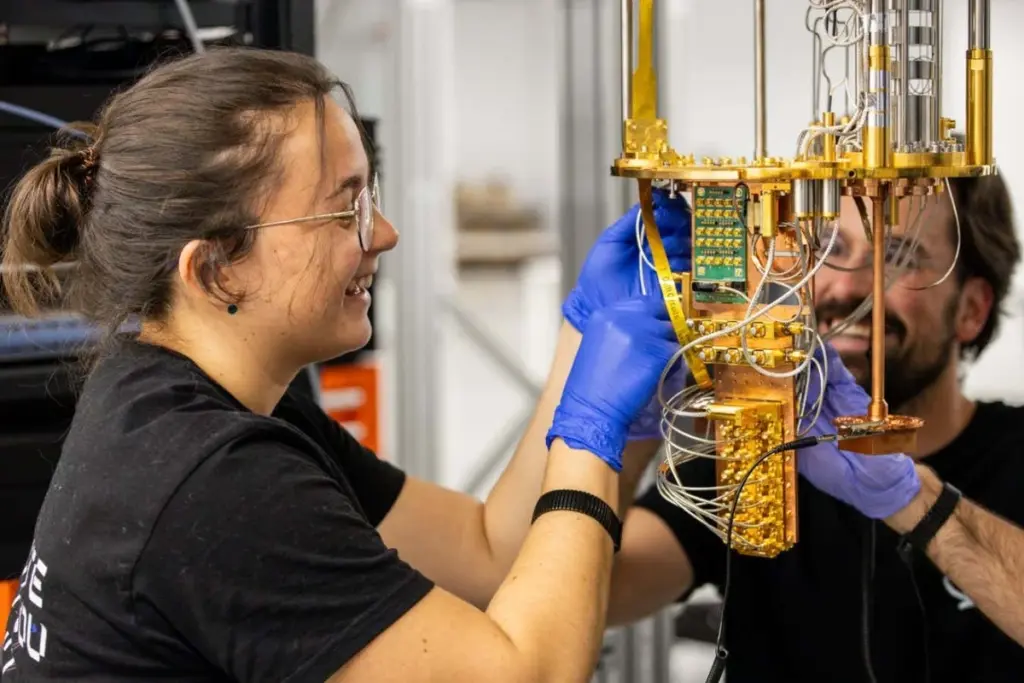
Quantum computers, once confined to the realm of theoretical speculation, are now becoming accessible to a wider audience. A new do-it-yourself kit allows individuals with sufficient financial resources and engineering expertise to assemble their own quantum computing system.
Qilimanjaro, a quantum computing firm based in Barcelona, has developed this offering, named EduQit. The company adopted a “flatpack furniture” assembly approach, providing all necessary components and tasking customers with the construction process itself. This innovative model aims to demystify complex quantum technology.
The EduQit System Components
At the core of the EduQit is a specialized chip constructed from minuscule superconducting circuits, serving as the quantum computer’s central processing unit. Accompanying this is a unique refrigerator designed to house and integrate the chip. The system also includes electronic devices that utilize radio waves and microwaves. These are critical for controlling the chip’s operations and retrieving the outcomes of its computations.
Completing the setup are various racks, power cables, and other ancillary devices that collectively form the functional quantum computer. While the assembly is not a simple undertaking, EduQit provides comprehensive instructions to guide users through the process. Qilimanjaro also offers dedicated training sessions conducted by their researchers, along with ongoing support during the assembly phase.
Assembly and Operational Timeline
Marta Estarellas from Qilimanjaro estimates that the training component can span up to three months. Following this, the complete system can be operational after approximately ten months of dedicated work. This extended timeline reflects the intricate nature of building and calibrating a quantum computing apparatus.
Performance and Cost Comparison
The EduQit quantum computer is equipped with five qubits. This configuration is considerably smaller, less than a tenth the size, compared to state-of-the-art quantum devices. However, its significantly lower cost, approximately €1 million, makes it a more attainable option. Typically, advanced quantum computers are developed by major technology corporations, well-funded startups, or specialized research institutions.
For perspective, Google has outlined ambitions to reduce their component costs by a factor of ten, aiming to bring the price of a single quantum machine below $1 billion. This highlights the substantial financial barrier that has historically limited access to such technology.
Commercial Alternatives and the EduQit Advantage
Smaller-scale commercial quantum computers are already available on the market, though they do not typically come as complete kits. For instance, Rigetti, a California-based company, offers a compact superconducting quantum computer for research and development. This system starts at around $900,000, often including only the main chip and a few basic components. This is akin to purchasing only a computer’s motherboard and requiring the buyer to source the monitor, keyboard, and other peripherals independently.
Consequently, research teams acquiring such systems must procure the remaining necessary components separately, adding to the overall cost and complexity. Qilimanjaro’s EduQit bypasses this fragmentation by providing a fully integrated solution.
Target Audience and Educational Value
Qilimanjaro specifically targets research institutions that may lack the extensive resources required to acquire and maintain traditional quantum computing technology. The company emphasizes the EduQit’s potential to provide the next generation of researchers with direct, practical experience in both building and operating quantum systems.
Currently, students can engage with quantum computing through cloud-based access or by utilizing simulations of quantum systems. However, Estarellas suggests that EduQit will enable them to cultivate more hands-on technical skills. This makes EduQit a potential quantum equivalent to the Raspberry Pi, a compact and adaptable computer originally designed as an educational tool that later found widespread use among hobbyists and scientists alike.
The Promise and Challenges of Quantum Computing
Quantum computers hold the potential to solve complex calculations that are currently beyond the capabilities of even the most powerful supercomputers. These applications range from decrypting internet security protocols to simulating molecular interactions for drug discovery. Nonetheless, quantum chips are inherently delicate and susceptible to errors. The realization of quantum computing’s full potential hinges on developing more robust methods for protecting and controlling these fragile systems.
A quantum computer comparable to the EduQit would have been considered cutting-edge in sophisticated laboratories a decade ago. The fact that such a system can now be offered as a DIY kit underscores the significant advancements in quantum computing technology over the past ten years.
Katia Moskovitch, associated with the firm Quantum Machines, notes that numerous fundamental questions remain regarding the future of quantum computing. She posits that broader engagement with these machines, allowing more individuals to experiment with them, will accelerate the discovery of answers to these complex challenges.