
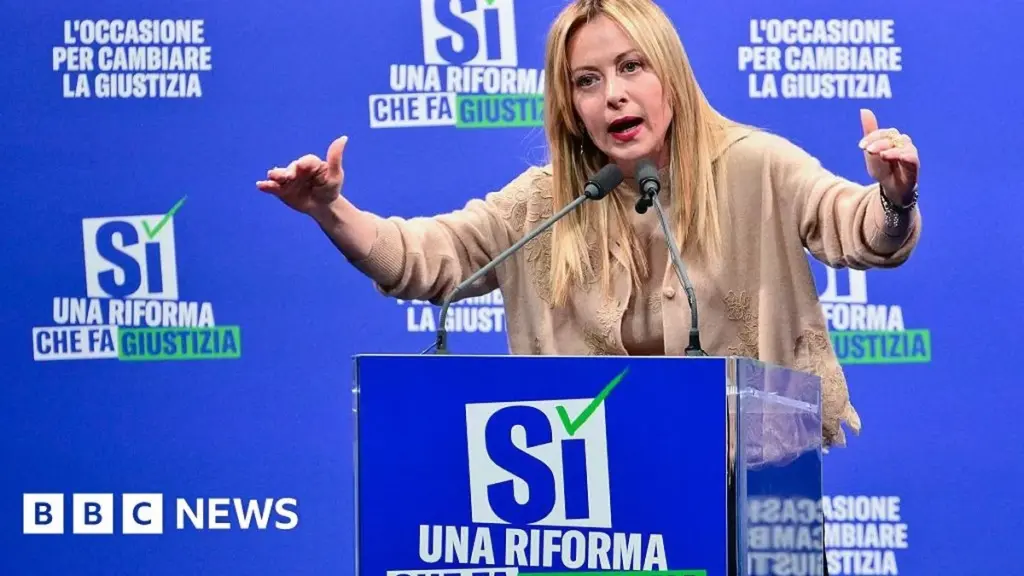
Italy is currently engaged in a vote concerning proposed changes to its constitution. This referendum presents a significant challenge for Prime Minister Giorgia Meloni, who is advocating for a “yes” vote and has actively sought to connect with new demographics in her campaign.
On Thursday, Meloni appeared alongside a popular rapper and a podcast host known for personal training content. Her aim was to persuade Italians to support a judicial reform she contends will lead to a more equitable system for everyone.
Meanwhile, opposition parties have framed the proposed reform by the right-wing government as a substantial threat to democratic principles. They have leveraged this to create a protest vote against Meloni’s leadership.
Having been in power for three and a half years, a duration that approaches a record in Italy’s history of coalition governments, Meloni has emphasized her role in bringing stability to the nation. However, as this referendum has increasingly become a personal contest, she may be facing her first significant electoral setback.
“She is determined to win. A loss would have repercussions, and she understands this,” explained Roberto D’Alimonte, a political scientist at Luiss University. “She needs to galvanize her supporters to improve her chances in this contest, though it is expected to be a close race.”
This strategic imperative led the Prime Minister to participate in the podcast ‘Pulp,’ hosted by rapper Fedez and Mr. Marra. Meloni, dressed in a casual sparkly jumper instead of her usual formal attire, addressed questions for an hour from the tattoo-adorned rapper and his co-host. The interaction was explicitly designed to engage younger voters.
The referendum does not have a minimum turnout requirement; the side securing the majority of votes over the two-day period will prevail. Notably, trade unions have already expressed their support for the “no” campaign.
Recent polling data indicated that low voter participation was likely to benefit the opponents of the reform. Meloni, however, passionately presented her case for a “yes” vote on the air.
Meloni’s Arguments for Reform
She asserted that modifications to the operational procedures of Italy’s judges and prosecutors would foster a system that is “more meritocratic, more responsible, and more efficient.”
Meloni also contended that her political adversaries were unfairly conflating the reform with a referendum on her premiership because they lacked substantial criticisms of the reform’s substance itself. Regardless of the outcome, the Prime Minister made it clear that she did not intend to resign.
“If you vote ‘no’ today solely to remove Meloni from office, you will end up with both Meloni and a justice system that remains ineffective,” the Prime Minister stated. “That does not appear to be a beneficial proposition.”
Examining the Italian Justice System
The question arises: is Italy’s justice system genuinely “broken”?
The system undeniably suffers from chronic overload, with some of the longest-running trials in the European Union. However, the proposed reform does not directly address this issue of case duration.
The referendum specifically focuses on segregating the career paths of judges and prosecutors. It also proposes the establishment of separate governing bodies for each profession. Additionally, a new disciplinary court for both groups is part of the proposal.
The perceived impact of these changes varies significantly depending on individual perspectives. Many Italian citizens find the intricacies of this referendum difficult to grasp.
Roots of the Reform
This initiative originated from Forza Italia, the party of the late Silvio Berlusconi, who was a prominent figure within the current coalition government. Berlusconi, a long-serving prime minister, frequently found himself involved in legal proceedings and often criticized the judiciary, portraying it as a “communist” obstacle to his authority.
Meloni herself has had public disagreements with the courts, alleging that “powerful factions” consistently impede her key policies, particularly concerning migration. At a recent event in Milan, she asserted, without providing evidence, that a “no” vote would result in “even more… immigrants, rapists, paedophiles, drug dealers being freed, thereby endangering your security.”
Such strong rhetoric is precisely why opposition parties are hesitant about this reform. They harbor concerns that Meloni’s ultimate objective is to bring the judiciary under her political influence.
Both Meloni and her team deny these allegations. However, in an era marked by global instability and rising living costs, exacerbated by a conflict in Ukraine, they acknowledge the potential for voters to use the referendum as an outlet for their frustrations.
“The geopolitical situation is undoubtedly challenging, and people are anxious. I empathize with that entirely. However, our focus must remain on the referendum’s core purpose,” argued Andrea di Giuseppe, a member of Meloni’s Fratelli d’Italia party. He suggested that an evaluation of Meloni’s own performance could be deferred until the general election next year.
“If you are dissatisfied with this government, then in 2027, you have the opportunity to dismiss it and choose a different one. At present, the significance of the referendum is paramount.”
Support and Reservations
A segment of the political left also supports this reform, viewing the close relationships between judges and prosecutors as excessively informal. “It creates a dynamic where mutual assistance on cases prevails, akin to a small, self-governing body. This is unconventional,” stated Alessandro Sterpa, a professor of constitutional law at Tuscia University.
Sterpa, who is not typically a Meloni supporter, highlights widespread past complaints regarding the influence of political factions, known as “correnti,” within the judiciary. He also perceives no element in the proposed reform that would increase government oversight.
Conversely, this reform would mark the first instance of a hard-right government altering Italy’s constitution, which was drafted in the 1940s following the defeat of fascism.
“For a considerable period, left-wing academics have maintained that only the left is capable of safeguarding the constitution. Such statements are no longer tenable,” Sterpa commented. “My grandparents fought fascism with weapons. Today, I support the reform because it serves the country’s interests.”
The “No” Campaign’s Stance
The concluding rally for the “no” campaign took place in Rome’s historic Piazza del Popolo. Participants arranged white tape on the cobblestones to spell out “Vote No.” An inflatable unicorn, adorned with a rainbow-colored tail, moved through the crowd carrying a sign around its neck that read, “Leave the Constitution in Peace.”
Passionate appeals to “defend democracy” resonated from the stage.
“The constitution established a balance of powers post-fascism, an essential safeguard against returning to such a regime,” argued Andrea Malpassi from the CGIL trade union, a strong proponent of the “no” vote. He expressed significant caution regarding any constitutional alterations by a prime minister whose political career began with admiration for dictator Benito Mussolini.
“In recent years, numerous investigations have been launched into the actions of ministers within this government,” Malpassi noted. “We must ensure that this possibility is not curtailed in the future.”
Potential Ramifications of a “Yes” Victory
Should Meloni achieve victory in this vote, it would bolster her considerable political aspirations, including plans to enhance the powers of her office through subsequent referendums.
However, this crucial vote occurs during a period of considerable difficulty. “Italians are disinclined to become involved in foreign conflicts, and the escalating gas prices negatively affect the government’s popularity. The prevailing atmosphere is highly unfavorable for Meloni at this juncture,” concurred Professor D’Alimonte.
While Meloni would remain in office following a “no” vote, the widely praised stability she has brought to Italy would likely be compromised during this vulnerable period. “She will not resign,” the professor stated. “However, she will undoubtedly be politically weakened.”
Additional reporting by Giulia Tommasi.