
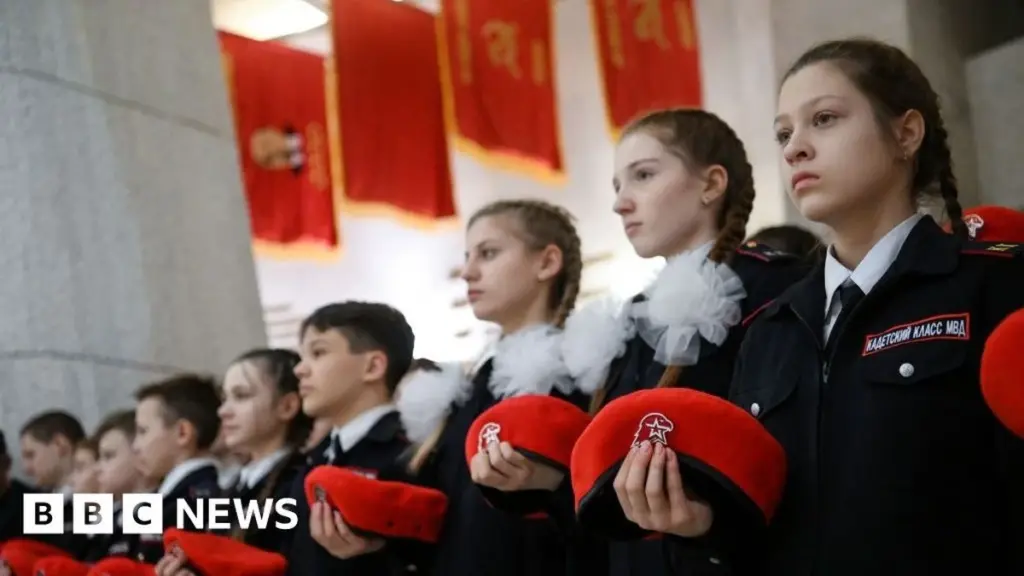
The intensifying wave of patriotic education and “war propaganda” aimed at Russian children has captured global attention, notably through an Oscar-winning documentary. This film, “Mr Nobody Against Putin,” draws on footage captured by Pavel Talankin, a primary school events coordinator and videographer from the provincial town of Karabash in the Ural Mountains.
Nina, a Moscow resident, experiences firsthand the increasing pressure to instill patriotic sentiment in her seven-year-old daughter. When her daughter was assigned a poem praising Russia’s “glorious army,” Nina found it excessive. She has found it challenging to shield her child from a growing number of “patriotic” activities and lessons integrated into the school curriculum.
What often troubles parents like Nina is their child’s positive engagement with these state-backed programs. “She likes her teacher, she likes her classmates – she likes being a part of it,” Nina shared. Fearing social isolation for her daughter, Nina once kept her home from a patriotic event, which resulted in her daughter expressing distress. “I don’t want her to feel like she doesn’t belong,” she explained.
Talankin’s documentary portrays his reluctant involvement in what he describes as Putin’s propaganda machine, particularly following Russia’s full-scale invasion of Ukraine in 2022. This period saw the introduction of flag-raising ceremonies and mandatory lessons designed to impart the government’s narrative on Russian values and global events. History textbooks were updated to align with current developments, including the official framing of the conflict as a “special military operation.”
These government directives have persisted. In a recent announcement, Russia’s Ministry of Education revealed plans to mandate a list of state-approved toys and games for nurseries, intended to foster “traditional Russian values.” The underlying message conveyed to children emphasizes the invasion as a defensive act and equates patriotism with unwavering loyalty.
Children’s Perspectives and Parental Concerns
Eight-year-old Maksim recounts his patriotic education lessons with enthusiasm, detailing what he learned about prominent Russian poets, painters, friendship, and conflict resolution. His excitement escalates when recalling discussions about robots, tanks, and laser tag. “They told us this is how to prepare for war,” he stated.
Maksim’s mother, Marina, shares Nina’s opposition to Russia’s invasion but avoids open discussion with her son to prevent him from repeating sensitive information publicly. Marina noted to the BBC that an “active anti-war position might attract unwanted attention.”
Anastasia Rubtsova, a psychotherapist, highlights the difficulty parents face in balancing school-imposed messages with their home environment. “A child has to live in this environment – attending the school, being a part of this group,” Rubtsova explained. She suggests that while parents need not endorse the propaganda, direct political confrontation in front of a child is unnecessary. Instead, she recommends focusing on universal values like the sanctity of human life and peaceful conflict resolution.
The Receptiveness of Young Minds
Research indicates that younger children are particularly susceptible to messages from authority figures. “If you tell a young child that the war is good, they will accept it,” Rubtsova commented.
Emily Willoughby, a researcher in behavioral genetics at the University of Minnesota, emphasizes that childhood and adolescence represent a crucial period for shaping attitudes. The long-term persistence of these attitudes, however, is significantly influenced by an individual’s broader social environment. “When parents actively disagree with institutional messaging, family influence usually prevails in the long run,” Willoughby stated.
The situation in Russia, where the state heavily controls information channels and limits alternative narratives, presents a less predictable outcome. A well-known study on Nazi-era education found that school-based indoctrination could yield lasting effects, especially when reinforced by the surrounding social context.
Variations in Implementation and Resistance
The implementation of the Russian government’s guidelines for patriotic education is not uniform across all schools. Some institutions rigorously adhere to these mandates, while others adopt a more lenient approach or subtly sidestep them. Teachers may also adapt, dilute, or quietly resist the prescribed messaging.
One scene in Talankin’s film depicts children in Karabash receiving Russian flags as they gather to hear President Putin announce the establishment of a youth movement reminiscent of the Soviet-era Pioneer organization. In another segment, a class is cautioned that adversaries will attempt to infiltrate their communities and disseminate propaganda to destabilize them internally.
These patriotic education sessions are known in Russia as “Conversations about Important Things.” Maia, a 14-year-old from St. Petersburg, finds them largely unengaging. “No one is participating in the discussion. We just sit there and listen to the teacher, and then leave,” she described.
Paul Goode, a professor of Russian studies at Carleton University, Canada, suggests that compelling citizens to participate in public displays of patriotism serves as a reminder of the regime’s pervasive power. This perception is further solidified by state-controlled media, commissioned public opinion polls, and electoral processes, he added.
Encouraging Military Recruitment
To bolster the effectiveness of “patriotic education,” Russian authorities facilitated easier army enlistment for school leavers in 2023. Some individuals have been enticed by substantial signing bonuses, while others have been persuaded to contribute to the war effort.
Maia, like her parents, believes Russia’s war is misguided but refrains from discussing it at school and is unaware of her classmates’ views. “At first I was worried that I couldn’t be friends with those who support the war and Putin,” she recalled. “But nowadays everyone behaves so neutrally that everything feels normal.”