
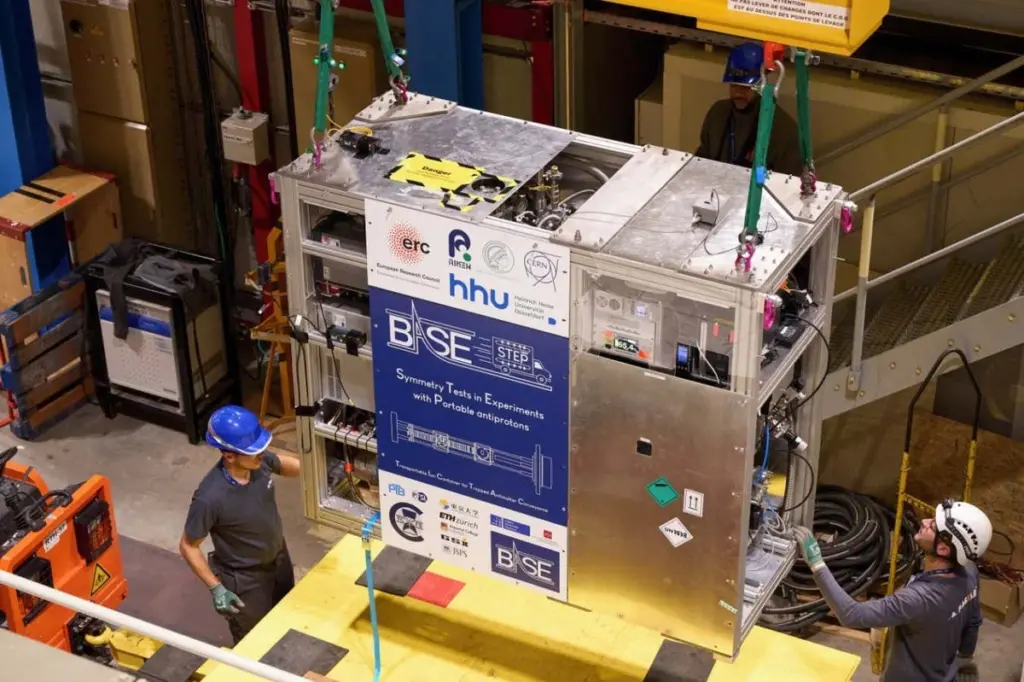
Deep within CERN’s antimatter facility, shielded by potent magnetic fields and an environment more rarefied than outer space, rests an extraordinarily delicate substance. Housed in a cabinet-sized container, weighing substantially less than a typical family car, a small collection of antiprotons has been held in remarkable stillness for weeks. Unlike many particles passing through this facility, these antiprotons have a singular purpose: to remain stationary and await their journey.
These approximately one hundred antimatter particles are slated for transport. They will be conveyed on a truck along a four-kilometer circuit encircling the CERN campus. This undertaking marks the initial demonstration of a future antimatter delivery system, which envisions transporting antimatter to research institutions across Europe.
The author visited CERN, located near Geneva, Switzerland, to witness the Symmetry Tests in Experiments with Portable antiprotons (STEP) experiment during its final preparations. Project leader Christian Smorra guided the tour of the facility. “This is a pivotal development for antimatter science,” Smorra commented. “The concept of transporting antiprotons has existed, in theory, since the inception of this facility. Now, for the first time, its practical realization is achievable.”
Scientists have understood since the 1920s that many fundamental particles possess a near-identical counterpart, differing only in electrical charge, known as antimatter. However, it took almost fifty years before researchers could produce and store the simplest form of antimatter, the antiproton, in substantial quantities. This was due to antimatter’s tendency to annihilate upon contact with its matter counterpart, the ubiquitous proton, vanishing in the process.
Initial efforts to contain antiprotons took place at CERN during the 1980s. These experiments involved accelerating protons and impacting them onto metal targets. Today, CERN’s Antimatter Decelerator hall, often referred to as the antimatter factory, is the world’s sole facility capable of producing millions of antiprotons on demand and preserving them for subsequent investigation. It hosts seven distinct antimatter experiments, including the Baryon Antibaryon Symmetry Experiment (BASE), of which STEP is a component.
All these research projects meticulously examine antimatter’s fundamental properties with exceptional accuracy. The objective is to identify any potential divergences from ordinary matter. Discovering such differences could offer insights into the universe’s apparent dominance of matter and the near-complete absence of antimatter.
Achieving the extraordinary precision required for these investigations necessitates filtering out disruptive radiation that could interfere with measurements. This presents a challenge within the antimatter factory. Antiprotons entering the hall travel at speeds approaching light, requiring powerful magnetic fields for deceleration. These fields are not entirely shieldable.
In 2018, Smorra and his team recognized the necessity of relocating antimatter away from the factory to a less electromagnetically noisy environment. This realization spurred their plan for an “escape.” “We had observed the disruptive effect of magnetic field fluctuations,” Smorra explained. “It became evident that we would eventually need to conduct our high-precision measurements elsewhere.”
This endeavor was far from simple. The containment of antimatter typically relies on substantial magnetic fields generated by superconducting magnets. These magnets require near-absolute zero temperatures, a process demanding considerable energy. Smorra and his team designed STEP to utilize a compact thirty-liter tank of liquid helium for cooling the magnets, allowing the associated electronics to be powered by a standard diesel generator. For the upcoming test, however, battery power will suffice.
Furthermore, the magnet system had to be engineered to withstand the intermittent acceleration and deceleration inherent in vehicular movement. A specialized vacuum system was also developed to ensure the necessary absence of interfering ordinary matter while antiprotons are loaded into and removed from the containment trap.
In 2024, Smorra and his colleagues successfully demonstrated STEP’s functionality with ordinary protons. They transported their experimental apparatus on a truck around the CERN campus. Now, the team is preparing for the actual antiproton transfer.
Preparations leading up to this point have been relatively uncomplicated. Approximately a week before this report, about one hundred antiprotons were decelerated and introduced into the intricate network of vacuums and electromagnetic fields designed to hold them.
Since then, these antiprotons have remained quiescent at the core of a complex assembly of wires and liquid helium conduits. Smorra’s team monitors their status via a small oscilloscope screen attached to the device. The characteristic vibrational frequency of antiprotons registers as a distinct twin-peaked pattern. Two googly eyes have been playfully affixed above each peak.
In the early hours of a Tuesday morning, a crane will lift the entire eight-hundred-and-fifty-kilogram apparatus onto the rear of a truck. The vehicle will be operated by a specially trained driver, adept at navigating CERN’s sensitive equipment with precision, ensuring smooth acceleration and braking.
The truck will then proceed on a four-kilometer loop around the CERN campus, ultimately returning to the antimatter factory from which it departed.
Should this test prove successful, Smorra and his team aspire to transport their antimatter capsule beyond the CERN perimeter, delivering it to research laboratories across Europe. One such facility is currently under construction at Heinrich Heine University Düsseldorf in Germany, designed to study antimatter where external magnetic fields are largely absent. However, achieving this objective may require several years. CERN will undergo a significant shutdown in July to upgrade the Large Hadron Collider for higher operational power, a process not expected to conclude until late 2028.
Once the antimatter delivery service is operational, it is conceivable that drivers on Swiss or German highways might find themselves alongside a truck carrying antimatter. Ostensibly a standard vehicle, its contents would be far from ordinary. While the inherent tendency of antimatter to annihilate upon contact with matter might seem alarming, Smorra assures that public concern is unwarranted.
“There is no inherent danger in transporting antimatter,” Smorra stated. “The quantities we are dealing with are extremely small. If one thousand antiprotons were to be lost during transport, it would go entirely unnoticed.”