
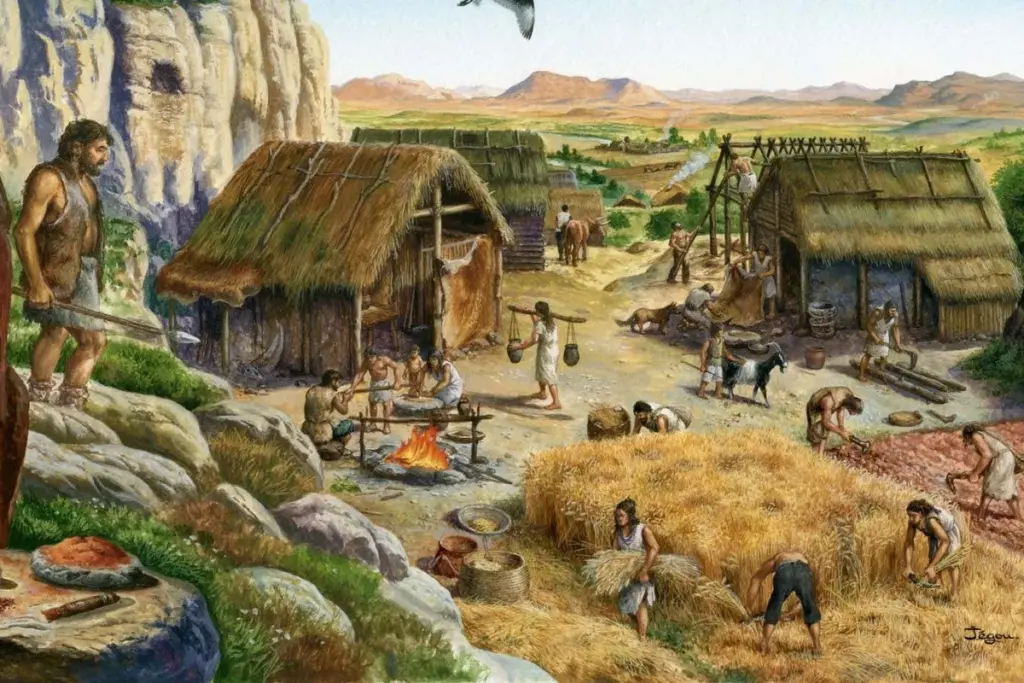
A comprehensive study, integrating a growing collection of ancient human genomes with contemporary genetic data, has provided an unprecedented view of human evolutionary trajectories over the last ten millennia. The research highlights convergent evolutionary patterns across diverse global populations subsequent to the widespread adoption of agriculture.
Laura Colbran of the University of Pennsylvania observed that “some of the same traits and the same genes are under selection in different populations.” This shared evolutionary pressure suggests common responses to similar environmental or lifestyle changes.
Evolutionary mechanisms are often driven by genetic variants that increase in frequency within a population, typically—though not exclusively—due to providing a survival or reproductive advantage. Analyzing variations across human genomes allows scientists to identify signatures of recent human evolution. The incorporation of ancient DNA offers a direct window, as Colbran noted, “Ancient DNA lets us look at genetic history live, as it were, whereas a lot of other methods tend to try and infer that.”
Historically, studies on recent evolution have predominantly focused on European populations due to the availability of extensive ancient and modern genomic datasets. However, Colbran’s team broadened this perspective by leveraging the expanding archives of non-European genomes. Their analysis, encompassing over 7,000 ancient and modern genomes predominantly from the last 10,000 years, offers a more globally representative insight into human adaptation.
The researchers employed ancient genomes as a baseline to predict what modern genomes would resemble in the absence of evolutionary pressures. Deviations from this baseline then served as indicators of selection. The study identified 31 distinct signals of selection. A significant finding was the prevalence of shared selection signals across geographically disparate populations. This convergence is strongly linked to the independent and contemporaneous adoption of agriculture worldwide.
One notable example involves a genetic variant that enhances the expression of the FADS1 gene. This gene encodes an enzyme crucial for converting plant-derived fatty acids into longer-chain variants common in meat. Increased FADS1 enzyme activity is believed to be beneficial for individuals consuming predominantly plant-based diets. This variant, present in less than a quarter of the oldest individuals studied, now exceeds three-quarters of the population in Europe, Japan, and Northern China. While the intensity of selection in Europe has remained consistent over the past 300 generations, it has notably increased in East Asia over the last 100 generations, according to the team’s findings.
Another area of significant adaptation concerns the alcohol dehydrogenase 1B (ADH1B) gene, which encodes an enzyme involved in alcohol metabolism. A specific ADH1B variant rapidly metabolizes alcohol into acetaldehyde, a process that triggers unpleasant physiological responses like facial flushing. This variant has become widespread in East Asia, purportedly acting as a deterrent to excessive alcohol consumption. Colbran described this as “the strongest signal for selection you see in East Asia.”
While this specific ADH1B variant was absent in ancient Europeans, Colbran’s team identified evidence of strong selection related to the ADH1B enzyme in European populations as well. “There’s something that’s changing the amount made, or how it’s responding,” Colbran explained. Although further research is necessary to pinpoint the exact variant and its function, it is strongly inferred to be an adaptation related to alcohol consumption patterns.
The study also extended to complex traits influenced by multiple genetic variants, such as the waist-to-hip ratio. Given its association with higher fertility, an increase in this ratio might be expected to be favored by selection. However, the researchers instead detected robust selection that appears to maintain the female waist-to-hip ratio within specific limits.
Colbran highlighted this finding as particularly intriguing, stating, “It is a really interesting one in that we do see stabilising selection.” Although variations in waist-to-hip ratios exist across different populations, the results suggest the existence of an optimal value, albeit one that might subtly shift depending on specific environmental contexts, as she explained.
Alexander Gusev of Harvard University commended the study, noting its inclusion of previously unanalyzed ancient DNA. He observed that “The authors find that variants under selection in one population are significantly enriched for being under selection in other populations.” Gusev interprets this as evidence supporting the hypothesis of parallel selection across populations, a concept previously proposed but not empirically demonstrated until now.
Yassine Souilmi from the University of Adelaide in Australia commented on the team’s methodology, which successfully identified both novel and previously recognized genomic regions subjected to selection. He stated, “Their new method takes full advantage of the large amount of ancient DNA available now.”
Colbran concluded that the current findings represent only the initial stage of discovery. As genomic sequencing expands, particularly with more non-European samples, a greater wealth of evidence for recent human evolution is anticipated.