
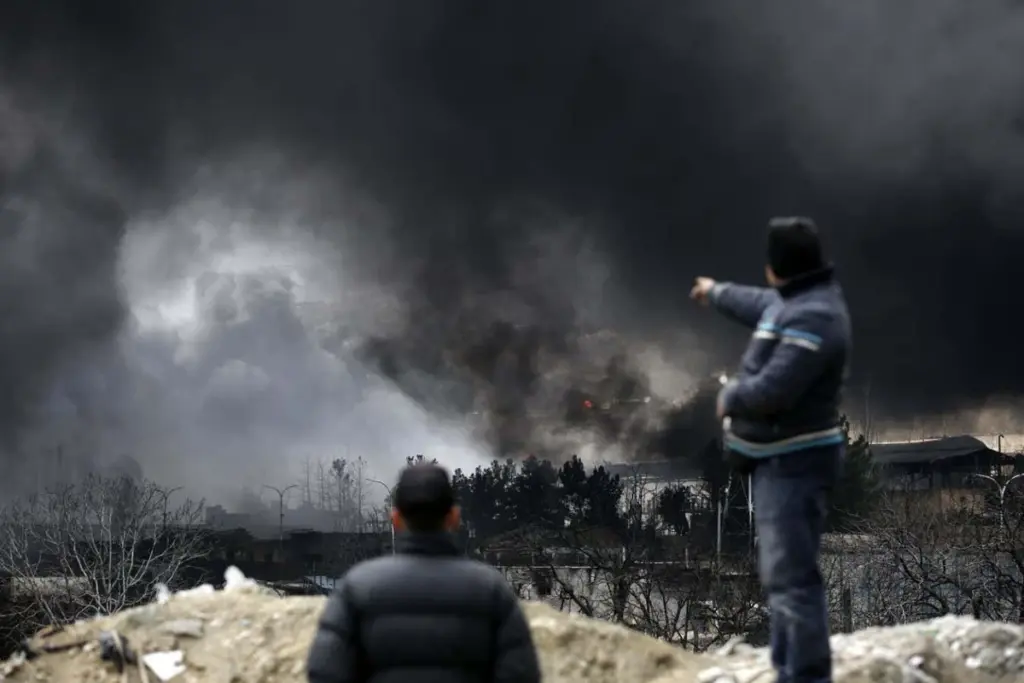
On March 8th, the skies over northern Iran turned dark with smoke as a US and Israeli bombing campaign against the country continued. This intensified situation led to an alarming development: black rain fell even on the capital city, Tehran. These unfolding, potentially catastrophic scenes have understandably triggered significant concern regarding threats to civilian health, not only within Iran but potentially extending to neighboring countries as well.
What Happened?
During the night of March 7th and into March 8th, US-Israeli strikes targeted Iran’s oil facilities. This marked the first such strikes since the conflict began just over a week prior. The attacks ignited substantial fires across four oil storage facilities and an oil transfer center, affecting both Tehran and the adjacent Alborz province. Visually striking flames illuminated Tehran’s night sky, while dense black smoke permeated the city by day. The resulting soot blanketed streets and vehicles, accumulating on residents’ balconies. Perhaps most disturbingly, thick, dark raindrops descended upon rooftops and streets in the capital, a region that had, until very recently, been experiencing a prolonged drought.
Authorities issued warnings about the possibility of acid rain. Local residents reported experiencing aching throats and burning eyes. The phenomenon of black rain was likely a direct consequence of the smoke originating from the oil facility fires. When precipitation occurs while passing through such heavily polluted air, it can effectively wash soot and other airborne particles from the smoke, depositing them on the ground in the form of dark raindrops.
While this development poses serious environmental and health implications, scientists are currently lacking crucial details, most notably the precise chemical composition of the emitted smoke. This information is vital for a comprehensive understanding of the risks involved, according to Anna Hansell, an expert at the University of Leicester in the UK.
What’s in the Black Rain?
The nature of the oil involved is a key factor. Unlike the refined petrol typically used in vehicles, much of the oil in the storage facilities was likely thicker and less refined. Furthermore, the combustion process resulting from the bombing would have been considerably less thorough than a controlled burn. Consequently, the smoke generated by these fires could carry aloft a widely diverse mixture of both completely and partially burnt particles. A significant portion of these particles are potentially harmful to humans if ingested in sufficient quantities.
“It’s going to be quite a nasty toxic moisture,” Hansell commented, highlighting the potential danger. The smoke would certainly contain partially and fully burnt carbon, commonly known as soot, alongside polyaromatic hydrocarbons. Oil also contains sulfur and nitrogen. When these elements combust, they form sulfur and nitrogen oxides. These gases can then react with atmospheric moisture, leading to the formation of acid rain.
These combined substances are likely contributing to a smog even denser than the notorious London smog experienced through much of the 20th century, with the 1952 event being particularly infamous. Hansell suggests, “This is potentially several orders of magnitude larger than the London smog.” Additionally, given that missiles struck buildings, the smoke may also be carrying minute particles from materials such as concrete, glass, and plastics. The explosions themselves could also be dispersing oil droplets into the air, which then precipitate as rain.
Hansell expressed uncertainty about the exact cause of the blackness, stating, “I’m not clear if the blackness is solely caused by burning diesel, where you get this sort of greasy black smoke that’s being carried in the raindrops, or whether you’ve actually got some very small droplets of oil as well.” This ambiguity underscores the need for further scientific analysis.
Will It Be Harmful to People?
Should the black rain contaminate water supplies and be consumed, it could lead to gastrointestinal symptoms. The severity would likely depend on the quantity ingested and the specific chemical makeup of the water. Symptoms might include stomachaches, heartburn, or diarrhea. More concerning is the potential for acid rain formation from nitrogen and sulfur dioxide, which could irritate the eyes and throat, mirroring the symptoms already reported by some residents.
However, the most significant threat might stem from the smoke itself rather than the black rain. Simply inhaling large quantities of fine particulate matter can have severe health consequences, with the specific chemical composition often being a secondary concern. Hansell explained, “If you get raindrops on your skin, yes, there will be some potentially carcinogenic compounds on your skin, but you can that wash off.” She further noted that while particles might persist longer if they enter the nose and mouth, very fine smoke particles suspended in the air have the capacity to penetrate deeply into the lungs and potentially enter the bloodstream.
Elevated levels of particles in the lungs can contribute to all-cause mortality and can be linked to a range of health conditions, including cardiovascular disease, lung cancer, chronic lung disease, and diabetes. The bioaccumulation of toxins within the environment also presents a risk, potentially contaminating fish, livestock, and crops, which could lead to long-term health issues for those who consume them.
Could It Threaten Other Countries?
Oil droplets and larger particulate matter tend to settle out of the atmosphere relatively quickly. However, smaller particles can travel considerable distances, hundreds or even thousands of kilometers, carried by the wind. Examples include dust particles from the Sahara Desert, which have been observed reaching the UK. Particles lofted by the Iran strikes could potentially travel as far as Washington D.C., though their concentration would likely be extremely low by that point.
Smoke from the fires has a more probable trajectory to reach other parts of Iran and countries in the Middle East, with the specific path heavily influenced by prevailing winds and atmospheric conditions. Hansell advised individuals in Iran to minimize their exposure by staying indoors. If going outside is necessary, wearing a face mask and goggles is recommended to protect the eyes from acid rain.
In circumstances where residents detect an unusual taste or observe black particles in their drinking water, they should seek alternative water sources, such as bottled water. People in other countries can remain vigilant for similar signs. Health authorities in affected nations are likely to issue alerts if winds are carrying significant quantities of particles from Iran. “Any large-scale environmental damage that you do like this, it doesn’t recognise borders, so what’s going into the water system, what’s going into the air, it’s going to be carried elsewhere,” Hansell concluded, emphasizing the transboundary nature of environmental pollution.