
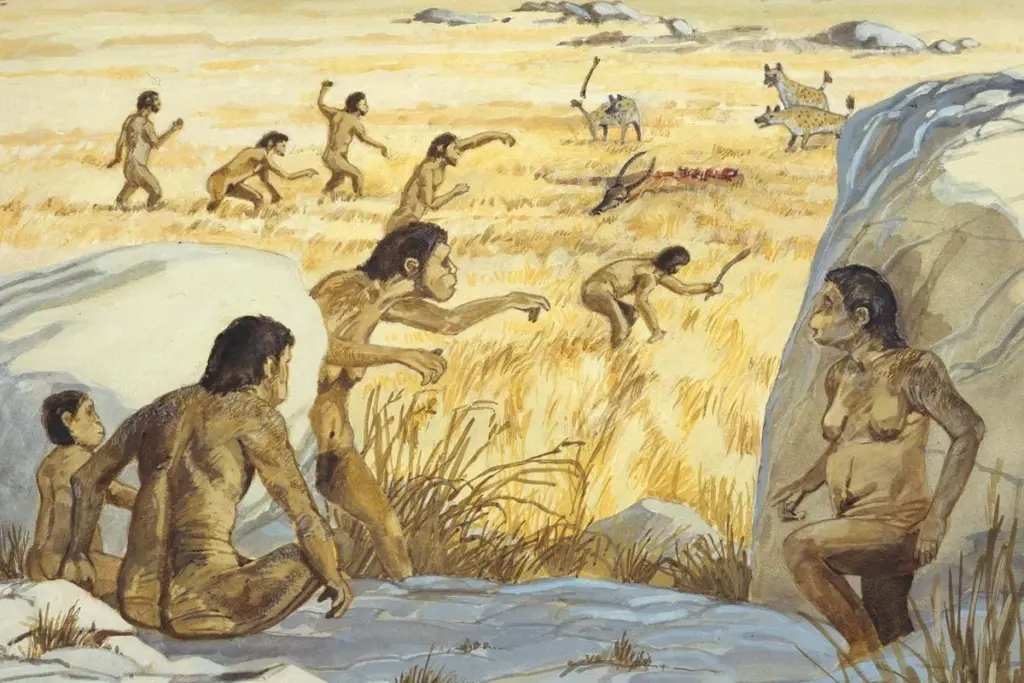
The existence of Homo habilis presents a curious paradox. On one hand, it proudly bears a name that has become widely recognized and is traditionally credited with being the earliest member of our genus, Homo – the first true humans. On the other hand, detailed knowledge about this species remains surprisingly scarce, and what little is known often appears peculiar. How can a species be simultaneously so famous and yet so obscure?
The Naming and Early Discoveries
The origin of its name is one of the few aspects of Homo habilis that can be stated with certainty. This designation was bestowed in 1964 by three palaeoanthropologists: Louis Leakey, Phillip Tobias, and John Napier. They themselves acknowledged that the suggestion actually came from their colleague Raymond Dart, who proposed “habilis,” a Latin word signifying “able, handy, mentally skillful, vigorous.”
This name was applied to a collection of fossilized bones and teeth unearthed in the Olduvai Gorge region of Tanzania, East Africa. The retrieved remains were rather disparate, including a lower jaw with intact teeth, a single upper molar, skull fragments identified as parietals, and several hand bones. The research team concluded that these fragments belonged to a single juvenile individual.
Crucially, these researchers contended that Homo habilis were the creators of the Oldowan stone tools discovered in the same vicinity. This assertion led to a broader claim: the ability to fashion tools was a defining characteristic of the genus Homo. The reasoning was that less “human-like” hominins, such as Australopithecus, likely did not produce tools, whereas Homo habilis and its progressively more intelligent successors did, marking them as distinct.
This represents a significant level of interpretation based on a limited number of fossils. However, given the scarcity of hominin fossils known at that time, Leakey and his colleagues were making the most of the available evidence.
Subsequent Discoveries and Clarification Challenges
Over the subsequent sixty-two years, further fossils were discovered and attributed to Homo habilis. Yet, these additional remains have not substantially clarified our understanding of the species. Instead, Homo habilis has often been relegated to a state of ambiguity.
“It’s what they refer to as a ‘wastebasket taxon’,” explained Ian Tattersall, associated with the American Museum of Natural History in New York. “When researchers encountered something they weren’t entirely sure how to classify, they simply placed it within Homo habilis. Consequently, Homo habilis rapidly evolved into a rather unwieldy collection of specimens, making definitive identification extremely difficult.”
This situation raises the question: can a coherent understanding of this pivotal species and its role in human origins be established?
A Significant New Specimen
The relevance of this discussion has recently been amplified by the emergence of a new Homo habilis specimen. This fossil was excavated in 2012 and 2014 from the Koobi Fora Formation near Ileret, Kenya. Researchers, led by Frederick Grine of Stony Brook University in New York and Ashley Hammond of the Catalan Institute of Palaeontology Miquel Crusafont in Barcelona, detailed their findings in The Anatomical Record on January 13.
While Grine and Hammond were unavailable for comment, Tattersall offered his insights in a commentary published on January 24. A discussion with Tattersall, conducted via telephone under challenging connection conditions, provided further context.
The newly discovered specimen is the most complete Homo habilis fossil ever found. It includes a collarbone (clavicle), portions of the shoulder blade (scapula), both upper arm bones (humerus), both elements of the two lower arm bones (ulna and radius), and fragments from the base of the spine (sacrum) and hip bone (os coxae).
Although significant parts are still missing, including the skull, rib cage, vertebral column, hands, legs, and feet, the recovered remains offer substantial insight into the anatomy of Homo habilis.
Anatomical Insights
The most striking observation is that Homo habilis possessed relatively long arms. A notable trend in human evolution involves a reduction in arm length. In contrast to our ape relatives, who exhibit long arms in proportion to their legs, humans have decidedly shorter arms. When compared with other Homo species, such as Homo erectus, Homo habilis clearly had longer arms.
Tattersall interprets this feature as evidence that Homo habilis likely continued to spend a considerable amount of time in trees, where elongated limbs are advantageous. Prior to the genus Homo, earlier hominins like Australopithecus appear to have lived a dual lifestyle, spending time in arboreal environments and also walking bipedally on the ground. “This mode of life has no modern equivalent, yet it was evidently quite successful for an extended period,” Tattersall observed. In contrast, later Homo species, such as Homo erectus, were primarily adapted for bipedal locomotion on land, whereas Homo habilis maintained a connection to arboreal life.
The skeletal structure also indicates that Homo habilis was relatively slender. Researchers estimate that this individual stood approximately 160 centimeters tall and weighed between 30 and 33 kilograms. This is considerably smaller than most Homo erectus specimens, further distinguishing Homo habilis.
However, many aspects of Homo habilis remain unknown. Information regarding their diet, social behaviors, and typical group size is scarce. The duration of the species’ existence and the extent of their geographical distribution are also subjects of uncertainty.
Despite these limitations, it appears that Homo habilis may be undergoing a transition away from its designation as a “wastebasket taxon.”
Establishing an Identity
In his analysis, Tattersall compiled a list of fossils that have been assigned to Homo habilis over the past six decades. This compilation includes a partial skeleton and cranium from East Turkana in Kenya, a fragmented skeleton and palate from Olduvai, another palate from Hadar in Ethiopia, a partial lower jawbone from Ledi-Geraru in Ethiopia, and a solitary cranium from Sterkfontein in South Africa.
Tattersall characterizes these fossils as a “motley assortment,” a description that proves accurate. Few Homo habilis bones exist in multiple copies, making it difficult to ascertain if the available remains are truly representative of the species.
This lack of consistent evidence has led to decades of taxonomic uncertainty. Some fossils attributed to Homo habilis might not belong to the species, or even to the genus Homo at all. Notably, the specimen from South Africa is widely considered to be an Australopithecus, suggesting that Homo habilis was confined to East Africa.
Certain researchers have even proposed that the entire species is an artifact of misclassification: a collection of disparate fragments from late Australopithecus and early Homo specimens, inappropriately grouped together.
The New Specimen’s Impact
The recent discovery provides strong support for rejecting this most extreme hypothesis. It suggests that most of the purported Homo habilis specimens can indeed be accepted. Despite its incompleteness, “it appears to possess the fundamental characteristics shared by most of the other skeletons that have been classified as Homo habilis,” Tattersall stated. These disparate fossil fragments, on the whole, align with the more complete skeleton.
This does not, however, resolve all ambiguities. Tattersall points out that features above the neck remain somewhat enigmatic: “The skulls and teeth present a rather unusual collection when examined together.” As the new skeleton offers no cranial elements, it does not assist in determining which of these disparate cranial remains might belong to the same species.
Timeline and Origins
The temporal range and geographical distribution of Homo habilis also require further clarification. “Thanks to the new specimen, we now understand that Homo habilis existed, at least in Tanzania and Kenya, roughly between 1.8 and 2 million years ago,” Tattersall explained.
It is possible that the species existed earlier or later, but this is less certain. The oldest claimed specimen is a partial lower jawbone from Ledi-Geraru in Ethiopia, dated to 2.8 million years ago. “In my assessment, it is not Homo habilis,” Tattersall commented. While it may exhibit closer affinities to the genus Homo than to Australopithecus, this does not automatically qualify it as Homo habilis, he noted. Tattersall hypothesizes that the lineage leading to the genus Homo was in the process of emerging around that period.
This leads to the open question of whether Homo habilis was truly the initial member of the genus Homo. Previously, it was thought that Homo erectus (whose African specimens are sometimes referred to as Homo ergaster) emerged later. However, recent fossil discoveries have extended the temporal range of this species backward: we now possess Homo erectus specimens dating back at least 1.85 million years and even 2 million years. When combined with the existing uncertainties surrounding the Homo habilis fossil record, it is not immediately clear which species is older.
Ultimately, the origin of our genus remains somewhat of a mystery. The fossil evidence provides clues, but their precise meaning is not yet fully understood. The traditionally accepted narrative proposes that a group of Australopithecus evolved into Homo habilis, and some of these later developed into Homo erectus (also known as Homo ergaster). However, it is plausible that multiple Homo species coexisted from the outset. Other evolutionary pathways may also have occurred.
If this situation seems less than definitive, it is important to remember that we now have evidence suggesting Homo habilis was likely a real species. This was not a certainty as recently as the previous year.