
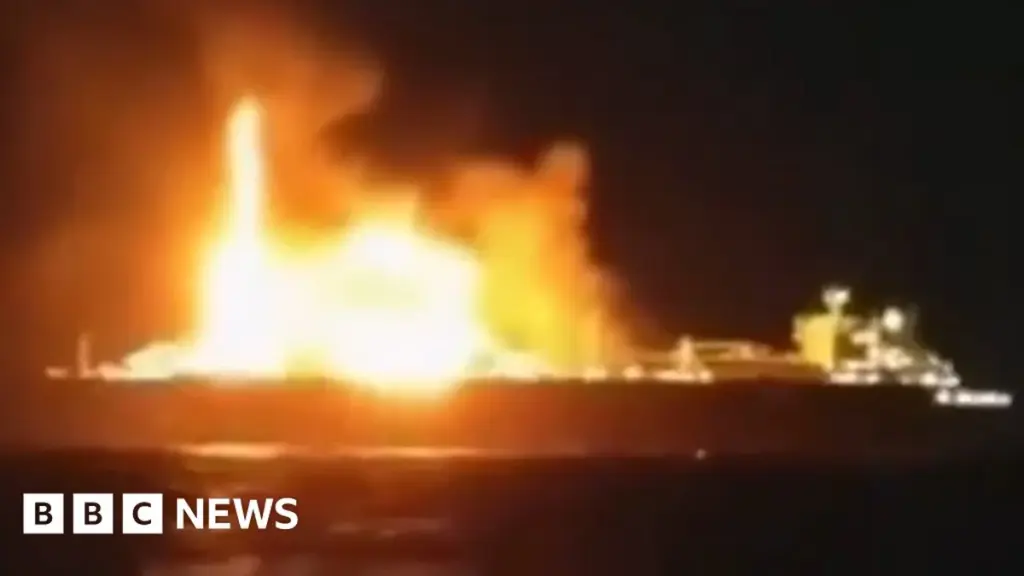
A Russian liquefied natural gas (LNG) tanker has sunk in the Mediterranean Sea, situated between Libya and Malta, following explosions and subsequent fires. Libyan port officials confirmed the incident.
Russia has formally accused Ukraine of orchestrating the attack on the vessel, identified as the Arctic Metagaz. The accusation states that the tanker was targeted by “uncrewed sea drones” launched from Libyan territory.
As of the latest reports, Ukraine’s SBU state security service has not offered any comment on the allegations. The Libyan port authority has also stated that the precise cause of the fire remains undetermined.
According to Libyan authorities, the tanker was laden with approximately 62,000 metric tonnes of LNG prior to the explosions. It reportedly sank roughly 130 nautical miles (240 kilometers) to the north of the Libyan port of Sirte.
Russia’s Ministry of Transport has reported that 30 Russian nationals were aboard the Arctic Metagaz. Maltese Home Affairs Minister Byron Camilleri stated that all crew members were located safely in a lifeboat during a rescue operation conducted by the Maltese armed forces.
Unverified footage, captured at night and purportedly showing the ship engulfed in flames after the Tuesday evening incident, has surfaced online. Serhii Sternenko, a prominent blogger and advisor to Ukraine’s defense minister, shared images on Wednesday morning claiming to depict the tanker in the Mediterranean. He noted what he described as a “serious hole in the engine room compartment,” rendering the vessel irreparable. Sternenko did not disclose the source of these images, and they have not been independently verified.
In a statement released on Telegram, the Russian Ministry of Transport characterized the incident as “an act of international terrorism and maritime piracy.” The statement also implied complicity from the European Union.
Moscow asserted that the Arctic Metagaz, which was en route from Russia’s northern port of Murmansk, was transporting cargo in compliance with all international regulations. The tanker was reportedly bound for Port Said, Egypt, and is considered part of Russia’s “shadow fleet”—vessels often used to circumvent international sanctions.
The Ministry of Transport provided no evidence to support its assertion that Ukrainian sea drones were responsible for the attack. However, earlier unconfirmed reports had suggested attacks originating from the Libyan coast.
A social media account linked to the Ukrainian government, United24, posted a cryptic message suggesting the drones were “Definitely. Maybe” not part of Ukraine’s official fleet.
Marine tracking data indicates that the tanker last reported its position off the southeastern coast of Malta the day before the fire. It had covered a significant distance by the time the fire was reported, leading to the assumption that the crew had deactivated its automatic identification system.
Russia has increasingly deployed a substantial number of vessels to transport oil and gas. This strategy is employed to sidestep international sanctions designed to limit revenues crucial for funding Moscow’s ongoing military actions in Ukraine. The nation’s shadow fleet largely consists of older tankers, many with opaque ownership structures and insurance arrangements.
Since Russia’s full-scale invasion of Ukraine in 2022, Kyiv has conducted numerous attacks on such vessels utilizing naval drones. Nevertheless, nearly all of these strikes have been concentrated in the Black Sea, a body of water shared by both Russia and Ukraine.