
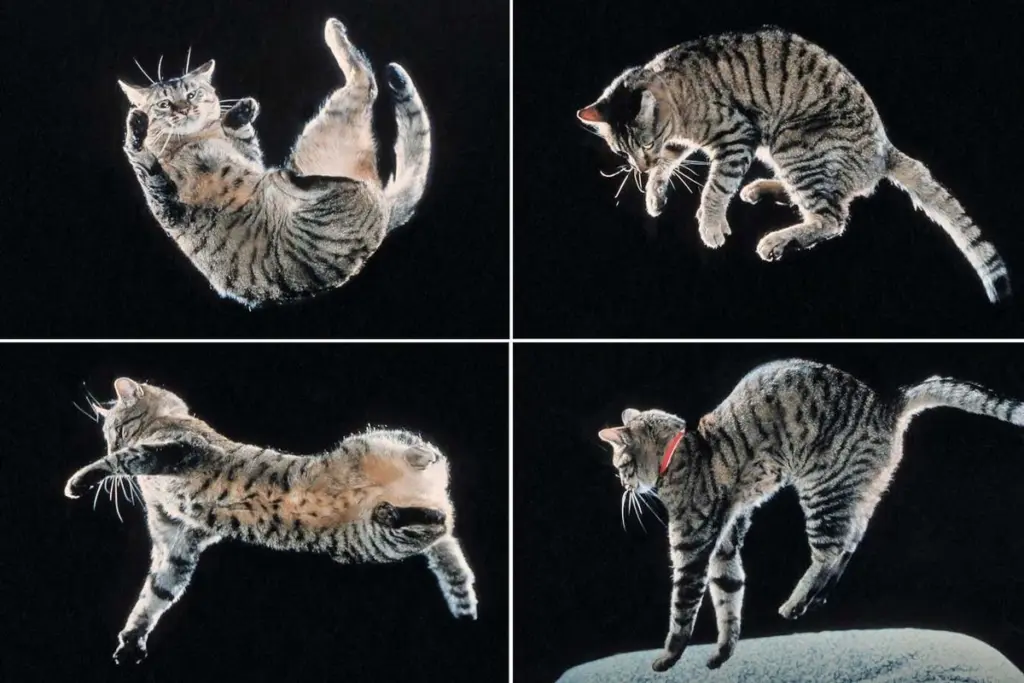
When cats manage to orient themselves correctly before hitting the ground, they employ a remarkable biological adaptation: a region of their spine possessing extraordinary twisting capabilities.
Researchers have observed that the flexibility of a cat’s thoracic spine, specifically, is exceptionally high. This adaptation plays a crucial role in their well-known ability to consistently land on their feet, a feat that has puzzled scientists for over a century.
Deciphering the Mid-Air Maneuver
The precise mechanisms behind a cat’s aerial righting reflex have been the subject of ongoing scientific inquiry. Over time, three primary hypotheses have emerged to explain this behavior.
One theory centers on the propeller-like action of the animal’s tail. The idea suggests that a cat swings its tail in one direction, inducing a compensatory rotation of its body in the opposite direction. However, evidence indicates the tail plays a less significant role. Even cats without tails have demonstrated the ability to right themselves in mid-air, suggesting other factors are at play.
Another prominent idea, known as the “bend-and-twist” model, posits that a cat first bends its body into an almost right-angled shape. It then proceeds to twist its anterior section independently from its posterior section. This strategy allows both the front and rear limbs to achieve the correct orientation simultaneously for landing.
A third possibility, the “tuck-and-turn” method, proposes a sequential rotation. The cat might rotate its front half first, followed by its rear half. This involves extending the hind legs while keeping the front legs tucked in, enabling the initial twist of the front. Subsequently, the orientation of the limbs is reversed—front legs extended, hind legs contracted—to facilitate the rotation of the rear section. This approach ensures one pair of limbs is correctly positioned before the other.
Experimental Investigations into Spinal Mechanics
To investigate these theories empirically, Yasuo Higurashi and his colleagues at Yamaguchi University conducted a series of experiments. Their study focused on understanding the specific contributions of different spinal regions to this complex maneuver.
In their initial phase, the researchers examined the spines of five deceased cats. They meticulously measured the rotational capacity of various spinal segments without causing damage. The focus was primarily on the thoracic spine, located in the mid-back, and the lumbar spine, in the lower back region.
The findings revealed a significant difference in flexibility: the thoracic spine exhibited a range of motion approximately three times greater than that of the lumbar spine. This anatomical observation strongly suggested a key role for the thoracic region in rotational movements.
The second part of their investigation involved high-speed video analysis of two adult cats being dropped from a height of one meter. These experiments provided insights into the dynamic process of mid-air rotation.
In both instances captured on video, the cats consistently completed the rotation of their front bodies milliseconds before their rear bodies began to rotate. This temporal sequencing aligns with certain theoretical models and highlights the coordinated action of different body segments.
Reassessing the Models and Unforeseen Patterns
These findings have prompted a reassessment of existing hypotheses. While the “bend-and-twist” model was previously considered dominant, the experimental data now lends more credence to the “tuck-and-turn” approach, or at least suggests a more complex interplay between the proposed mechanisms. The pronounced flexibility of the thoracic spine, for example, implies that the front of the cat’s body might initiate and lead the rotation.
It is important to recognize that these models are not necessarily mutually exclusive. Nature often employs multifaceted solutions, and a cat’s aerial righting may involve a combination of strategies rather than adherence to a single, simple mechanism. The complexity of a cat’s anatomy and its movements supports this view.
An unexpected detail emerged from the live cat experiments: both subjects consistently rotated to the right. One cat exhibited this tendency in every trial, while the other did so in six out of eight attempts. This observation was further corroborated by reports from other researchers who had noted similar directional preferences in their own video analyses of falling cats.
The reason for this apparent rightward bias remains unclear. One speculative explanation involves asymmetries in the internal organ placement within a cat’s body, which might make rotation in one direction anatomically easier than the other. Further investigation is needed to understand this curious directional preference.
Journal reference: The Anatomical Record DOI: 10.1002/ar.70165