
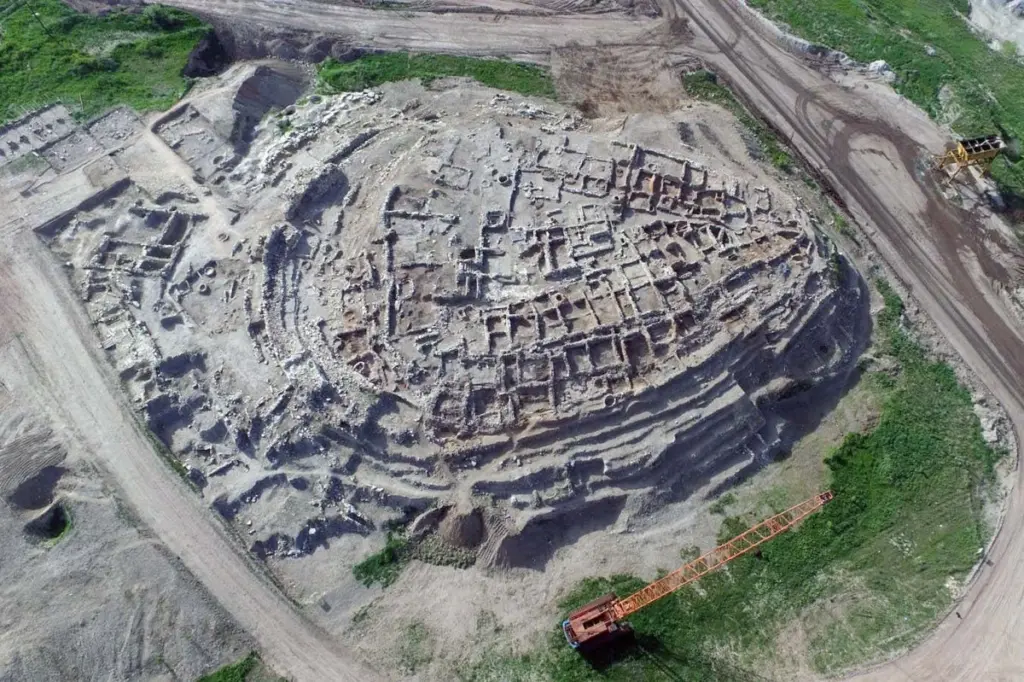
An extensive survey of archaeological sites throughout western Turkey has revealed the presence of hundreds of sizable towns. These settlements show evidence of significant activity during the Bronze Age. The findings lend support to a contentious theory suggesting this region was once the heartland of a major political entity. If correct, this power could have profoundly destabilized the eastern Mediterranean approximately 3,200 years ago.
Traditionally, scholarly understanding of the eastern Mediterranean during the Bronze Age, spanning roughly 2000 to 1200 BC, has focused on the coexistence of several prominent civilizations. These historically recognized powers included the Ancient Egyptians, the Mycenaean Greeks, and the Hittites, whose influence was centered in what is now modern-day central Turkey.
However, Eberhard Zangger, president of Luwian Studies, an international non-profit foundation, has long harbored a suspicion that previous research might have overlooked a crucial element. He posits the existence of several powerful states situated in western Turkey. These hypothetical entities would have been geographically positioned between the Hittites to the east and the Mycenaeans to the west.
A decade prior, Zangger presented initial evidence derived from satellite imagery. These images indicated a substantial number of archaeological sites in western Turkey that aligned with his hypothesis. Nevertheless, the precise periods of occupation for these sites remained unclear based solely on the visual data from orbit.
Over the past ten years, Zangger and his team have engaged in a detailed examination of Turkish-language excavation reports originating from several of these sites. Their efforts have also included numerous on-site visits. This comprehensive approach aimed to develop a more precise understanding of the occupational histories of these locations.
The research specifically targeted large settlements, defined as those with a diameter of at least 100 meters. Crucially, these sites needed to contain evidence of Bronze Age pottery, as identified by archaeologists. The culmination of this work is a newly published database detailing 483 such sites distributed across western Turkey.
“We are examining settlements, each likely housing several hundred individuals who resided there for many centuries,” Zangger stated. He proposes that these settlements were organized into a network of smaller states, which he collectively terms the Luwian states. This organizational structure draws parallels with the Mycenaean civilization, which also appears to have been structured as a collection of independent states, each governed by its own palace and ruler.
Zangger suggests that these Luwian states have largely remained unrecognized due to a historical tendency among Turkish excavators to prioritize the study of individual sites rather than investigating their broader regional connections. This focus on isolated excavations may have obscured the larger political landscape.
Corroboration and Divergent Views
The notion of small yet significant states existing in this area is not entirely unsupported by existing historical records. Guy Middleton of Newcastle University, UK, who was not involved in this specific research, noted the presence of a prominent kingdom known as Arzawa in western Anatolia. “The king of Arzawa corresponded with Pharaoh [Amenhotep III] and was referred to as a ‘Great King’ – one of the gang – at a time when the neighbouring Hittites were in a slump,” Middleton commented, highlighting the potential influence of western Anatolian rulers.
Despite this, Zangger acknowledges that substantial archaeological evidence directly attributable to Arzawa and other Luwian states remains elusive. He attributes this scarcity, in part, to the fact that many sites associated with these states experienced continuous occupation well beyond the Bronze Age. Consequently, the earliest Luwian layers are often buried deep beneath subsequent archaeological strata. “It takes you years, even decades of excavation before you get to the Bronze Age levels,” he explained, underscoring the challenges involved.
Ian Rutherford of the University of Reading, UK, offered a linguistic perspective. He pointed out that “Luwian” was the term used by the Hittites to categorize people inhabiting western Anatolia. However, Rutherford expressed caution regarding the precise ethnic or cultural composition of the region. “Whether all of the people living there were Luwian or whether there were non-Luwian cultures there too, we can’t say without more evidence. I’m sceptical,” he stated, emphasizing the need for more definitive proof.
A Controversial Hypothesis: Luwian Involvement in Mediterranean Collapse
The most debated aspect of Zangger’s theory is his suggestion that the Luwian states occasionally formed a unified political coalition. He contends this confederation was powerful enough to contend with other major Bronze Age civilizations in the eastern Mediterranean. Zangger even proposes that a Luwian coalition played a role in the disintegration of the Hittite civilization around 3,200 years ago. He further speculates that a simultaneous attack on Ancient Egypt might also be linked to this Luwian influence.
Traditionally, the mysterious “Sea Peoples” have been implicated in these widespread Bronze Age collapse events. Zangger posits that these enigmatic groups were, in fact, Luwians. This interpretation diverges from that of many other researchers, including Middleton, who argue that the historical narrative surrounding the Sea Peoples and the collapse of Bronze Age civilizations is considerably more complex and multifaceted.
Zangger finds unexpected support for his theories within an unlikely source: the ancient Greek legend of the Trojan War. This epic tale is set during the Late Bronze Age and describes a massive conflict involving tens of thousands of Mycenaean Greeks against the city of Troy. Notably, Troy is situated within a region identified by Zangger as one of his proposed Luwian states.
He argues that the narrative of the Trojan War appears unusual if one assumes that a large Greek army required a decade to conquer a single, relatively small city. Zangger suggests the story’s enduring popularity in the centuries following the Bronze Age stems from its audience’s awareness that it referenced a much larger engagement. This engagement, in his view, involved the Greeks battling a formidable coalition drawn from several Luwian states. “Fiction has to make sense,” Zangger concluded, implying that the legend’s plausibility to its ancient audiences required a greater scope of conflict than typically presented.
Journal Reference: Scientific Data DOI: 10.1038/s41597-025-06241-9