
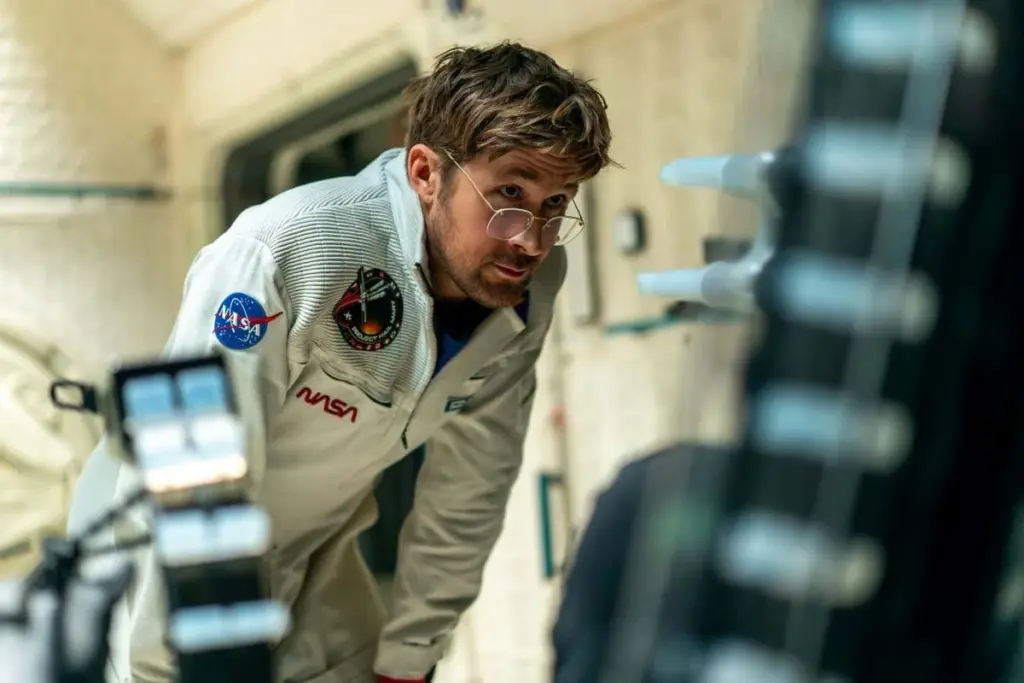
During a screening of “Project Hail Mary” in an IMAX theater, a solitary gasp escaped me. Puzzled by the lack of similar reactions from others, I realized the reason: I am a physicist.
To elaborate, with only a minor spoiler: a particular scene in the film depicts the spaceship Hail Mary suddenly accelerating. Ryland Grace, the character portrayed by Ryan Gosling, is unrestrained and consequently suffers a severe impact to his head against the screens before him. In reality, such an event would have been fatal. While I regularly encounter cinematic portrayals where characters endure impacts and falls that should be devastating, usually I can readily suspend disbelief. However, this viewing experience differed due to the film’s meticulous attention to accurately representing the physics of motion in outer space. Rather than simply fabricating scientific concepts to appear plausible, the directors, Phil Lord and Christopher Miller, apparently enlisted a NASA team to ensure their science fiction narrative adhered closely to real-world principles.
The crucial scientific principle at play here is momentum. Anyone who has rapidly braked a bicycle can attest to the concept of momentum; the inertia is greater with a heavier bike and increases with speed. Momentum can be understood as the cumulative force carried by an object and its motion. This relationship explains why larger vehicles, such as trucks, require greater stopping distances and anticipate longer deceleration times than smaller cars. Their greater mass and velocity contribute to a higher momentum.
One of the remarkable aspects of physics is the universality of momentum. Isaac Newton’s second law formally described this concept, establishing it as a fundamental principle across the cosmos. Even when astronauts depart Earth, they continually encounter momentum in novel and unforeseen circumstances. When Newton’s first law is considered alongside his second, the dynamics of space travel become particularly fascinating.
Newton’s first law states that an object in motion will remain in motion, and an object at rest will stay at rest, unless acted upon by an external force. This often appears counterintuitive in daily life due to numerous forces at play on Earth. In a cricket match, for instance, a struck ball eventually succumbs to Earth’s gravity, ceasing its aerial trajectory. Gravity counteracts the initial force imparted by the bat. In the vacuum of space, distant from significant gravitational influence, such impediments are absent; an object set in motion would continue indefinitely.
This principle directly applies to Grace’s experience in the film when his spaceship abruptly accelerates. Without the restraining force of a seatbelt, he is propelled forward. The collision between his head and the spaceship panel occurred with substantial momentum, as no opposing force could counteract the impact. This is precisely why I anticipated a fatal outcome, though the film, of course, prioritizes its plot over strict adherence to physics in this instance.
Throughout the movie, numerous subtle moments of this nature induced anxiety. The film’s accurate portrayal of physics, even if not always mirroring human physiology, was at times intensely unsettling yet also profoundly beautiful. A scene depicting Grace throwing an object from his spaceship captivated me with its elegant simplicity: the object continued its trajectory in a perfectly straight line, without any deceleration—a scenario impossible on Earth.
Four years prior, my experience watching a film like “Project Hail Mary” would likely have been different. My academic career had largely focused on distancing myself from Newtonian physics, preferring the complexities of relativistic and quantum sciences. As a first-year university student, I found thought experiments involving speeding cars and airborne sports balls somewhat uninspired, yearning instead for grand cosmic principles. Over time, as a professor, I’ve come to appreciate the foundational role of Newtonian physics in introducing students to concepts that extend into realms like the quantum world, where momentum takes on a particularly significant and complex form. This acceptance was initially reluctant.
A significant shift occurred while I was researching material for my new book, “The Edge of Space-Time.” My intention was to explore humanity’s methods of understanding and conceptualizing space. During this process, I discovered that Newton’s first law, in particular, is intrinsically linked to this narrative. To my considerable surprise, I learned that over a millennium before Isaac Newton’s birth, the Zhou Kingdom philosopher Mozi and his followers had documented principles akin to this law in the Mo Ching.
I dedicated three weeks to an in-depth study of the three known English translations of the Mo Ching, which ultimately led to a renewed appreciation for the fundamental importance of motion. The passages from the Mo Ching compelled me to re-examine Newton’s original text, the Principia, consulting both the Latin and English versions. Suddenly, my fascination was reignited. Decades after completing my initial physics degree, I continue to have my understanding of the universe reshaped by novel insights. Crucially, this re-engagement would not have been possible without the dedicated translation efforts of my colleagues in the humanities, who immerse themselves in ancient languages.
My experience watching “Project Hail Mary” represented a true moment of synergy: scientists provided guidance to artists, who in turn created art that benefited from the translation work of humanists. I found myself gripping my chair with a mix of anxiety and critical assessment of the story and its author, Andy Weir. Yet, I departed the theater with a deep satisfaction in how my own mind had been trained to perceive the universe in motion, and with a sense of gratitude towards all the individuals who made it possible for me to witness such a depiction.