
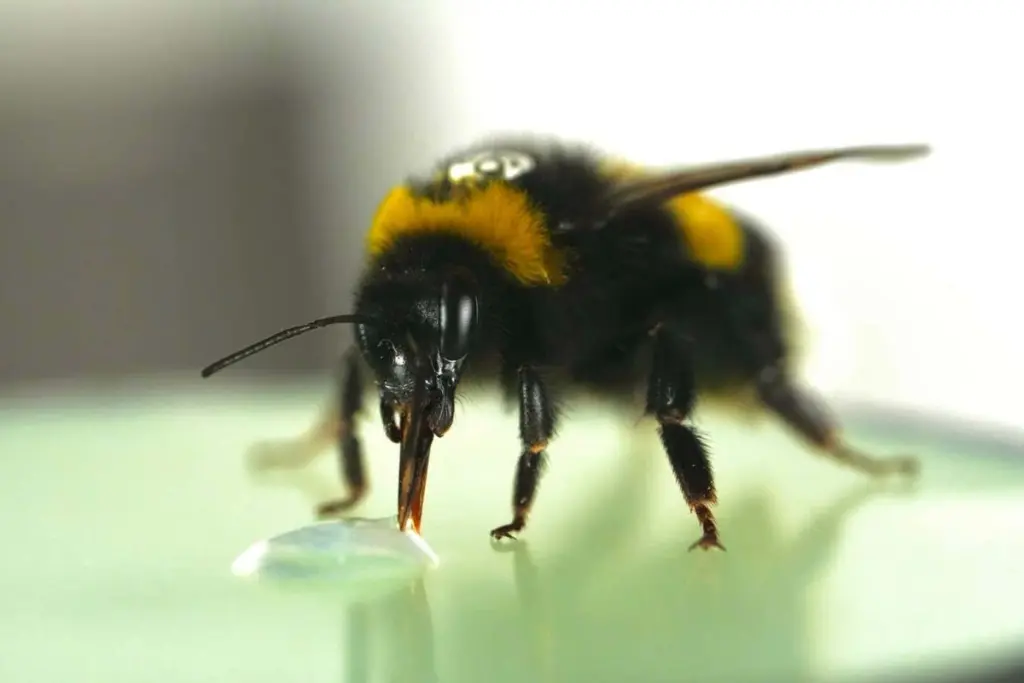
Bumblebees have demonstrated an impressive capacity to learn and distinguish between Morse code-like sequences of flashing lights and vibrations. This ability signifies a sense of rhythm, a trait previously unobserved in animals with comparably small brains.
The recognition of flexible, abstract rhythms – such as identifying the same pattern or melody played at varying tempos or in different modalities – has until now been documented in only a limited number of avian and mammalian species. These include parrots, songbirds, and primates like chimpanzees.
Researchers at Macquarie University in Sydney, Australia, led by Andrew Barron, conducted a series of experiments to ascertain if buff-tailed bumblebees (Bombus terrestris), possessing significantly less complex brains, could also comprehend a range of distinct rhythms.
Initial Experiments with Light Sequences
In the initial phase of the study, bumblebees were trained to differentiate between two artificial flowers. These flowers emitted flashing LED lights, with one producing extended flashes and the other short pulses, analogous to dashes and dots in Morse code. Crucially, one flower contained a sucrose reward, while the other presented unpalatable quinine.
After the bees learned to associate specific flashing patterns with either reward or punishment, their preference was tested using flowers filled only with water. A significant majority of the bees continued to choose the flower that had previously dispensed sucrose, indicating successful learning of the light cues.
Increased Complexity and Tactile Stimuli
Subsequently, the complexity of the light stimuli was elevated. Each artificial flower emitted a distinct flash pattern: either “dash dash dot dot” or “dot dash dot dash.” The bees were still capable of distinguishing between these more intricate visual sequences.
The subsequent phase yielded a particularly noteworthy outcome, according to Barron. The artificial flowers were superseded by a maze structure, featuring a vibrating floor at the junction of two pathways.
Transferring Pattern Recognition Across Sensory Modalities
“If it was vibrating dot dash dot dash, it meant turn right to get sugar,” Barron explained. “So, one rhythm indicated to turn left, one rhythm indicated turn right, and we trained them like that. We showed they could learn that.” This demonstrated their ability to associate specific vibrational patterns with directional choices for receiving a reward.
In the final experiment, without any further training, the scientists replaced the vibrating floor with LED lights that flashed in the same patterns previously used for the floor vibrations. “Not all of them got it, but the population overall showed that they were able to transfer the task from vibration into light pulses,” Barron stated. This finding highlights their capacity to generalize learned patterns.
Implications for Understanding Cognition and Technology
In essence, the bumblebees proved capable of recognizing a pattern irrespective of its presentation medium. They demonstrated this ability with both light flashes and vibration pulses, confirming their understanding of the underlying rhythms.
Barron noted that abstract rhythmic recognition was previously believed to necessitate a considerably larger brain. Understanding how bees achieve this with their minute brains could potentially revolutionize the way miniature drones and other small, autonomous devices perceive and interact with their environments.
“I think what this work is showing is there’s got to be a simpler trick,” Barron remarked. “That an organism like a bee, with a bee-type brain, is able to abstract a rhythm is remarkable.” His sentiment underscores the surprising cognitive abilities found in species with less complex neurological structures.
Journal reference: Science DOI: 10.1126/science.adz2894