
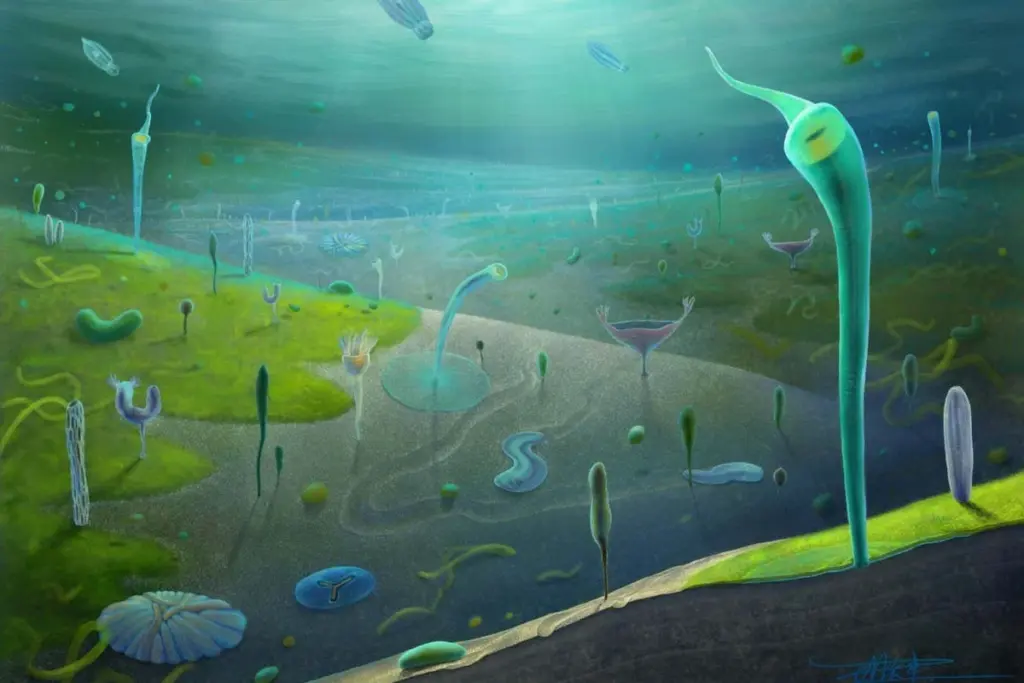
A substantial collection of exceptionally well-preserved fossils unearthed in China is prompting a reevaluation of the long-held theory that complex life forms underwent a rapid evolutionary surge during the period known as the Cambrian explosion.
This transformative era, occurring approximately between 541 million and 513 million years ago, is generally regarded as the time when the majority of animal lineages extant today first appeared. It also saw the emergence of a diverse range of experimental life forms, many of which subsequently became extinct.
Prior to this period, the Ediacaran, life was considerably less complex according to prevailing scientific understanding. However, the newly discovered fossil site in Yunnan province, China, referred to as the Jiangchuan biota, presents a stark contrast. This remarkable find comprises over 700 fossils dating back to between 554 and 537 million years ago.
The implications of this discovery are significant. Gaorong Li, associated with Yunnan University in Kunming and the lead researcher on the project, stated, “This evidence indicates that animal communities resembling those of the Cambrian did not emerge suddenly. Instead, they already possessed well-established foundations and transitional forms by the close of the Ediacaran epoch.”
Ross Anderson, from the University of Oxford and a collaborator on the research, noted that the unexpected sophistication of these fossils raises questions about whether the Cambrian explosion was a more gradual process as opposed to a sudden burst.
“We are definitely uncovering a more intricate narrative concerning the origins of animal diversity and the timing of its initial proliferation,” Anderson explained.
When Li first began exploring the Jiangchuan site in mid-2022, his expectations were focused solely on finding examples of algae.
Instead, the research team encountered a variety of organisms classified as bilaterians—animals exhibiting bilateral symmetry. Prior to this, very few examples of such creatures from the Ediacaran period had been documented. Among these findings are two novel species of deuterostomes, a significant group encompassing vertebrates, suggesting this lineage was already quite diverse before the Cambrian.
Some of the recovered fossils have been identified as cambroernids, a group characterized by coiled bodies and filamentous appendages. These were previously thought to have only appeared after the start of the Cambrian period. Additionally, fossils bearing resemblance to the Cambrian organism Margaretia were discovered. This organism, appearing as a tube with perforations in its walls, was described by Li as “overall resembling an animal inhabiting a ventilation pipe.”
Li highlighted the most frequently found fossil: an animal that likely anchored itself to the seafloor at one end and possessed a retractable tubular appendage at the other, a feature that conjured comparisons to the sandworm from the science fiction series Dune.
“This suggests an organism that lived affixed to the seabed, extending this structure for feeding purposes,” Li commented. “Another identified form is a sausage-shaped worm with a short, robust, curved body, clearly indicating a capacity for movement.”
He further described these animals as both peculiar and strangely familiar. They may represent what he termed “evolutionary experiments” from a formative phase where life was exploring diverse body plans and ecological strategies.
“They already exhibit key anatomical features found in modern animals, such as a mouth, a digestive tract, and a proboscis or pharynx,” Li elaborated. “However, the configuration of these structures differs from that observed in most contemporary animals. In essence, despite their unusual external appearance, they incorporate fundamental body modules shared with modern animal life.”
Joe Moysiuk from the Manitoba Museum in Winnipeg, Canada, pointed out that the sudden appearance of most extant animal body plans in the early Cambrian fossil record has remained a challenging puzzle for paleontologists for centuries.
“There is substantial reason to believe that their ancestral forms should be present in the preceding Ediacaran period, and evidence hinting at these ancestors has been accumulating over several decades,” Moysiuk stated.
“While the preservation quality of some specimens is somewhat coarse, leading to a lack of extremely fine details, the collection does contain some forms that are distinctly animal-like.”
Although these fossils suggest the presence of certain animal groups before the Cambrian period, Moysiuk clarified that they do not necessarily disprove the concept of the Cambrian explosion itself.
“Instead, they provide a more precise temporal framework for the likely commencement of this evolutionary radiation, suggesting that the divergence of animal body plans probably occurred over a period of approximately 30 million years stretching across the Ediacaran-Cambrian boundary.”
Han Zeng, an independent researcher from the Chinese Academy of Sciences, remarked that the discovery of complex animal fossils in geological deposits predating the Cambrian would represent a “significant breakthrough in paleontology.”
“Over the past several decades, various carbonaceous fossils have been recovered from late Precambrian shales of similar age in South China,” Zeng noted. “While the majority of these fossils have been identified as algae or cyanobacteria, a few remain ambiguous, exhibiting possible animal affinities. Further research will be crucial to clarify the biological identities of these fossils. If their animal nature is confirmed, these findings could significantly alter our understanding of early animal evolution.”