
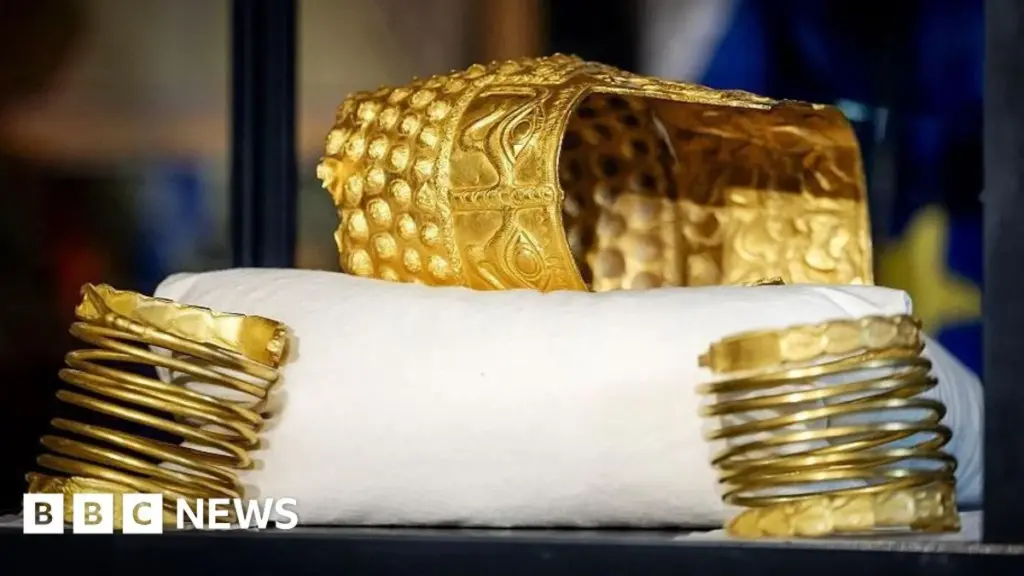
A 2,500-year-old golden helmet, considered one of Romania’s most significant treasures, has been recovered more than a year after it was stolen during a raid on a Dutch museum. The artifact, along with two golden bracelets dating back to approximately 450 BC, were officially returned to the Drents Museum on Thursday. They are now secured behind a glass display, under the watchful eyes of two armed police officers. A third bracelet remains unaccounted for.
The theft of the Coțofenești helmet and its accompanying bracelets, carried out by an armed gang that breached the Drents Museum in Assen, sparked widespread outrage in Romania. It also prompted significant questions regarding the security protocols for priceless artifacts lent to museums in other countries. Romanian prosecutor Daniela Buruiană described the recovery as a “long-awaited result” and expressed happiness that the Romanian artifacts were now back.
These treasures originate from the Dacian era, an Iron Age civilization that flourished in the region now known as Romania. They had been on loan from Romania’s National History Museum at the time of their disappearance. The incident led to a diplomatic dispute between the two nations, culminating in the Dutch government reportedly paying approximately €5.7 million for insurance compensation. Romanian officials have declined to comment on the future of this sum.
Robert van Langh, the director of the Drents Museum in the northern Netherlands, confirmed that the helmet sustained minor dents but is expected to be restorable. The bracelets, he noted, remained in perfect condition. Rareș-Petru Stan, a Romanian prosecutor, emphasized the “major impact” the theft had within his country. He commended his Dutch colleagues for their diligent efforts and perseverance.
Stan added that the investigation continues with the aim of locating the final bracelet. He expressed gratitude for the prospect of returning this national treasure to the Romanian people. Dutch public prosecutor Corien Fahner revealed that the helmet and bracelets were surrendered to authorities on Wednesday, following negotiations involving the legal representatives of the three suspects involved.
Two men in their mid-30s and a 21-year-old will face trial later this month. The individuals were apprehended within days of the museum break-in, which involved the use of explosives to gain entry. However, by then, the priceless artifacts had vanished without a trace.
Art experts have posited that the helmet and bracelets were likely stolen to order, commissioned by a criminal organization. Several provincial museums in the Netherlands have become targets in recent years, partly due to the challenges in providing adequate security for high-value artifacts. The display case holding the helmet and bracelets offered minimal resistance to the armed perpetrators.
Recent years have seen a rise in such incidents. In 2024, two works by Andy Warhol were stolen from a southern Netherlands gallery. Six years prior, a painting by Frans Hals, titled “Two Laughing Boys,” was taken from a small museum in the central town of Leerdam.
The former head of the National History Museum in Bucharest, Ernest Oberländer-Târnoveanu, faced significant criticism domestically for approving the loan of these gold objects abroad. He lost his position within days of the theft. Oberländer-Târnoveanu conveyed his relief at the helmet’s retrieval, describing it as a “unique item in European and even global cultural heritage.” He further characterized the helmet as an important social and political symbol of Dacian civilization.