
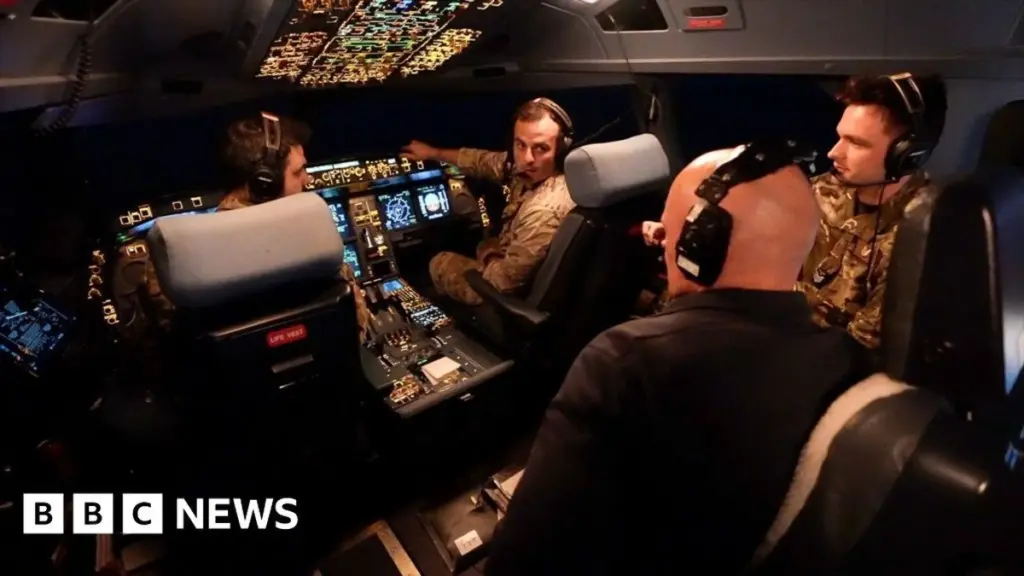
The night air above RAF Akrotiri in Cyprus is fractured by the sharp screech of a Typhoon and an F-35 jet. Their passage is soon followed by the deeper thrum of a larger refuelling aircraft, joining the mission to intercept Iranian drones.
This RAF Voyager acts as a crucial aerial refuelling platform, supporting the Typhoon and F-35 jets that have maintained a constant vigil over Cyprus and Jordan for the past month. These defensive patrols commenced following the initiation of bombing campaigns by the United States and Israel against Iran.
The BBC was among the first media outlets to witness these round-the-clock defensive operations firsthand. From the Voyager’s cockpit, the distant lights of Cyprus gradually receded as the aircraft approached the coastlines of Israel and Lebanon.
As the mission progressed, a brief flash of orange light appeared in the distance. A crew member pointed it out, stating, “Quite often you can see either incoming missiles from Iran or the Israeli response.” The pilot, speaking over the intercom, added, “It might be the Iron Dome from Israel,” referencing Israel’s missile defense system. “We don’t know for sure,” he continued, “but there’s a lot of kinetic things happening in that area at the moment.” This observation offers evidence that Iran continues to pose a threat, a month after significant bombing campaigns, by launching missiles and drones.
During this extensive nine-hour mission, the accompanying Typhoon and F-35 jets refuelled on seven separate occasions, collectively taking on approximately 30 tonnes of aviation fuel. They were observed emerging from the darkness at speed, executing the precise manoeuvre required to connect with the fuel lines extending from the tanker’s wings. While routine for the fighter pilots, the interception of Iranian drones presents a more significant challenge.
British jets operating from bases in Cyprus and Qatar have successfully downed several drones over the past month. While the exact number of times their sophisticated advanced short-range air-to-air missiles (ASRAAM) have been employed for this purpose remains undisclosed, it is understood to be in the low single figures. This practice represents a considerable expenditure, using an expensive projectile to neutralize a comparatively inexpensive fiberglass drone.
The Complexities of Drone Interception
On the ground, Squadron Leader “Bally,” an RAF F-35 pilot, elaborated on the mission’s inherent complexities. “Operating on a fast jet is already a dangerous business,” he explained. “Let alone when trying to target something close to the surface.” He noted that with drones flying at low speeds and altitudes, there is a “risk of flying into the ground.” Furthermore, he highlighted threats that extend beyond direct enemy activity, encompassing the inherent dangers of close proximity to other aircraft operating within the same airspace.
During the observed mission, no specific targets were identified. However, the jets have been actively engaged in what has been designated “Operation Luminous” since the commencement of the conflict.
Preparations and Incidents at RAF Akrotiri
Despite some criticism, government officials have consistently affirmed that adequate preparations were undertaken. This included the deployment of additional jets, air defence systems, and military personnel to Cyprus in the weeks preceding the conflict. Major General Tom Bewick, Commander British Forces Cyprus, emphasized the “prudent planning” that preceded the war, which incorporated enhanced ground-based air defenses and radar capabilities.
However, these measures did not prevent a drone from impacting the base on the second night of the conflict. This small drone, presumed to have been launched from Lebanon, struck a hangar on the portion of the base utilized by the U.S. Air Force. It is widely understood that the U.S. consistently operates a U-2 spy plane from RAF Akrotiri, though this is not officially acknowledged.
Sources confirm that the drone, possessing a wingspan of two meters, was tracked by radar as it approached the base. Sufficient warning was available to sound the air raid sirens and ensure personnel were moved to safety. General Bewick characterized the resulting damage as minimal, stating, “They didn’t get much bang for their buck.” He also noted his “suspicion” that the perpetrator “hit what they were aiming at.”
Enhanced Defenses and Ongoing Vigilance
Following this incident, General Bewick reported that Akrotiri’s air defenses have been significantly bolstered. The base now hosts eight Typhoon jets and an equal number of F-35 jets. Recent additions include Wildcat helicopters equipped with short-range air defense missiles and Merlin helicopters fitted with early warning radar systems.
The Royal Navy destroyer, HMS Dragon, is presently providing additional air defense capabilities from its position off the coast of Cyprus. General Bewick expressed his satisfaction with the presence of such a “super high-end” warship in the region, confirming that the base now possesses robust air defenses. Given Iran’s public declaration of RAF Akrotiri as a target, General Bewick acknowledged the necessity of taking such threats seriously, stating he would be “a fool not to take the Iranians at their word.” While acknowledging the base remains vulnerable to attack, he stressed that it is now “as well protected as it can be.”
Signs of increased confidence are evident at the base. Many service families who had departed their residences after the drone strike have since returned. Air raid warnings are now issued less frequently, a consequence of improved intelligence gathering and detection capabilities.
The United Kingdom has also extended assurances to Cyprus. In the wake of the drone incident, the President of Cyprus called for “open and frank discussions” regarding the future operational status of RAF Akrotiri. General Bewick stated that he is now engaged in close collaboration with Cypriot authorities, while firmly asserting that the UK’s sovereignty over the base is “not up for debate.”
The duration of the current conflict remains uncertain, with its conclusion and timing beyond the control of the United Kingdom. The heightened defense posture at RAF Akrotiri will inevitably place additional strain on the UK’s already stretched military resources. Some of the Royal Navy helicopters presently stationed at RAF Akrotiri were originally scheduled to join the aircraft carrier HMS Prince of Wales on its planned deployment to the North Atlantic.
RAF jets have temporarily suspended their decade-long counter-ISIS missions, known as “Operation Shader,” to concentrate on the defense of Cyprus. Group Captain Adam Smolak, the Station Commander at RAF Akrotiri, also anticipates a prolonged conflict, predicting that the base will require defending “for quite some time to come.” Historical precedent suggests that U.S. military interventions in this volatile region are rarely swift or uncomplicated.