
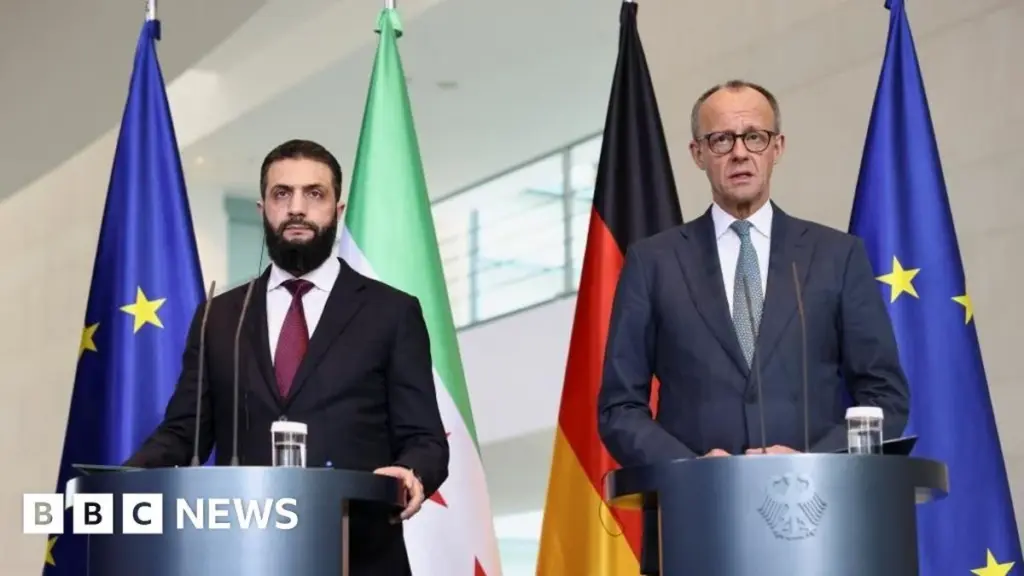
German Chancellor Friedrich Merz has indicated a shared aspiration with Syrian President Ahmed al-Sharaa to see approximately 80% of Syrian refugees currently residing in Germany return to their home country within the next three years. This follows an era where nearly a million Syrians sought refuge in Germany due to the ongoing civil war.
Speaking in Berlin after a meeting with President al-Sharaa, Chancellor Merz stated that the situation in Syria has undergone a fundamental change more than a year after the conflict’s conclusion. Consequently, the necessity for international protection should be re-evaluated. However, specific details regarding the implementation of these returns were not extensively provided.
Merz’s administration has adopted a more stringent stance on refugees and migrants, a policy shift occurring as support for the anti-immigration Alternative for Germany (AfD) party has seen a considerable rise. Initially, the government’s priority will focus on repatriating individuals who no longer possess valid residency rights, with a particular emphasis on criminal offenders. Further returns are anticipated to follow.
“Looking ahead over the next three years – as Sharaa has expressed his hope – around 80% of Syrians currently residing in Germany are expected to return to their home country,” Merz remarked.
He acknowledged the significant contributions many Syrian refugees have made in Germany. Nevertheless, Merz suggested that the majority desire to return home, where they are expected to play a crucial role in Syria’s reconstruction in the coming years. Both leaders recognized that a portion of the Syrian population would remain in Germany.
Chancellor Merz highlighted that it serves Germany’s interests for Syrian doctors and caregivers to have the option to stay if they wish. President al-Sharaa expressed Syria’s gratitude for Germany’s welcoming approach to refugees during the civil war.
“We are proud that Syrians have learned very quickly to contribute to society,” al-Sharaa commented. “We are working with our friends in the German government to establish a ‘circular’ migration model.” This model, he explained, would permit Syrians to participate in their homeland’s reconstruction while allowing those who choose to stay to maintain the stability and established lives they have built in Germany.
However, Franziska Brantner, representing Germany’s opposition Green Party, raised concerns that returning to Syria may not be a viable option for many due to the current lack of infrastructure and the prevailing security instability. She noted that numerous Syrians are deeply integrated into German society, holding essential jobs and having children attending local schools.
President al-Sharaa’s visit to Germany was met with a number of protests. The Kurdish Community in Germany (KGD) has urged Chancellor Merz to secure concrete commitments regarding minority protections in Syria during the visit. The KGD has accused al-Sharaa of human rights abuses and war crimes.
A significant number of Syrians arrived in Germany during the 2015 refugee crisis. At that time, former Chancellor Angela Merkel made the decision not to close the country’s borders to those fleeing the Syrian civil war. Her statement, “Wir schaffen das,” translating to “We’ll manage this,” was interpreted by some supporters as a pragmatic declaration of intent, but it later became a political burden. Merkel faced substantial criticism, with many viewing it as an open invitation for large-scale migration. This narrative has since fueled the rise of far-right parties, such as the AfD, across Europe, whose platforms often center on anti-migrant sentiments. Today, concerns about migration remain a prominent factor in European politics, prompting many governments to implement more restrictive controls.