
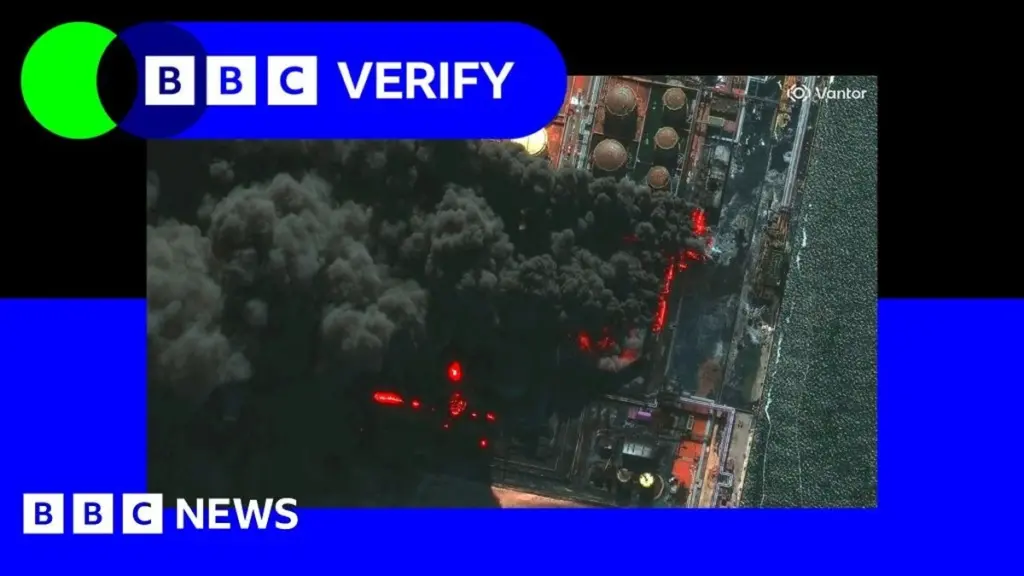
Satellite imagery and verified video evidence indicate that Ukraine has conducted a series of strikes against crucial Russian oil export infrastructure situated near the Baltic Sea over the past week. These attacks have reportedly left some facilities ablaze for multiple days.
BBC Verify has confirmed at least three oil sites within Russia’s Leningrad region, located near Saint Petersburg, were targeted. These incidents, commencing on March 23rd, occurred approximately 500 miles (800 kilometers) north of the Ukrainian border.
The confirmed strikes included multiple assaults on the vital Baltic Sea ports of Ust-Luga and Primorsk. Additionally, an attack was reportedly carried out against the nearby Kirishi oil refinery, situated inland.
Analysis from the Finland-based Centre for Research on Energy and Clean Air (Crea) highlights the strategic importance of these locations. In 2025, preliminary data suggests 22% of Russia’s total oil exports originated from Primorsk, with an additional 20% departing from Ust-Luga.
Recent data reveals a significant disruption in maritime activity. On March 26th and 27th, no ships were recorded loading oil across any of Russia’s three Baltic ports. Crea notes this marks the first instance of two consecutive days without such activity since the full-scale Russian invasion of Ukraine in 2022.
Satellite imagery from March 24th depicts substantial plumes of smoke billowing from burning oil facilities in Primorsk. Further images from March 27th show ongoing fires at Ust-Luga and significant damage to the Kirishi refinery.
BBC Verify’s assessment of photographic evidence indicates the following impact:
- Primorsk: At least eight storage tanks sustained destruction or damage.
- Ust-Luga: A minimum of eight tanks were reportedly destroyed or damaged.
- Kirishi: At least two storage tanks showed signs of damage.
Nasa’s FIRMS (Fire Information for Resource Management System), which detects heat signatures on the Earth’s surface, registered ongoing fires at Primorsk as of early Monday morning. A heat signature was also detected by FIRMS at Ust-Luga later that morning.
The governor of the Leningrad region, Alexander Drozdenko, stated on Sunday that the fire at Ust-Luga had been contained. No casualties were reported following these incidents.
Several videos confirming the aftermath of attacks on all three facilities over the past week have also been verified by BBC Verify, including footage showing massive smoke plumes rising from Primorsk.
Robert Brovdi, the commander of Ukraine’s military drone forces, has stated that an operation targeting these three Baltic oil export facilities took place between March 23rd and March 28th. Brovdi indicated the strikes were intended to “demilitarize Russia’s oil arteries, refining capacity, and crude export infrastructure.”
Ukraine’s military has identified the Kirishi refinery as one of Russia’s three largest oil-processing plants, responsible for producing “fuels that support the armed forces of the aggressor state.”
Following the initial attacks on March 25th, calculations by Reuters, based on market data, suggest that approximately 40% of Russia’s oil export capacity was temporarily halted.
Crea’s analysis indicates that Russia earned approximately £7.1 billion from oil exports during the final three weeks of March. These earnings occurred amidst a sharp rise in oil prices, influenced by disruptions related to the conflict involving Iran.
On Monday, Ukrainian President Volodymyr Zelensky mentioned that allies had requested Kyiv to reduce attacks on Russia’s energy sector due to concerns about the global energy crisis. He maintained that these attacks would only cease if Russia stopped targeting Ukraine’s energy infrastructure.
Alexander Lord, an analyst at the UK-based intelligence firm Sybelline, commented on the situation. He suggested that Kyiv is likely attempting to counteract the significant revenue increase that Russian oil and gas exporters are currently experiencing. However, Lord added that as the conflict prolongs, the U.S. may increase pressure on Ukraine to halt these targeted strikes as part of broader efforts to influence global oil prices.