
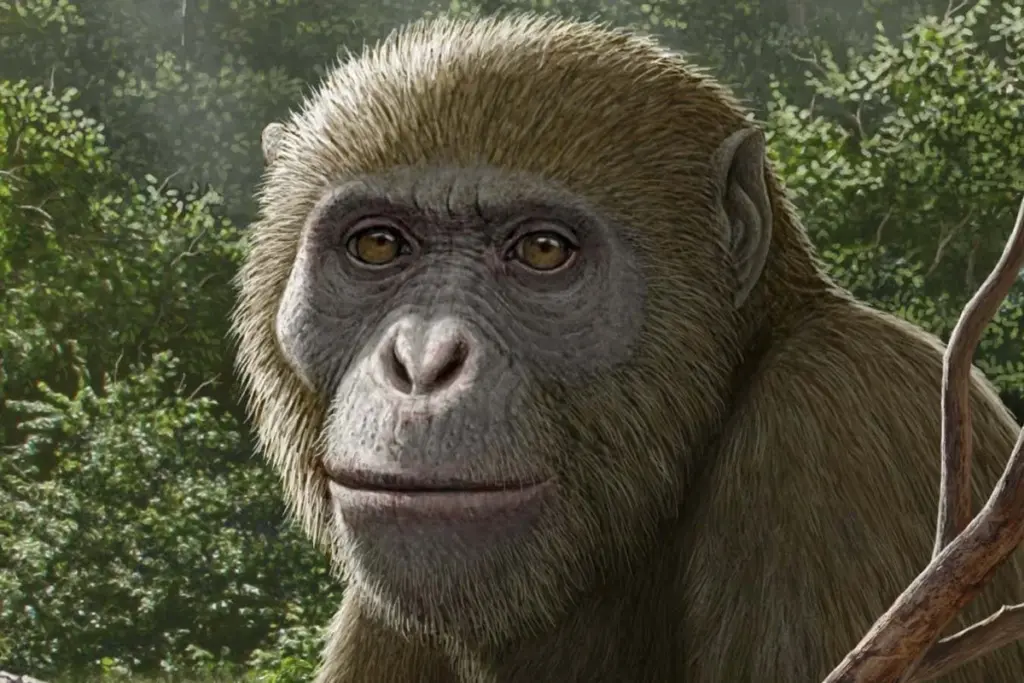
A recently unearthed ape species, dating back approximately 17 million years, offers compelling evidence that the earliest apes may have originated in North Africa, contradicting the long-held belief that their evolutionary beginnings were in East Africa.
During expeditions in 2023 and 2024 at the Wadi Moghra archaeological site, situated in northern Egypt, Shorouq Al-Ashqar of Mansoura University, alongside her colleagues, made a significant find. They discovered teeth and jawbone fragments belonging to two ancient apes within geological deposits estimated to be between 17 and 18 million years old.
The research team ultimately recovered four fossil specimens. These included the anterior portion of a mandible, or jawbone, accompanied by two molar teeth found in close proximity, all attributed to a single individual. A second, separate mandibular fragment, lacking its tooth crowns, was identified from a different ape.
Al-Ashqar and her team propose that the newly identified creature, designated Masripithecus moghraensis, represents the closest known ancestor to all current great apes—a group encompassing humans, gorillas, and chimpanzees—as well as lesser apes like gibbons and siamangs. Apes are distinct from monkeys primarily due to the absence of a tail.
While it is generally accepted that the earliest apes evolved on the African continent, fossil evidence indicates that by 16 million years ago, certain ape lineages had already dispersed beyond Africa, inhabiting regions of Europe and Asia.
The location of these new fossils in North Africa, rather than East Africa, has been a considerable surprise to researchers. East Africa has historically been considered the primary locus for major advancements in ape evolution.
Al-Ashqar explains that the ape-like characteristics present in the mandible were the decisive factors in classifying the creature as a hominoid. She specifically points to the symphysis, the area where the two halves of the mandible meet, noting its structural resemblance to those found in later ape species.
“The molars themselves are highly informative,” Al-Ashqar stated. “They possess a low, rounded form and are extensively crenulated, meaning they are ridged. Furthermore, the second and third molars are remarkably similar in size.”
Estimates suggest that M. moghraensis weighed around 25 kilograms, making it larger than monkeys from the same period. Phylogenetic analysis confirmed its placement squarely within the hominoid lineage, according to Al-Ashqar.
The observed characteristics of the teeth and mandible indicate that M. moghraensis possessed a varied diet. Al-Ashqar suggests the ape likely subsisted primarily on fruits but was also capable of consuming harder foods such as nuts and seeds, a capability supported by its robust jaw and complex molars.
However, without the discovery of fossilized limb bones, determining the species’ mode of locomotion or whether it lived predominantly in arboreal or terrestrial environments remains speculative.
The size of the canines on the recovered specimens suggests that both individuals were male, according to Erik Seiffert from the University of Southern California, Los Angeles, who also contributed to the research. Despite this, their overall size would have been comparable to that of a small female chimpanzee.
Seiffert commented, “For many years, palaeontologists have encountered a certain homogeneity in the types of species discovered in the early Miocene epoch of East Africa. This new finding demonstrates that the evolutionary narrative in North Africa was distinct.”