
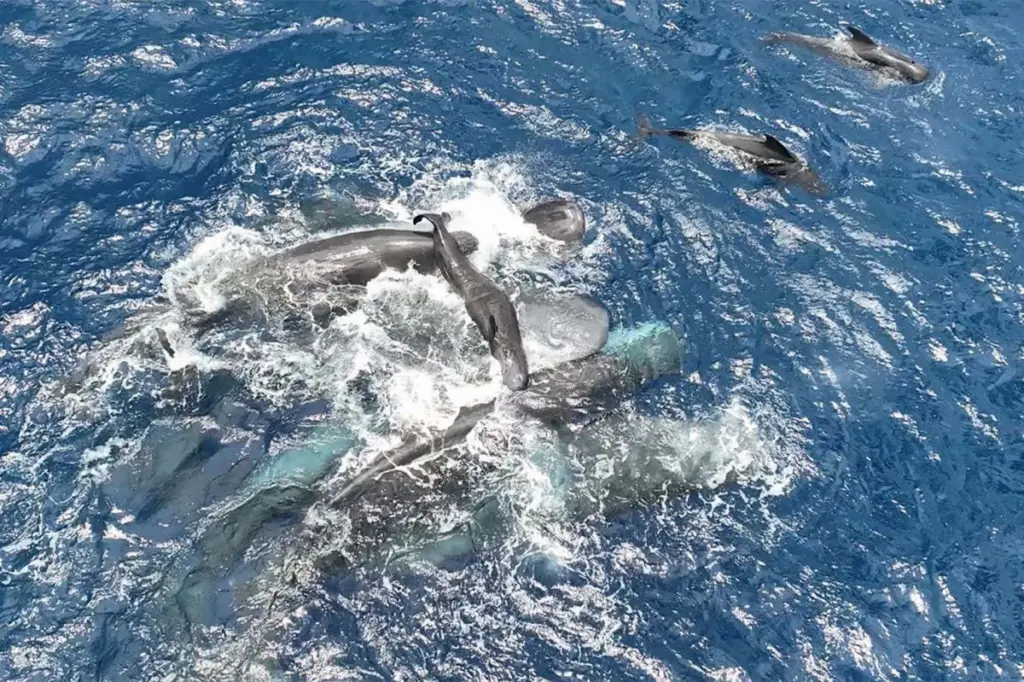
A remarkable event involving a sperm whale giving birth has been observed, with ten other females from her social unit providing assistance. This marks the first documented instance of such complex cooperative birthing behavior in species other than primates.
In July 2023, scientists engaged in long-term monitoring of a sperm whale pod in the Caribbean since 2005 encountered a noteworthy gathering. All eleven females within the observed group converged near the ocean’s surface. Researchers, fortuitously equipped with drones at the time, were able to capture video and audio recordings of the unfolding event.
Shortly after the females clustered, the distinctive flukes of a calf began to emerge from its mother. The birthing process spanned approximately thirty minutes. During this period, the other female whales exhibited coordinated movements, forming a highly synchronized defensive formation to safeguard both the mother and her newborn.
Immediately following the calf’s birth, the surrounding female whales meticulously maintained their positions. They actively took turns ensuring the newborn remained elevated at the surface, thereby facilitating its ability to breathe and allowing its flukes adequate time to fully unfurl. Newborn sperm whales, initially lacking sufficient buoyancy, cannot remain afloat independently. This vital assistance is believed to be critical for preventing young calves from drowning during their first few hours of life.
“This represents the inaugural evidence of birth assistance observed in non-primate species,” stated Shane Gero, a team member with Project CETI in New York. He further noted that such sophisticated social behavior was previously thought to be exclusive to humans, with only recent observations extending to non-human primates.
Gero elaborated on the social structure of sperm whales, describing it as being “driven by strong female leadership in which knowledge is shared across generations of females.” He expressed fascination with witnessing the “intergenerational support from the grandmother to her labouring daughter, and the support from the other, unrelated females.”
The arrival of short-finned pilot whales approximately 18 minutes post-birth elicited clear defensive reactions from the adult female sperm whales. According to Giovanni Petri from Northeastern University London, another team member, the sperm whales consistently positioned at least one adult between the newborn and the approaching pilot whales, even from below. Reports indicate that the adult females engaged in behaviors such as opening their jaws and jerking their heads towards the pilot whales. In one notable instance, a pilot whale forcefully rammed the nose of the adult female closest to the newborn. The sperm whales also altered their direction of movement when pilot whales swam directly in front of their group.
Underwater audio recording equipment had been deployed by the researchers as part of a separate study to monitor the vocalizations of the sperm whales. Petri reported striking findings from the acoustic data, noting “statistically significant shifts in the overall vocal style at key moments: the onset of labour and the first interactions with pilot whales.” These vocal pattern changes were significantly more pronounced than the normal variations observed during the unit’s regular social interactions, returning to baseline levels once the critical period surrounding the birth had concluded.
The integration of acoustic data with direct behavioral observations allowed the researchers to establish a clearer understanding of the connection between the animals’ actions and their vocal communications. While the sex of the calf remains undetermined, the research team expressed hope for future field sightings within the coming months, which would allow for the calf to be named. The survival of the calf through its first year, a period with very high mortality rates for young sperm whales, is considered a positive indicator.