
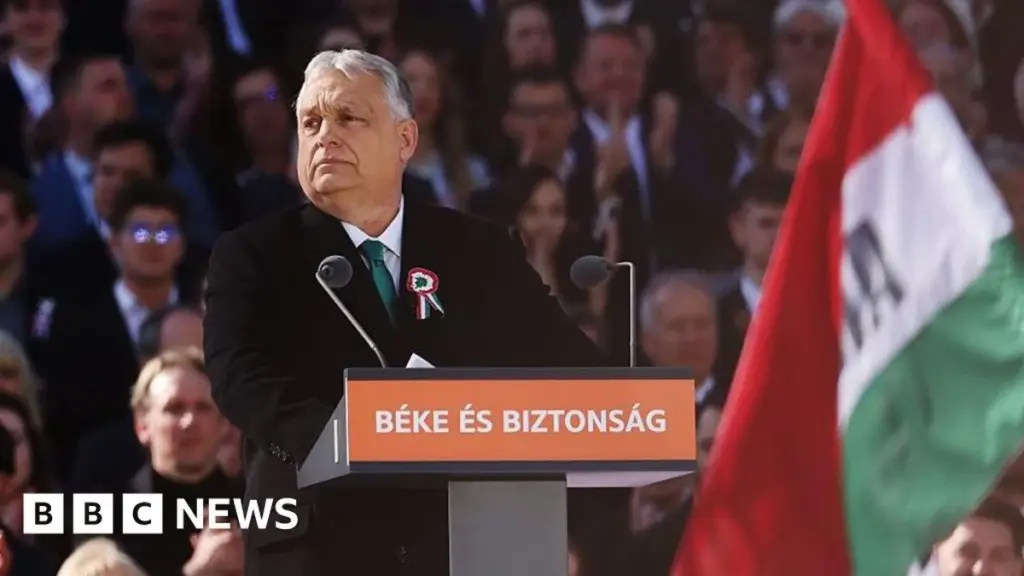
Viktor Orban’s Fidesz government in Hungary faces accusations of widespread voter intimidation. These allegations surfaced in a documentary film released on Thursday, just weeks before the April 12th parliamentary elections. Current opinion polls indicate the ruling party is trailing behind its opposition.
The documentary, titled “The Price of the Vote,” premiered on Thursday evening at a cinema in Budapest and was also made available on YouTube. It details the findings of an extensive six-month investigation conducted by independent filmmakers and journalists.
Within the film, testimonies from voters, local mayors, former election officials, and a police officer detail how substantial sums of money and even illicit drugs are reportedly offered to coerce individuals into voting for Fidesz. The documentary further alleges that these tactics target fifty-three of Hungary’s 106 individual electoral districts, potentially affecting up to 600,000 voters. This figure represents approximately 10% of the anticipated six million projected voters.
Following sixteen years of Fidesz governance under Orban, recent polling data suggests the party is indeed losing ground. Peter Magyar’s center-right opposition party, Tisza, appears to be leading by a margin at least as significant as the number of voters allegedly targeted by these practices.
The film specifically highlights rural areas and smaller towns as the focus of these alleged intimidation efforts. These communities have increasingly fallen under Fidesz’s sway since 2010. The documentary paints a picture of rural Hungary characterized by a collection of impoverished villages, many of which are home to the country’s substantial Roma minority.
Mechanisms of Influence and Alleged Coercion
Statements made within the film claim that local mayors wield considerable power over the daily lives of residents. This influence reportedly extends to providing employment, firewood, transportation to polling stations, and, in at least one documented instance, access to necessary medicine. These provisions are allegedly offered in direct exchange for casting a vote in favor of the ruling party on election day.
The BBC has reportedly contacted various government ministers, along with the communications departments for the government, the interior ministry, and the national police force, seeking reactions to these claims. To date, the only official response has come from Tibor Navracsics, the Minister for Public Administration and Regional Development, who is generally regarded as a more moderate figure within the government.
Navracsics stated, “If there is any wrongdoing, just let the ministry of interior do its job.” He declined to provide specific comments on the allegations presented in the documentary.
Earlier this year, in January, Viktor Orban addressed a large gathering of local mayors and town councillors in Budapest. During his speech, Orban reportedly stated, “Mayors, ladies and gentlemen, the situation is the following: this election must be won by you.” He further emphasized the critical role of their engagement, saying, “The 2026 election will be decided by whether you get involved. If you do, we’ll win; if you don’t, we won’t.”
The documentary juxtaposes these remarks from Orban with interviews featuring approximately twenty individuals from fourteen of Hungary’s nineteen counties. These testimonies span from the southern regions of the country to the northeast.
Filmmakers’ Conclusions and Witness Accounts
The extensive reach of these alleged practices, coupled with the striking similarity of the accounts from villages situated hundreds of kilometers apart, led the filmmakers to conclude that the operations are centrally planned by senior Fidesz officials. Aron Timar, one of the documentary’s creators, spoke with the BBC, explaining their evolving understanding: “In the beginning, we thought the key piece of this process is vote-buying. But then we realised that the money is just the icing on the cake. The key word here is dependency and vulnerability.”
One interviewee, a serving police officer whose identity is concealed in the film through voice and facial distortion, described the scale of the operation: “The money comes in on a pretty serious scale, and with quite a large entourage.” This officer expressed disillusionment, stating, “I didn’t become a police officer to serve a corrupt system. To help cover things up.”
In one specific village, the local Fidesz mayor also serves as the district doctor for an area encompassing thirty-two settlements. Residents interviewed for the film claim they fear they will be denied necessary prescriptions if they do not vote for the ruling party. Allegations also suggest that firewood is distributed exclusively to those who vote for Fidesz.
Another account details a situation where a former local candidate withdrew his bid for elected office. This decision, he claims, followed alleged threats from child protection services to remove his children from his care. He asserts that authorities did not want him competing against the Fidesz party’s preferred candidate. Following the film crew’s visit to one village, the police reportedly visited the hotel where they were staying, inquiring about the guest list.
Filmmaker Timar clarified to the BBC that their concerns are not with the police force in general: “We believe that most of the policemen in the country are fair people. So this is not about the police force. This is more about the political influence on the police.”
Financial and Material Incentives
For voters reportedly offered money, the typical sum mentioned ranges from 50,000 to 60,000 forints (approximately £110-£133). This is described as a considerable amount in communities where child benefit payments are only £26-£43 per child per month. However, the filmmakers emphasize that the practices described extend beyond simple vote-buying.
In some of the villages cited in the documentary, Fidesz has historically recorded extremely high voting percentages, ranging from 80% to 100% in previous elections. The film outlines various alleged practices, including the provision of cars and minibuses on election day. It also details claims of voters feigning illiteracy to enlist a “companion” in the voting booth, voters submitting photographic proof of their ballot for Fidesz, and other forms of “chain voting.”
While allegations of vote buying have surfaced in Hungarian elections before, they were reportedly on a much smaller, localized scale and did not claim to have a significant impact on election outcomes. A substantial portion of Hungary’s estimated 800,000 Roma minority lives in significant poverty. Data from Hungary’s state-supported Maltese charity indicates that 270,000 of them reside in the 300 poorest settlements across the country.
The Role of Drugs in Alleged Vote Coercion
Among the most serious allegations presented by several individuals in the film is the purported use of “crack” or “smoky” – a cheap and highly addictive synthetic drug prevalent in impoverished villages – in exchange for votes. Hungary, under the Fidesz government, has enacted some of Europe’s most stringent drug criminalization laws.
Police reports suggest a growing epidemic of drug use in disadvantaged settlements. A single dose, typically heated in aluminum foil and inhaled, costs approximately 1,500 forints, a little over £3. The Hungarian police established the Delta program in March 2025 to combat the crack epidemic, though critics argue its effectiveness is limited. One character in the film described an incident: “They arrested 12 people; 10 were released; one was held for 24 hours.”
Election Campaign Amidst Allegations of Interference
The film’s release comes with less than three weeks remaining before Hungarians head to the polls. The election campaign has been overshadowed by almost daily claims of both domestic and foreign plots aimed at undermining a fair vote.
Fidesz officials, including the prime minister, have alleged interference from both the European Union and Ukraine, suggesting these entities are attempting to prevent a fifth consecutive victory for Orban. Conversely, independent media outlets and the opposition Tisza party have pointed to alleged Russian involvement in support of Orban, who is widely perceived as Vladimir Putin’s closest ally within the European Union.
The Washington Post recently reported on an alleged proposal from Russia’s SVR Foreign Intelligence Service to stage a staged assassination attempt against Orban. The publication also presented evidence suggesting that Hungarian Foreign Minister Peter Szijjarto had been providing his Russian counterpart, Sergey Lavrov, with ongoing updates on discussions held behind closed doors at European Council summits.
Following these reports, Poland’s prime minister, Donald Tusk, revealed that Lithuania had previously requested the exclusion of a Hungarian delegation from a NATO meeting due to concerns about information potentially being leaked to Russia. Szijjarto initially dismissed the Russia-related allegations as fake news but later defended such consultations as “perfectly natural,” stating, “I consult with the Turks, the Serbs, and the Russian foreign minister. If necessary, I consult with the Chinese, the Africans, and the south-east Asians in order to establish co-operation that serves Hungary’s interests as much as possible.” He further asserted, “We will not abandon the national interest, even if there is very crude foreign intelligence interference in the Hungarian elections with the participation of Brussels.”
Divergent Polls and Election Prospects
Rival polling organizations present contrasting outlooks for the upcoming election. On Wednesday, the Median agency reported a lead for Tisza, with 58% of support compared to Fidesz’s 35%. In contrast, the government-funded Nézöpont agency placed Fidesz ahead, with a margin of 46% to Tisza’s 40%.