
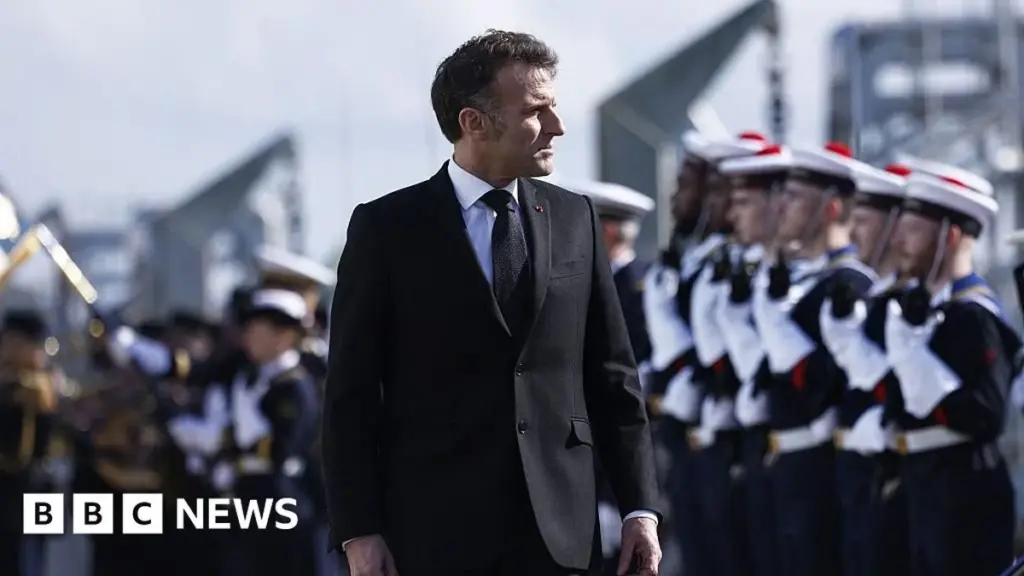
France is undertaking a significant shift in its nuclear defense policy, intending to bolster its nuclear arsenal and expand its deterrent capabilities to encompass other European nations. This move represents a major development in the country’s strategic approach to defense.
During a recent address in Brittany, President Emmanuel Macron articulated these changes, framing them as a necessary response to an increasingly volatile global strategic environment. He posited that the coming half-century would be characterized by the prominence of nuclear weapons.
Speaking to naval personnel at the Ile Longue base, near Brest, in the presence of a nuclear submarine, Macron announced that the number of French nuclear warheads would see an increase from the current approximate figure of 300. He also revealed plans for the introduction of a new nuclear-armed submarine, christened “The Invincible,” slated for launch in 2036.
“Advanced Deterrence” Strategy Unveiled
Eight other European countries—the United Kingdom, Germany, Poland, the Netherlands, Belgium, Greece, Sweden, and Denmark—have reportedly agreed to participate in a new strategic initiative termed “advanced deterrence.” Polish Prime Minister Donald Tusk acknowledged this development via X, stating that such armament efforts among allies aim to deter potential aggression.
Under this framework, these eight nations are expected to engage in exercises involving France’s air-launched nuclear capability, known as the “force de frappe.” They may also offer hosting capabilities for French nuclear bomber bases. Macron explained that this arrangement would facilitate a broader “spread” of France’s Strategic Air Forces (FAS) across the European continent, thereby complicating strategic calculations for potential adversaries.
Furthermore, France’s partners are set to contribute to the development of “auxiliary” capabilities aligned with this new nuclear doctrine. These include space-based early warning systems, air defense mechanisms for intercepting drones and missiles, and long-range missile technology.
Continuity and Key Principles of Deterrence
While described by officials as the most substantial evolution in French strategic thought since 1960, this “advanced deterrence” strategy largely preserves the foundational principles established by the late President Charles de Gaulle. Notably, partner nations will not receive an explicit “guarantee” of protection. The ultimate authority for decisions regarding the use of nuclear missiles will remain solely with the French President.
The overarching objective continues to be the dissuasion of potential aggressors by demonstrating that any attack on France would incur an “unsustainable price.” Previously, France maintained a degree of ambiguity regarding what constituted its “vital interests,” an attack on which would warrant a nuclear response.
In recent years, French governments have alluded to the possibility that these “vital interests” could extend to those within Europe. Macron’s “advanced deterrence” initiative further solidifies this concept, albeit within the established tenets of deterrence where explicit pronouncements are avoided.
Adhering to a parallel principle, Macron announced that France will cease public communication regarding the exact number of nuclear warheads it possesses. This aligns with a long-standing cooperative agreement France holds with the United Kingdom, Europe’s other nuclear power. Recent exercises by France’s FAS have included participation from UK officials for the first time.
Bilateral Cooperation with Germany
Following Macron’s address, France and Germany jointly announced their intention to pursue “closer cooperation” in the realm of nuclear deterrence. According to a joint statement signed by Macron and German Chancellor Friedrich Merz, the initial steps this year will involve German participation in French nuclear exercises and collaborative development of conventional capabilities with European partners. This cooperation is explicitly stated to complement, rather than supersede, NATO’s existing nuclear deterrent.