
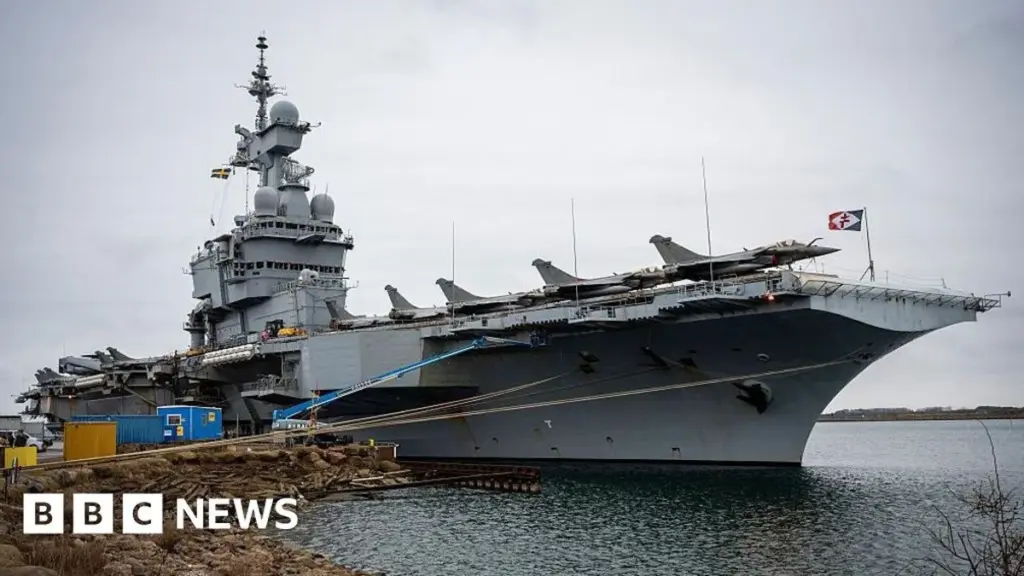
The Swedish military jammed a drone that was observed near the French aircraft carrier Charles de Gaulle while it was docked in Malmo. Sweden’s defence minister, Pål Jonson, stated that the drone was “probably” Russian in origin.
French military officials indicated the drone was sighted approximately seven nautical miles, or 13 kilometers, from the Charles de Gaulle. This marks the carrier’s first visit to Sweden, and it is scheduled to participate in upcoming NATO exercises in the region.
Speaking with public broadcaster SVT, Jonson suggested there was likely a significant connection between the drone and a Russian naval vessel present within Sweden’s territorial waters in the Öresund Strait, the waterway separating Sweden and Denmark. The exact fate of the drone remains unclear. Jonson mentioned that the Russian ship proceeded into the Baltic Sea.
In recent months, NATO allies have reported numerous drone sightings in proximity to military installations and airports. These incidents have included events in Denmark and the Baltic states.
An investigation was initiated in December following drone flights observed over Île Longue, a naval base near Brest in Brittany that houses France’s fleet of nuclear ballistic missile submarines.
Both military forces have sought to downplay the significance of the drone incident. Colonel Guillaume Vernet, a spokesperson for the French General Staff, commented that the event highlighted the effectiveness of the Swedish response. He also confirmed that the incident had no detrimental effect on the French mission.
France’s foreign minister was scheduled to visit Sweden on Friday, and its armed forces minister was expected to board the Charles de Gaulle in Malmo. It is not yet confirmed whether these visits were connected to the drone incident that occurred earlier in the week.
General Dominique Trinquand, a former French military commander with experience at the UN, remarked that if the drone was indeed Russian, then Moscow’s engagement in intelligence activities in the area would not be surprising. He told French media that Russia conducting such operations while the French aircraft carrier was deployed there represented a clear strategic signal.
The Charles de Gaulle is equipped with its own naval escort and carries Rafale fighter jets and reconnaissance aircraft. However, when operating within a host nation’s territorial waters, it relies on that nation for defensive support.
The arrival of the carrier strike group in Sweden signifies a shift in France’s military strategic focus towards its NATO partners in Northern Europe.
As part of an operation named La Fayette 26, the Charles de Gaulle will participate in several prearranged NATO exercises. These are planned to take place in the Baltic Sea and off the coast of Norway in the Atlantic Ocean.
This deployment is being viewed as a strategic response to Russia, following a sustained period of what has been termed Russian hybrid warfare.
Separately, the Swedish coast guard has launched an investigation into a fuel spill that occurred in the port of Malmo. Two oil tankers are docked in the same port as the Charles de Gaulle. The spill was detected on Thursday, and while its precise cause is unknown, port authorities have informed Swedish media that it is not linked to the aircraft carrier.