
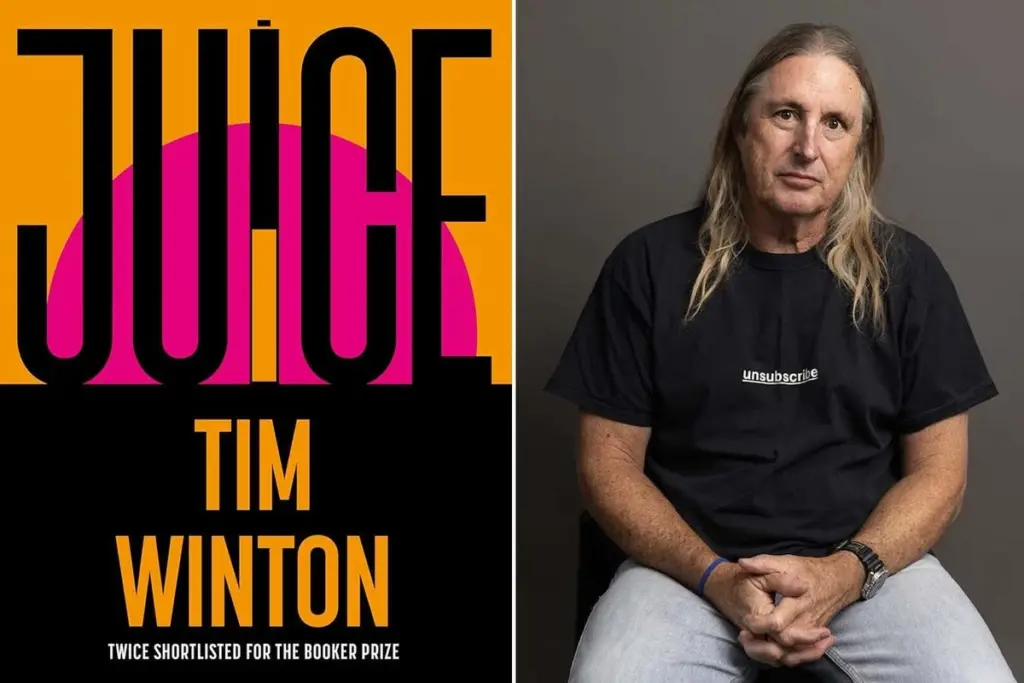
The New Scientist Book Club has recently delved into narratives that explore significant societal transformations. Following January’s discussion of Sierra Greer’s “Annie Bot,” which examined the emancipation of a sex robot, the club shifted its focus in February to Tim Winton’s “Juice.” This novel presents a stark vision of Australia many generations into the future, grappling with extreme environmental conditions.
Winton’s narrative is driven by an unnamed protagonist recounting his life within a severely overheated world. Through his story, readers gradually understand the nature of his compulsory work: enacting retribution against the descendants of those responsible for the planet’s climate crisis. The story also details the harsh realities of survival in such a future.
Initial reactions to “Juice” were largely positive, with many members finding the book exceptionally well-written, compelling, and at times, terrifying. Glen Johnson remarked on Winton’s skill in depicting adaptations to a familiar climate zone, noting how natural these seemed despite their divergence from current practices, likening them to the resourcefulness of rural Australians. Victor Churchill found the novel “absolutely compelling,” appreciating its ability to maintain a sense of positivity amidst significant adversity. He noted that the deliberate pace at which the protagonist’s situation unfolds creates impactful revelations for the reader.
Kim Woodhams Crawford also expressed strong approval, believing the novel accurately reflects the potential for climate disaster, emphasizing that such a future remains a possibility regardless of political viewpoints, particularly given recent extreme temperatures in Australia.
However, not all readers were immediately captivated. Linda Jones mentioned struggling with the initial 18 pages, admitting she almost abandoned the book but found it significantly improved once the narrator’s backstory began. Phil Gurski echoed this sentiment, describing the start as “very slow.”
The narrative style itself sparked varied opinions. Some appreciated the perspective of the imprisoned protagonist telling his life story, finding it imbued with a “magic realism-like vibe,” as described by Gosia Furmanik. Others questioned the plausibility of sharing such a detailed life history within a dystopian future setting. Jacqueline Ferrand wondered if a stranger would indeed be interested in hearing the entirety of another’s past. Steve Swan humorously suggested he would have lost patience, and perhaps taken more drastic action, than the character tasked with listening.
A significant point of discussion was the classification of “Juice” as dystopian. Tim Winton himself contributed to this debate in an essay, suggesting that the term “dystopia” can sometimes act as a “softener,” creating a sense of distance that is no longer affordable. Members engaged deeply with this concept. Victor Churchill argued the novel was “post-dystopian,” where inhabitants have adapted to their world and are moving forward, rather than being in a state of ongoing catastrophe or under autocratic rule. Margaret Buchanan suggested that definitive judgment would require further generational observation, while current Australian temperatures might indicate otherwise.
Niall Leighton, however, firmly maintained that the novel is set in a dystopia, posing the question of whether living in dystopian conditions equates to living in a dystopia. He further questioned the utility of dystopian visions, quoting Shevek on the need for imagination and revolution. Leighton posited that instead of more warnings, humanity requires stories that “focus on a place we can hope to build,” advocating for narratives that depict societies free of discrimination and hierarchy.
Gosia Furmanik raised concerns about the plot’s plausibility, questioning the decision to prioritize retribution against descendants of fossil fuel oligarchs over public education or environmental regeneration. She felt the motiviation for vengeance ultimately proved pointless as the climate continued to degrade.
Regarding the novel’s conclusion, the reviewer found a “drop of hope” and an open ending to be personally satisfying. Samantha de Vaux expressed a similar view, stating her acceptance of the ending as belonging to the author and his characters, appreciating how the challenging book engaged her on a visceral level.
As the book club transitions to its March selection, “Juice” will be set aside. The upcoming read is Daisy Fancourt’s non-fiction work, “Art Cure: The Science of How the Arts Transform Our Health.” Fancourt, a professor of psychobiology and epidemiology, explores the arts as a vital component of well-being, equating them to a “forgotten fifth pillar of health.” Members are invited to join discussions, with an essay by Fancourt and a book extract providing a preview of its themes.