
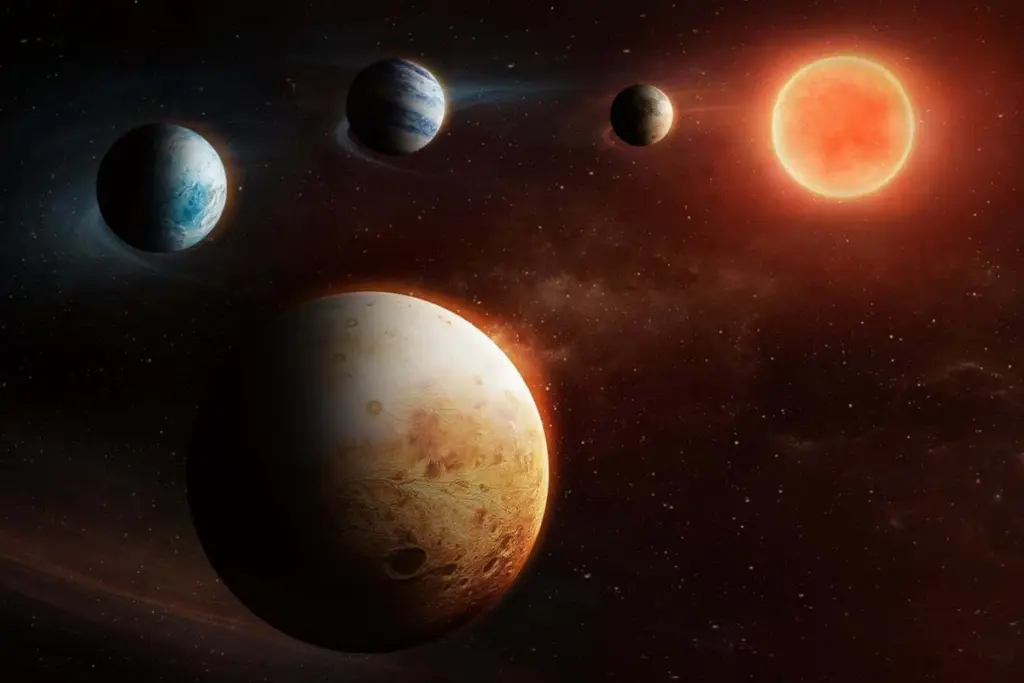
Astronomers have identified a planetary system that appears to have formed in an unconventional “inside-out” manner. Unlike typical systems, such as our own solar system, where rocky planets are found closer to the star and gaseous giants are situated further away, the LHS 1903 system features a rocky planet at its outer edge. This discovery challenges prevailing theories regarding planet formation.
The most distant of the four planets within the LHS 1903 system was not immediately detected in initial data from the Transiting Exoplanet Survey Satellite (TESS). These initial observations had identified one rocky planet, slightly larger than Earth, located in close proximity to the star, followed by two gaseous planets, somewhat smaller than Neptune, in more distant orbits. However, subsequent investigations led by Ryan Cloutier at McMaster University in Hamilton, Canada, utilizing eight additional observatories, revealed the distinct signals of a fourth world. This newly identified planet, also rocky, is marginally larger than the system’s other rocky planet.
The presence of this rocky world, situated farther from the star than its gaseous counterparts, was unexpected. “These systems are not unheard-of,” Cloutier stated, “but they’re rare. The systems that possess this unique architecture and can be characterized in detail are extraordinarily uncommon.”
The specific characteristics of these planets, including their sizes and the fact that all four orbit their star in periods less than 30 Earth days, enabled researchers to rigorously test models of planetary formation. “Producing a single planet can be achieved through various mechanisms, but when you need to account for four different ones, you can begin to distinguish between different models,” explained Solène Ulmer-Moll from Leiden University in the Netherlands. “You must find a model that can explain all of them simultaneously.”
Current understanding suggests that most planetary systems form their planets concurrently from a single disc of dust and gas. The size and composition of these planets are determined by their formation location within this disc and subsequent events, such as collisions with other celestial bodies. For the LHS 1903 system, however, this standard model appears insufficient.
If the planets in LHS 1903 had formed through conventional processes, the outermost planet would have been expected to possess a substantial gaseous envelope, similar to the two inner gas giants. While this atmosphere could theoretically have been lost through a collision or radiation bombardment, the simulations conducted by the research team indicate that such a process would have also stripped gas from at least one, if not both, of the inner planets. “It is remarkably difficult to sculpt the outermost planet without affecting those gaseous planets that orbit closer to the star,” Cloutier commented. However, the orbital configuration of the system makes it highly improbable that any of its planets did not originate from the same protoplanetary disc.
Cloutier and his team concluded that the most plausible explanation for the formation of this system involves a process known as “inside-out” planet formation. In this scenario, a single planet initially forms and then migrates inward toward the star, creating space for the subsequent formation of another planet, and so on. This migration process requires significant time, leading to the planets forming in progressively different environments as the protoplanetary disc evolves. “The final planet, if enough time has elapsed, forms in an environment where no gas is available,” Cloutier elaborated. He added that this system demonstrates the considerable diversity inherent in planetary formation processes across the universe.
Journal reference: Science DOI: 10.1126/science.adl2348