
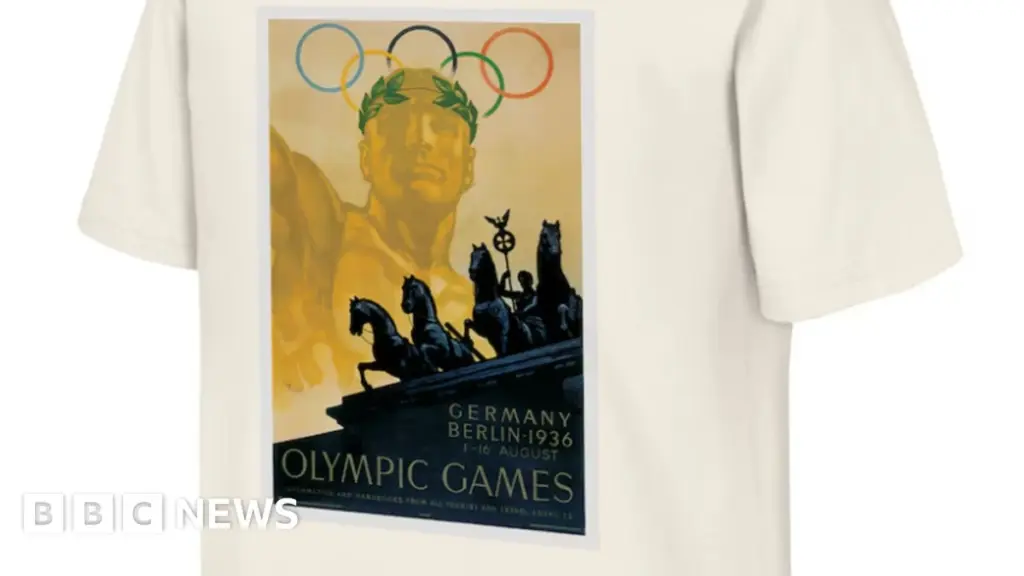
The official online merchandise store for the Olympic Games has drawn criticism for selling T-shirts featuring designs from the 1936 Berlin Olympics. These Games were notably utilized by Adolf Hitler and the Nazi regime for propaganda purposes.
In Germany, calls have emerged for the discontinuation of these sales. However, the International Olympic Committee (IOC) has defended its decision, classifying the items as part of its “Heritage Collection.” This collection aims to celebrate design styles from across all Olympic Games editions.
The T-shirts in question showcase the original poster design for the Berlin Olympics, created by Franz Würbel. At the time of reporting, these specific items were out of stock.
Historical Context of the 1936 Games
The 1936 Olympic Games in Berlin were exploited by Hitler as a platform to promote his ideology of racial superiority and to showcase Nazi Germany on an international stage. The Berlin T-shirt design includes a male figure adorned with a laurel wreath, with the Olympic rings positioned above him. Below the figure, the Brandenburg Gate is depicted alongside the inscription “Germany Berlin 1936 Olympic Games.”
Klara Schedlich, spokesperson for sports policy for the Green Party faction in the Berlin House of Representatives, communicated to the German press agency, DPA, that “The 1936 Olympic Games were a central propaganda tool of the Nazi regime.” She further stated that the IOC appeared to be “clearly not reflecting sufficiently on its own history.” Schedlich described the image choice as “problematic and unsuitable for a T-shirt” when presented without adequate context.
IOC’s Defense and Art Collection Perspective
In response to the controversy, an IOC spokesperson informed the BBC that while the committee “of course acknowledge[s] the historical issues of Nazi propaganda,” it also wished to emphasize that the 1936 Berlin Games were a venue where “4,483 athletes from 49 countries compete in 149 medal events.”
The spokesperson elaborated on the “Olympic Heritage Collection” initiative, explaining it was made available to the public to celebrate “130 years of Olympic art and design.” This series features emblems, pictograms, posters, and mascots drawn from all Olympic Games editions. The IOC highlighted that many participants in these Games achieved astounding athletic feats, referencing Jesse Owens.
Jesse Owens, an African-American track and field athlete, achieved significant success at the 1936 Games, winning four gold medals. His victories notably challenged the Nazi narrative of Aryan racial supremacy.
The IOC representative also noted that the historical context of the Berlin Games is provided at the Olympic Museum located in Lausanne. Production and sale numbers for the 1936 T-shirts were indicated as limited.