
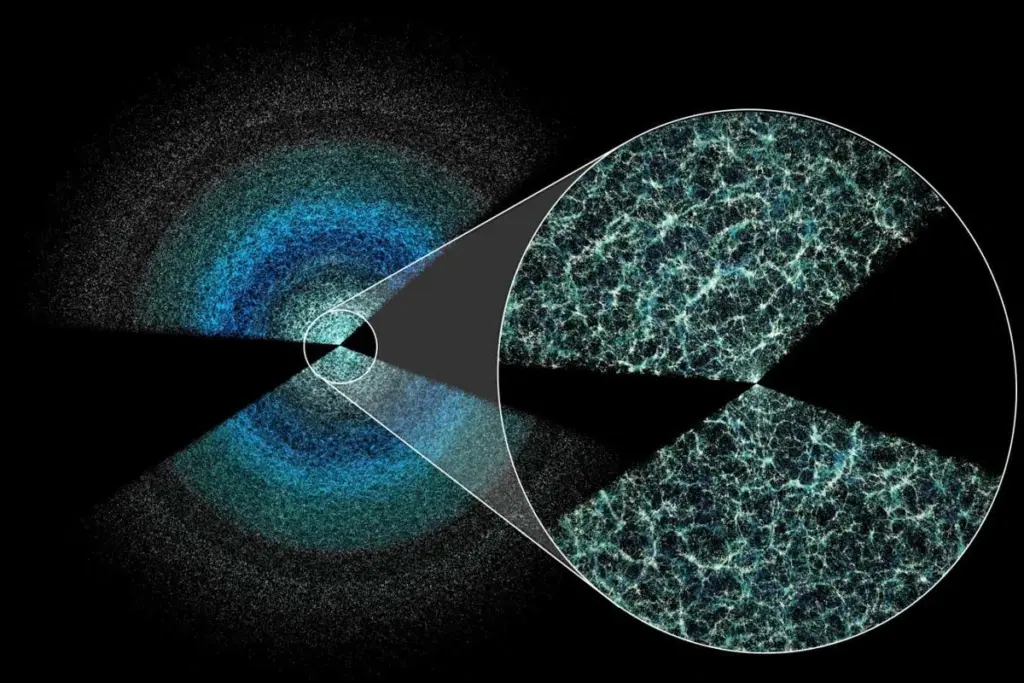
A five-year astronomical survey has concluded, having meticulously cataloged over 47 million galaxies and quasars. This extensive data collection effort has enabled researchers to finalize the most intricate map of the universe ever created. The gathered information holds the potential to shed light on the puzzling phenomenon of dark energy’s apparent weakening, a discovery that could fundamentally challenge our current understanding of the cosmos.
The Dark Energy Spectroscopic Instrument (DESI), situated at the Kitt Peak National Observatory in Arizona, has been actively observing the night sky since 2021. Initially, the project anticipated collecting data on approximately 34 million galaxies and quasars. However, DESI’s exceptional efficiency surpassed these expectations. Due to the immense distances involved, some of these exceedingly faint galaxies were detected through the observation of as few as 100 or 200 photons.
David Schlegel from the Lawrence Berkeley National Laboratory in California highlighted the transformative impact of this new dataset. He noted that previous maps of the universe collectively documented around 5 million galaxies, meaning the DESI survey expands our cosmic knowledge by a factor of nearly ten. “We have been on this trajectory for my entire career,” Schlegel explained, “where, every decade, we create maps ten times larger. This leads to the question of when we will have mapped every observable galaxy within 10 billion light-years. If this trend continues, we anticipate reaching that milestone by 2061.”
While the main observational phase of the survey is now complete, the analysis of the vast quantity of data will require another year before it becomes accessible to the scientific community. The project is slated to continue collecting data for at least an additional two and a half years. There are also aspirations to upgrade DESI, potentially enabling its operation well into the 2030s. Schlegel emphasized DESI’s continued status as the world’s leading instrument of its kind.
DESI’s current map encompasses 14,000 square degrees of the celestial sphere, with the team aiming to extend this coverage to 17,000 square degrees. The entirety of the observable sky measures over 41,000 square degrees. However, a significant portion remains challenging to study due to the presence of bright and relatively close celestial objects, such as our own Milky Way galaxy.
The collected data will empower scientists to conduct detailed comparisons of galaxy distribution across different epochs, from the distant past to the present day. This comparative analysis is expected to yield crucial insights into the behavior of dark energy, which accounts for approximately 70 percent of the universe’s total mass-energy content. Preliminary data released by DESI in 2024 indicated that dark energy might be weakening over time, a departure from the assumption of its constancy.
A confirmed weakening of dark energy would carry profound implications for the standard cosmological model, known as lambda-CDM. The comprehensive DESI dataset promises to facilitate a more thorough investigation into this potentially universe-altering phenomenon. Dr. Ofer Lahav of University College London recalled the stark contrast between current data availability and his early career. “When I was a PhD student in Cambridge, 40 years ago,” he stated, “we had a sample of thousands of galaxies. The community was desperate for data. I believe my students today likely face the opposite challenge: being inundated with data, making its analysis exceptionally demanding.”
The sheer volume of data available from DESI is poised to lead to significant scientific revelations concerning the universe’s fundamental nature. Lahav also suggested that the survey might have captured unusual, singular cosmological events that will fuel exciting lines of research.