
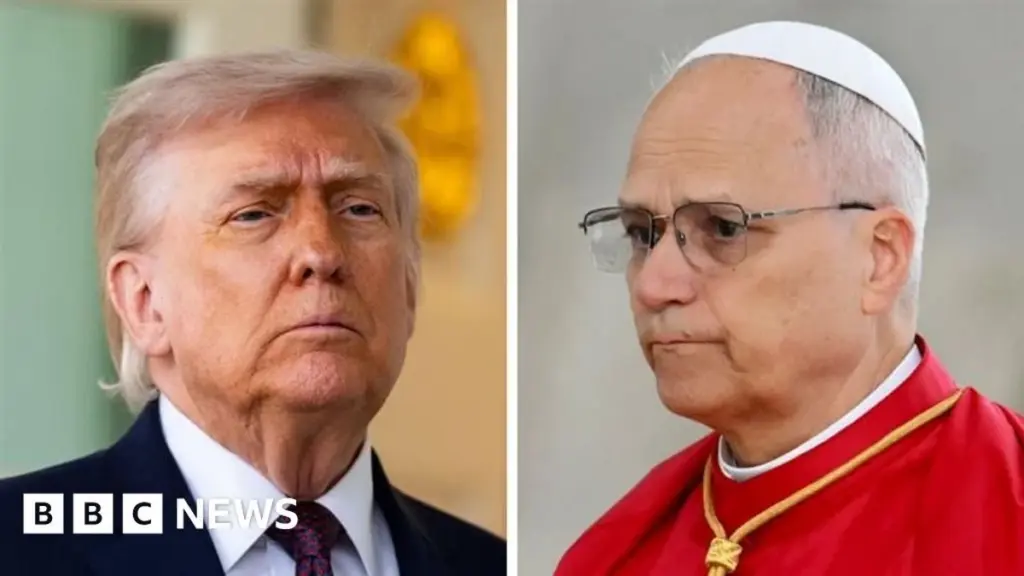
President Trump has frequently encountered criticism from Catholic leadership. His strict immigration policies, central to his campaign rhetoric and applauded by his base, have drawn sharp disapproval from various church figures. This has, for some time, placed the upper echelons of the US Catholic Church at odds with numerous rank-and-file Catholics who lean more conservatively.
However, the significant backlash observed over the past 48 hours, stemming from Trump’s sharp criticism of Pope Leo and his dissemination of an AI-generated image depicting him in a Christ-like manner, signifies a notable departure from previous dynamics.
The source of some of this criticism is particularly striking, originating from individuals and groups who have been steadfast, conservative Catholic allies. Their discontent extends beyond Trump’s public disagreements with Pope Leo. A more profound issue, the war in Iran, is at the heart of their unease.
The strong reaction to Trump’s extensive social media broadside against the first American pontiff—whom Trump characterized as overly liberal and too “weak on crime”—coupled with the AI image, has crystallized a significant shift in the perspective of many Catholic conservatives since the conflict’s commencement six weeks prior.
A Bishop’s Unwavering Stance Amid Shifting Allegiances
“I pray that all of this will clarify for people that we don’t look to a national leader, we don’t look to those who have the most money or the most weapons. We look to Christ,” stated Bishop Joseph Strickland. These are indeed powerful words from a man who, as recently as last year, participated in a prayer event to “consecrate” the president’s Mar-a-Lago residence.
In 2024, Strickland delivered the keynote speech at CPAC, an event where Donald Trump was the guest of honor. Furthermore, in 2020, he addressed a march organized by Trump supporters advocating for the reversal of election results. His consistent and staunch support for Donald Trump through various challenges is well-documented. In fact, his overt political alignment and his public confrontations with the late Pope Francis were factors contributing to his removal from his position as Bishop of Tyler, Texas.
Yet, in the context of starkly diverging narratives from the White House and the Vatican concerning the war in Iran and the broader Middle East, Bishop Strickland has made a rare departure from supporting the current administration. He articulated to the BBC, “I do not believe this conflict meets the criteria of a just war. I stand with the Holy Father and his call for peace. This is not about politics. It’s about moral truth.” Bishop Strickland explained that the sheer scale of death and suffering endured by innocent civilians meant the war could never be considered “just.”
Beyond this, he has actively challenged the White House’s approach to the conflict and has encouraged other Catholics to voice their dissent. Bishop Strickland stated, “It becomes very dark when religion is used to justify immoral behaviour… using religion to justify especially dropping bombs is contradicting what the faith is about.”
When questioned about Trump’s attack on Pope Leo and the image some have termed “AI Jesus”—an image Trump claimed he believed depicted a doctor, not Jesus—Bishop Strickland conveyed his “duty” to remind the US president of the Gospel of Matthew. He referenced a passage emphasizing that supreme authority rests with Christ, not with any earthly leader. “When world leaders forget this truth, all are in peril,” he warned.
Political Ramifications and Evolving Catholic Demographics
This evolution in the perspective of conservative Catholics towards the US president carries political risks, especially considering his increased support among this demographic during the 2024 election. The landscape remains complex, according to research from the Pew Research Center. Racial background played a significant role, with 62% of White Catholics casting votes for Donald Trump and 37% for Kamala Harris, while 41% of Hispanic Catholics voted for Trump and 58% for Harris.
This still indicated a general trend towards the Republican Party among Catholics as a whole, but it was marked by pronounced divisions. Historically, data suggests that for many American Catholics, political outlook holds greater sway than religious affiliation. They are largely divided along party lines, noted Greg Smith, Senior Associate Director of Religion Research at Pew Research Center.
American Catholics comprise constituencies with deeply polarized views on issues such as abortion and immigration. This context makes a unified stance among Catholics across the left and right, particularly regarding the war in Iran, a rarity. Their perceptions of the head of the Catholic Church further illustrate this division. Pope Francis garnered considerably more support among Catholic Democrats than among Catholic Republicans, whereas Pope Leo enjoys high approval from both groups, according to Pew.
Pope Francis was often perceived as a spontaneously progressive figure whose actions occasionally alienated Catholic traditionalists. This included, for instance, his restrictions on the Latin Mass, a policy Pope Leo has since eased.
Critique of Papal Authority and Shifting Political Alignments
“The Pope is not above a certain level of criticism,” remarked Peter Wolfgang, executive director of the Family Institute of Connecticut and a prominent voice within the US Catholic “right.” He elaborated, “The Pope is the Pope; we owe him a certain amount of deference, but I don’t think that Catholicism wants the obedience of cadavers. We are living, thinking persons.”
Wolfgang has transitioned from a cautiously pragmatic Trump supporter, prioritizeing the overturning of abortion laws, to a more enthusiastic advocate. He is a strong proponent of mass deportation policies and the brand of Catholic nationalism championed by JD Vance. However, he is now highly critical of the US president’s conduct toward Pope Leo.
“President Trump does not understand how Catholicism works. The Pope is not merely a head of state; he is the Vicar of Christ. Attacks on him are received as attacks on the Church itself. The more he attacks the Pope, the more his support will drop among his Catholic voters,” Wolfgang told the BBC.
Peter Wolfgang stated that his faith compelled him to challenge US Catholic bishops when they criticized President Trump’s immigration policies. Yet, this same faith now leads him to oppose the current war. “When President Trump is out there talking about ending Iranian civilization, or Secretary Hegseth is out there making some bloodthirsty prayer that is unrecognizable to Catholics, then it’s completely natural for conservative Catholics to line up behind Pope Leo,” he said.
Shortly after the initial US and Israeli strikes on Iran, US Secretary of Defense Pete Hegseth delivered a highly controversial prayer at a Pentagon worship service invoking “overwhelming violence” and “justice executed swiftly and without remorse.”
In his writings, Peter Wolfgang typically directs his sharpest criticisms toward the Catholic “left.” However, he believes the Iran issue has, to some extent, united various factions, partly due to the clarity of the Pope’s anti-war message.
Unprecedented Clergy Stances and the “Just War” Debate
Unusually, no senior US Catholic clergy members have publicly endorsed the war in Iran. Even Robert Barron, Bishop of Winona-Rochester, a known Trump ally, called for the US president to apologize to the Pope for his angry tirade, a demand that was rejected.
Steven Greydanus, a deacon and prominent commentator positioned on the liberal wing of the Catholic Church, also observes this unusual convergence of opinions. He believes that the White House’s “subversion” of the principles of “Just War Theory”—the theological framework that dictates the permissibility and conduct of war—has been a contributing factor. However, he also attributes it partly to the contrast between President Trump and the “healing presence” of Pope Leo.
“While I am grieved by the directness of Donald Trump’s attacks on Pope Leo, in a way I welcome the clarity of the choice Catholics are being presented with,” Greydanus commented.
The Vatican has maintained its position that the events of recent weeks are not an adversarial conflict between Pope Leo and President Trump, but rather a Pope drawing upon his faith to oppose the rationale behind the war. Nevertheless, when President Trump declared that “a whole civilization would die” in Iran, the Pope did respond directly, labeling the threat “truly unacceptable.”
“There is an important difference between challenging a man and challenging the principle that makes war possible,” stated the Reverend Antonio Spadaro SJ, Undersecretary for the Vatican’s Dicastery (Ministry) for Culture and Education.
Rev. Spadaro informed the BBC that while behind-the-scenes dialogue was occurring in “places of power,” the Pope also needed to issue public declarations against the conflict to “mark the moral limit” of what constitutes acceptable conduct.
Regarding the observed convergence among US Catholics across the political spectrum in their support for Pope Leo’s anti-war messaging, Rev. Spadaro offered his perspective from Vatican City. “He does not unite everyone, of course,” he acknowledged. “But Pope Leo moves the Catholic debate away from a purely partisan track.”
Analyzing Trump’s Actions and the Pope’s Moral Authority
Questions linger regarding President Trump’s decision to post an AI image that was almost certain to alienate and offend some of his supporters. Uncharacteristically, he did retract and delete the image. Furthermore, inquiries surround the motive behind the tirade directed at Pope Leo. For some, it appeared intended to undermine the Pope’s opposition to the war.
“But in trying to delegitimize, Trump’s attack implicitly acknowledges the weight of the pope’s moral voice,” observed the Vatican’s Rev. Spadaro. “If Leo were irrelevant, he would not deserve a word. Instead, he is invoked, named, opposed—a sign that his words matter.”