
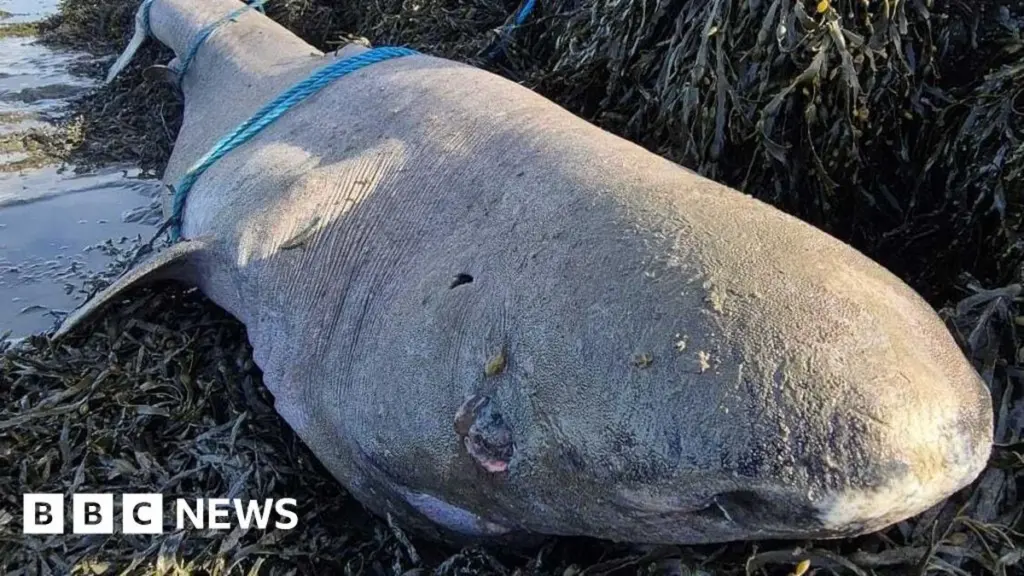
A rare deceased Greenland shark that appeared on the coast of County Sligo is anticipated to be preserved for exhibition within an Irish museum. This species, known for its exceptional longevity—exceeding 500 years, the longest documented lifespan for any vertebrate—was found on the shores of Finisklin on a recent Saturday. This marks the first recorded instance of this particular shark species stranding on Irish shores, and it is estimated to be as old as 150 years.
The Greenland shark is indigenous to the waters surrounding the Arctic and the North Atlantic regions. Its appearance on the Irish coast has been characterized as an “extremely rare” event by the Irish Whale and Dolphin Group (IWDG).
Initially, the IWDG received a report from two individuals describing a 2-meter (approximately 6 feet 6 inches) dead basking shark. However, a closer examination revealed a different species. Photographs later confirmed that it was not a basking shark but indeed a “very rare and interesting stranding,” subsequently identified as a Greenland shark.
The IWDG further elaborated on the Greenland shark’s status as the longest-living vertebrate globally, with a lifespan spanning several centuries. The oldest specimen ever recorded was documented as being “over half a millennium in age.” These sharks are substantial creatures, typically reaching lengths between 4 to 6 meters (13 to 20 feet).
Remarkably, Greenland sharks achieve sexual maturity around the age of 150, and their gestation period for pups can last between eight and 18 years. The male shark discovered in Sligo exhibited “highly developed claspers,” suggesting it was potentially close to reaching maturity.
Preservation Efforts Underway
The specimen is now under the care of the Natural History Museum of Ireland (NHMI). A spokesperson for the NHMI informed BBC News NI that the shark was located in a challenging area of the coast, requiring specialized equipment, including a crane, to be safely removed from the shore.
The NHMI plans to conduct a “detailed scientific post-mortem examination.” This procedure is intended to aid researchers in their understanding of this “elusive deep-water species.” Tissue samples and specific anatomical components are being preserved for the NHMI’s scientific collections.
Subject to the condition of its skin and its suitability for preservation, the National Museum intends to display the specimen in the future. This would provide visitors with an opportunity to learn about one of the planet’s most enigmatic shark species.