
The minute hand had barely ticked past 1:23 AM when a routine safety test shattered the quiet, unleashing a catastrophic explosion. A confluence of flawed design and insufficient safety protocols led to radioactive material being dispersed across the globe. Within a mere 48 hours, Chernobyl was tragically branded the site of the world’s most severe nuclear disaster. Forty years onward, a journey to Ukraine reveals the profound and enduring legacy of this event.
My exploration begins with Kateryna Shavanova, an academic whose research focused on radiation-consuming bacteria at Chernobyl. Her studies were interrupted when Russia’s invasion of Ukraine commenced in 2022. She now serves with the Ukrainian army’s chemical, biological, radiological, and nuclear risk team. A patch on her uniform humorously translates to “It’s not time to drink iodine yet,” a wry nod to the emergency treatment for radiation poisoning. As we seek refuge from the chill in a former family residence within the city of Chernobyl, situated fifteen kilometers south of the eponymous nuclear power plant, Shavanova candidly admits that there is no simple answer to the question of regional safety. The answer, she explains, hinges on the inquirer and their intentions.
The explosion of Chernobyl’s reactor 4 in 1986 released over one hundred distinct radioactive materials. Among the most perilous was iodine-131, readily absorbed by the human body, particularly by the thyroid gland. With a half-life just exceeding one week, this radionuclide posed a relatively short-lived threat. The danger posed by other, more persistent materials such as caesium-137 and strontium-90, each with a half-life of approximately 30 years, is also gradually diminishing.
Nevertheless, the repercussions of the Chernobyl disaster will persist for a considerable duration. The most heavily contaminated area remains reactor 4 itself. At the moment of its explosion, it contained 1900 kilograms of uranium-235 and 760 kilograms of plutonium-239. These isotopes have remarkably long half-lives, measuring 704 million years and 24,110 years, respectively. Fortunately, a significantly smaller quantity of these long-lived contaminants was released compared to the shorter-lived ones. Much of the localized radioactive debris was meticulously collected and buried. This hazardous task was undertaken at immense personal risk by an army of up to 600,000 “liquidators” who responded in the immediate aftermath of the catastrophe.
Despite years spent reporting on nuclear safety and observing hazardous materials from behind protective shielding within UK reactors, Chernobyl presents a distinct and unsettling experience. Radioactive material lies just beneath the surface of the soil. While adherence to guide instructions ensures personal safety with only a minute increase in the risk of radiation-related illness, the omnipresent potential for danger creates an underlying unease. Radiation’s intangible nature renders the risk a more abstract concept, challenging to fully apprehend. It is perhaps unsurprising that lingering radiophobia led to the disposal of my boots before returning home.
Following the disaster, the once-thriving cities of Chernobyl and the adjacent Pripyat were evacuated. Power station personnel and their families were relocated to the newly constructed city of Slavutych. Chernobyl workers continue to reside there, but their commute to the power plant is now a considerable 260-kilometer round trip, necessitating a crossing of the Dnieper River. The prior, brief train journey extended into Belarus, a nation with concerningly close ties to Russia.
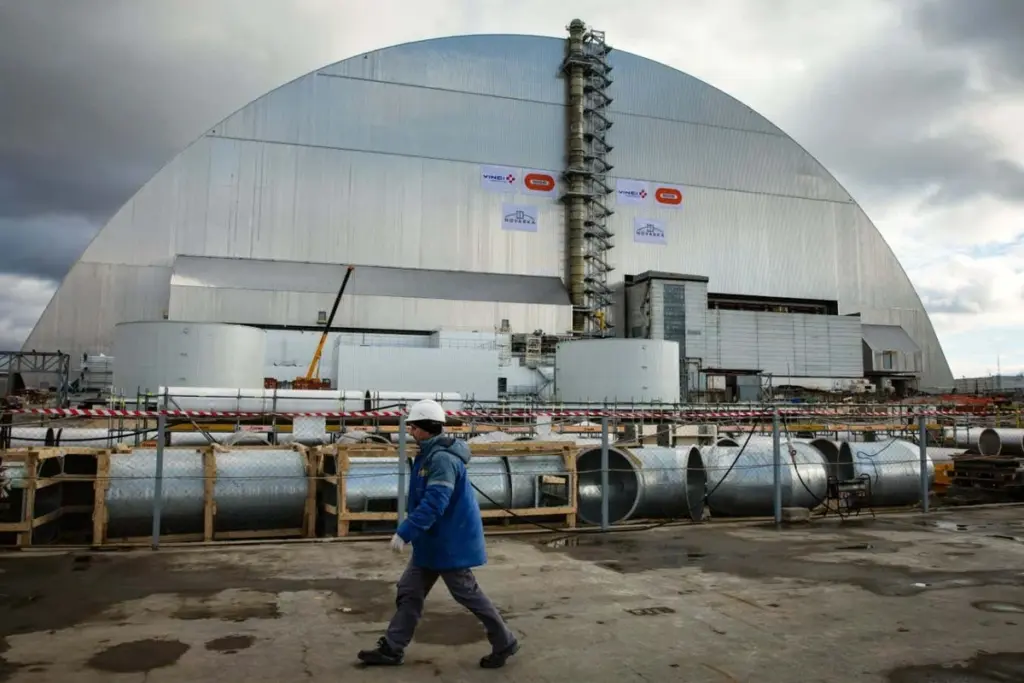
For decades, the workforce at Chernobyl primarily consisted of scientists dedicated to monitoring contamination and researching the environmental impacts of radiation exposure. This equilibrium shifted in 2010 with the initiation of the New Safe Confinement (NSC) arch project. This colossal structure was designed to encapsulate both the ruins of reactor 4 and the concrete sarcophagus hastily erected over it in the months following the accident. Scientists experienced a collective sigh of relief upon the NSC’s completion in 2016. This milestone paved the way for long-term plans to decommission reactor 4 and manage its hazardous remnants, a process anticipated to span a century.
The individuals encountered express a deep affection for this place, describing it as both beautiful and intellectually stimulating. “People who work here, they love it. They can’t leave. They have roots,” remarks Shavanova. It is easy to understand this sentiment; the landscape evokes the serenity of a picturesque nature reserve. The absence of human habitation, juxtaposed with the decaying remnants of industrial infrastructure, lends the area an almost otherworldly atmosphere.
This unexpected tranquility was disrupted in 2019 by the broadcasting of a highly successful HBO drama that vividly depicted the disaster’s horror for a new generation. “After that, it was like Disneyland,” Shavanova recounts. “We couldn’t do our job because there were a lot of tourists.”
However, this influx of visitors paled in comparison to subsequent events. The full-scale Russian invasion of Ukraine, commencing on February 24, 2022, positioned Chernobyl directly between the advancing troops and the capital, Kyiv. Driving through the region today, clear evidence of the invasion force is visible: bomb-damaged structures, military cemeteries, and extensive minefields.
Upon seizing control of Chernobyl, Russian soldiers dug trenches in contaminated zones, looted valuables, and destroyed laboratories, research, and data. Denys Vyshnevskiy, associated with the Chornobyl Radiation and Ecological Biosphere Reserve, returned after the Russian occupation to discover his office had been ransacked. Shoes, a microwave, and maps were missing. His extensive library remained largely undisturbed, with the singular exception of one missing copy of Keith Richards’s autobiography.
Computers were confiscated, prompting Vyshnevskiy to alter his passwords, assuming the equipment was taken by intelligence agencies for its data or maps. However, he later found components strewn across abandoned Russian trenches, indicating that bored soldiers had simply removed parts for potential use or resale. “It’s typical behaviour for a medieval army,” Vyshnevskiy observes, as a smartphone alert interrupts to announce an air raid in Kyiv.
The occupation, which concluded in April 2022 with the recapture of the plant by Ukrainian forces, remains an indelible part of Chernobyl’s narrative. Within a building belonging to the Institute for Safety Problems of Nuclear Power Plants (ISPNPP), several ransacked rooms have been preserved as time capsules. Papers and equipment are scattered, computers are smashed, and furniture is broken, creating the impression that Russian troops had departed only moments before. Olena Pareniuk, an ISPNPP researcher, guided me through her laboratory, where her work on identifying radioactive waste-eating bacteria had been irreparably set back by this destruction.
A Complex Problem
To safeguard against future Russian incursions, the 2600 square kilometers of the exclusion zone surrounding the ruined reactor are now under intense military protection. The complex scientific and environmental challenges of Chernobyl’s cleanup have been significantly compounded by a difficult geopolitical and logistical situation.
Sergii Obrizan, a colleague of Vyshnevskiy at the Chornobyl Radiation and Ecological Biosphere Reserve, states that the former depth and breadth of their research are no longer feasible. “The war and everything around it – troops, occupation, militarisation – influences the zone a lot, and our work,” he notes. A portion of Vyshnevskiy and Obrizan’s duties involves monitoring wildlife within the exclusion zone, where the diversity of species is astonishing. Wolf and moose tracks were visible, though the animals themselves remained elusive. “They’re smart, they avoid humans,” Vyshnevskiy remarks. He has encountered wolves perhaps five or six times in his 26 years of working in the exclusion zone, and while he has not seen a lynx or a bear, colleagues have reported sightings.
Regrettably, such excursions are now impossible in numerous Chernobyl habitats, which are littered with landmines deployed by both Russian and Ukrainian forces. Vyshnevskiy recounted the tragic death of a firefighter battling a forest fire caused by a downed Russian drone, who stepped on a mine. His remains were discovered 70 meters away. He is aware of three wild horses killed in similar incidents, though the vastness of the zone means most animal casualties likely go unnoticed.
Throughout the visit, minefields and military checkpoints became commonplace. Areas formerly designated as tourist attractions or public spaces are now classified military sites. This pervasive militarization has displaced scientists; where hundreds once worked, on this visit, all converged around a single table for dinner cooked by Vyshnevskiy.
Prior to the war, research institutions and groups occupied a row of houses adjacent to Lenin Street, each claiming a dedicated building. Tonight’s gathering takes place in a structure formerly used as a makeshift laboratory by the Ukrainian Institute of Agricultural Radiology. Its expansive garden features mature apple trees, some of whose fruit, I am informed, is occasionally consumed. Cotton bags suspended from the ceiling of an outbuilding showcase experiments on insect life. Bookshelves are lined with notebooks filled with handwritten scientific data from past research.
Art historian Oksana Semenik shares over dinner that her father was deeply saddened to learn his former home in an evacuated village had recently been demolished. The reason, and whether the demolition was carried out by Russia or Ukraine, remains unknown. During her childhood, residents were informally permitted to visit once a year, a practice Semenik wryly notes was accompanied by Soviet assurances that radiation would “take the day off.”
Some individuals chose to return permanently. Approximately 1200 evacuees resettled in Chernobyl during the late 1980s and early 1990s, without official intervention to prevent their return. They exist in a legal gray area that has become even more ambiguous since 2022. Obrizan states that their numbers have gradually declined due to old age, but approximately 40 civilians still reside in the city of Chernobyl, with an additional six in a neighboring village.
Among these residents is retired teacher Yevhen Markevich, now 88 years old. He has resided in Chernobyl his entire life, with the exception of one month following the 1986 disaster when he was temporarily relocated. Markevich and his wife, Galyna, warmly welcomed me into their wooden home, shared with a dog and 15 cats that freely access the house through a kitchen wall hatch. Though their movements understandably show the effects of age, the couple does not appear to exhibit symptoms of radiation exposure. Their garden is meticulously tended, and they speak with evident affection for their home.
The notion that Chernobyl has been entirely abandoned since the 1986 accident is, in reality, a misconception. Reactor 2 remained operational until 1991, reactor 1 continued until 1996, and reactor 3 was not shut down until 2000. Workers conducted their duties in conventional office settings, situated mere hundreds of meters from one of the most radioactive sites on Earth.
Chernobyl’s Deadliest Legacy
Jim Smith, a researcher at the University of Portsmouth, UK, contends that approximately two-thirds of the exclusion zone is technically safe for human inhabitation. “The danger to humans isn’t so great now, and really never has been,” Smith states. “The Soviets spent a lot of effort: once they’d acknowledged that they’d done this terrible thing, they almost went over the top in evacuating people and in some of the measures they took.”
Smith points out that millions globally receive higher natural radiation doses from geological sources or air travel than the Markevichs and other self-settlers experience from living within the exclusion zone. However, this does not negate the illness and fatalities directly attributable to Chernobyl. Two individuals perished in the explosion itself, while approximately 28 firefighters and emergency personnel died within the first three months from radiation exposure. Attributing specific incidents occurring years or decades later to the disaster is considerably more challenging. The most reliable estimate, derived from extensive population models, suggests a death toll of 15,000, according to Smith. Inadequate pre-1986 data, some inflated figures, and public misperceptions about radiation have contributed to a narrative that is far grimmer than the verifiable data supports.
Arguably, Chernobyl’s most devastating legacy has been its impact on public perception of nuclear power. A recent study estimated that the consequent increase in fossil fuel use led to heightened air pollution, reducing global life expectancy by 318 million years. By studying Chernobyl, researchers here aim to counter public distrust of nuclear power and apply their extensive expertise to other nuclear incidents. Several of them visited Fukushima following the 2011 disaster, where their knowledge proved invaluable. While the underlying physics of these events share similarities, their economic and political contexts differ significantly. Ukraine possessed sufficient territory to cordon off Chernobyl and leave it undisturbed. In Japan, however, land is scarce, and a cultural imperative to rectify mistakes necessitated a decontamination process that would be economically unviable in Ukraine. Despite these extensive efforts, former residents of the Fukushima region have been hesitant to return. Radiation remains a source of public apprehension, its effects sometimes minimal and at other times catastrophic, demanding a comprehensive understanding of physics, biology, and geography to fully grasp why.
To gain a deeper understanding, a visit into the heart of Chernobyl’s exclusion zone, specifically the site of reactor 4, becomes necessary. Approaching the 36,000-tonne NSC shelter, constructed between 2010 and 2016 at a cost of €1.5 billion, presents a challenge to comprehend its sheer scale. Though appearing squat from a distance, its immensity is unveiled by the size of the external staircase at its end. The arches span 257 meters and rise 100 meters, with approximately 650,000 bolts securing its structure.
Among the numerous unusual structures and sights within this region, the NSC shelter stands out as particularly uncanny. It is relatively modern and featureless. Yet, mere meters away lies the shattered reactor, the hastily assembled sarcophagus constructed by the Soviet Union, the remains of at least one plant worker, and some of the most infamous and deadly spaces on Earth, where a single misstep or prolonged exposure could prove rapidly fatal. A part of me yearns to explore its interior, to traverse the debris and witness the fuel fragments, the grotesque lava-like formations, and the decaying machinery. Simultaneously, another part urges me to retreat as far as possible.
Inside, on the NSC’s ceiling, crane gantries are installed, designed for the gradual and meticulous dismantling of both the sarcophagus and the reactor. However, last year, a Russian drone struck the NSC’s roof, piercing its multi-layered construction. Footage from that night depicts fire and smoke billowing from a gaping hole. Fortunately, the impact occurred sufficiently near the edge of the structure that debris did not fall onto the fragile reactor or sarcophagus below, potentially triggering a collapse and releasing dangerously radioactive material. Today, a temporary patch is visible on the roof. Plainclothes security personnel soon emerge and escort me away.
The NSC arch comprises two layered shells, separated by approximately 12 meters of open space. Each layer consists of insulation material sandwiched between metal sheeting. Viktor Krasnov, acting director for science at the ISPNPP, displays a small cross-section of the roof stored in a bin bag behind his desk. He explains that the metal itself is non-combustible. He then extracts a piece of the insulation from the section’s interior and, using a cigarette lighter, demonstrates its non-flammable nature. The primary concern lies with a rubber sheet embedded within the insulation, intended to maintain the structure’s airtight seal.
It was this rubber that ignited, smoldering for three weeks. Anatoly Doroshenko, a junior scientist at ISPNPP, spent this period piloting a drone equipped with an infrared camera over the facility to identify hotspots and guide firefighters. The drone was also fitted with radiation sensors to ensure the safety of the response teams. Ultimately, the initial opening, measuring about 60 square meters or the size of a squash court, became a secondary concern. Firefighters were compelled to create approximately 200 new apertures in the structure to position their hoses and extinguish the rubber fire. The material had burned away across a significant portion of the colossal building.
Krasnov states that careful monitoring of conditions within reactor 4 resumed expeditiously after the Russian occupation. However, they now face the renewed challenge of ensuring the building’s integrity, a setback they could have done without. “You cannot tell radioactivity to stop being radioactive,” he states. “The war didn’t stop us. We’re working on how to restore it.”
In April 2025, engineers temporarily patched the inner and outer shells of the NSC, striving to seal it before the onset of winter rains and snow. Krasnov confirms that the structure is now airtight once more. However, the remnants of the drone landed on a gantry within the NSC, and the tracks for the overhead cranes are also damaged. The absence of these functional cranes presents a significant engineering obstacle for the long-term decommissioning of reactor 4. Ordinarily, such repairs would be relatively straightforward. Yet, in Chernobyl’s context, a substantial neutron flux continues to emanate directly from the reactor’s shattered core. Thus, the question of how to repair the gantry and cranes remains. “Well, I wouldn’t like to do it,” Pareniuk admits. “And I wouldn’t like to be responsible for the people who are repairing it.”
“To see this building destroyed, which was very, very difficult to build in the first place, is extremely painful,” says Balthasar Lindauer at the European Bank for Reconstruction and Development, which oversaw the funding and construction of the NSC. Funds originally allocated for decommissioning work had already been redirected to secure the site following the Russian occupation. Now, additional resources are required solely for repairing the NSC. “If Ukraine is left alone with this problem, I see very difficult times ahead,” Lindauer warns. “A hundred years was quite a luxurious kind of timeframe. That luxury may have been reduced.” Currently, no definitive plan exists for the permanent dismantling and safe storage of reactor 4’s radioactive remains.
Elsewhere, however, encouraging signs of change are apparent. Chernobyl’s cooling ponds were extensive, man-made lakes meticulously maintained seven meters above the level of the Pripyat River through pumping systems. Entire villages predating the plant were submerged during the ponds’ creation; remnants of concrete electricity pylons, standing long before the power station’s existence, are still visible. One scientist recalls swimming in a cooling pond years ago to wash off after a day spent collecting radiation measurements in the dusty exclusion zone. Such jarring and seemingly illogical practices are a constant feature at Chernobyl, where risks are carefully weighed by experts who must live with them daily. The cooling pond pumps were deactivated in 2014, and it took four years for the water levels to stabilize with the river. The lowest sections remain flooded, revealing the contours of ancient, meandering riverbeds that had been hidden for decades. These areas have accumulated heavy radioactive elements, rendering them even more dangerously contaminated today than the larger ponds immediately after the accident.
A brief hike across a now-dry section of the ponds, alongside Olena Burdo from the Kyiv Institute for Nuclear Research, reveals a thick layer of shells from the ponds, interspersed with wild boar bones and young birch trees. The route is confined to areas marked with white tape, indicating clearance by army sappers for mines. Abandoned boats and a fire engine are also visible. In less than a century, this landscape has transitioned from land to lake and back to land. “Before 2022, we thought only about radiation,” Burdo remarks. “Now we think about radiation and mines.”
Burdo explains that the land exposed by draining the ponds is relatively safe on the surface, but contaminants like strontium can be found just 20 centimeters below. She is currently conducting studies on rodents to observe wildlife migration into the newly drained areas. As we walk, Burdo notices a small burrow, suspecting it indicates the presence of a new rodent species not yet documented in the pond area—a subject for future investigations. Two years ago, vegetation began to proliferate rapidly, which has led to the dredging of strontium. Grass with high contamination levels is consumed by rodents, which in turn become prey for larger animals. While radiation undoubtedly influences wildlife in the cooling pond vicinity, this does not inherently render the area dangerous. Burdo aims to conduct experiments to differentiate ecological effects from radiation effects. “It’s new territory. Maybe in the whole world we don’t have the same place. I think it’s really unique.”
There are indications that these cooling ponds may be reverting to their original state: a functioning forest and a healthy ecosystem. “Maybe it can be, but we don’t know,” Burdo says. “We’ll learn about this maybe in the future, 10 years later, something like this.” The rapid pace of environmental change and the unforeseen consequences of human intervention underscore the necessity for careful consideration regarding any future use of this territory. Vyshnevskiy recalls the first decade after the disaster marked by a series of unsuccessful experiments, as politicians apparently sought to establish some form of agricultural use for the exclusion zone. Fish farms, beekeeping operations, grain cultivation, and dairy farms—none proved successful. Vyshnevskiy points out that these plans generally disregarded the fact that the area was not particularly fertile even before the plant’s existence. “It was nonsense,” he states. “They wasted a lot of money.”
Some individuals maintain that agriculture could be viable, although the zone’s designation as a nature reserve makes large-scale farming unlikely. Smith was involved in a project to produce vodka within the exclusion zone. While the grain cultivated near Chernobyl contained a level of caesium that exceeded the European Union’s radioactivity limit of 1250 becquerels per kilogram, the vodka distilled from it contained no detectable strontium or caesium. Last year, 2000 bottles were sold, with proceeds donated to Ukraine.
Chernobyl’s Future
If the exclusion zone is unlikely to see widespread repopulation or agricultural use, what are its potential applications? The consensus among most individuals encountered is a clear rejection of a return to “dark tourism,” where visitors seek out diaries, dolls, or gas masks in abandoned Pripyat homes for staged photographs on Instagram. “It’s not respectful,” Pareniuk asserts. “It’s like going to a graveyard just to see ghosts and zombies. But the people who lived here were real people, not ghosts and zombies.”
Many also emphasize Chernobyl’s crucial role in researching radiological disasters, advocating for the area to once again become a hub for scientists. “The Chernobyl zone is a unique place for researchers, and there’s no other place like this in the world,” Obrizan states. He fondly recalls visits from Western universities before the war and clearly misses the collaborative work undertaken with them.
Vyshnevskiy similarly views the zone as a “supermarket for researchers.” The site offers opportunities to study the effects of caesium radiation on aquatic environments, strontium’s impact on insects, rodents, birds, or large mammals, methods for restoring nature at former industrial sites, and the testing of new safety or monitoring equipment for other reactors. Such research can be conducted here.
While a somber consideration, such information is likely to prove valuable. Nuclear disasters have occurred and will likely continue to occur. A recent study suggests that one can be expected every 25 years, or once for every 3704 years of reactor operation across all global reactors. Consequently, an accident may be considered overdue. “It’s not a matter of belief, it’s a matter of the calculations,” Pareniuk asserts.
On a more optimistic note, akin to advancements in the aviation industry, lessons learned from each accident contribute to preventing future occurrences. However, the current situation presents an unprecedented challenge with active warfare near nuclear power plants, including ongoing military activities at the Zaporizhzhia Nuclear Power Plant in southern Ukraine, which compromises safety. “It’s a pity, but Russia will always be our neighbour, and they have a lot of nuclear weapons and they have a lot of nuclear power plants, and they don’t treat them well,” Shavanova comments. “You should understand our experience and use it. You can practise here. We can use it for something good.”
To characterize Chernobyl’s exclusion zone as a dangerous wasteland is both factually accurate and fundamentally misses the point. Hundreds of species are thriving here more successfully than in any other location. Nature is being afforded the space to recover and flourish. Radiation persists, either decaying in isolated hotspots or absorbed by flora and fauna. While forest fires, floods, and the Russian military pose threats that could potentially mobilize this radiation, if left undisturbed, the area remains safe. With diligent stewardship and a return to peace, Chernobyl could evolve into a European treasure rather than a monument to disaster.