
The shattered remnants of Chernobyl’s Reactor 4 represent one of Earth’s most inhospitable environments. These ruins are not only physically perilous but are intensely irradiated, shrouded in perpetual darkness, and contained within a decaying concrete sarcophagus, itself covered by the New Safe Confinement structure.
Yet, for scientists, understanding the goings-on within these ruins is crucial. This challenging task falls to Anatoly Doroshenko, a young scientist affiliated with the Institute for Safety Problems of Nuclear Power Plants (ISPNPP).
Doroshenko undertakes what might be considered the planet’s most dangerous job: venturing deep into the reactor’s ruins to collect readings and samples. He gets as close as eight meters to the core, sometimes performing these excursions as often as once a month.
A Scientist’s Perspective on the Extreme Environment
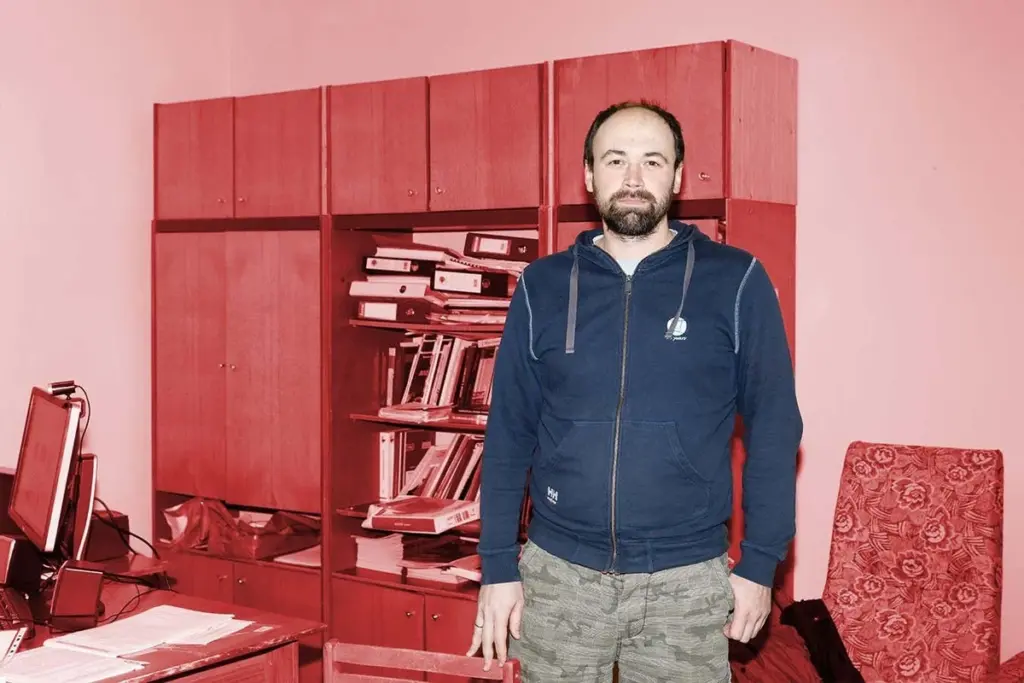
“It’s not scary,” Doroshenko stated, standing beside a scale model of Chernobyl at the institute’s laboratory within the exclusion zone surrounding the plant. “I prepared for it for a considerable time. You simply need to achieve a mental state ready to accept it and the imperative of doing the work.”
“It is indeed a strange feeling. I believe it can be likened to the sensation of conquering Everest, venturing into space, or exploring the ocean floor. A certain adrenaline rush is invariably present.”
Each expedition into the reactor requires him to accomplish a list of tasks within a strictly limited timeframe, necessitating a careful balance between speed and precision. “You must acquire knowledge about your intended actions and destinations. You must maintain self-control,” Doroshenko advised. He repeated the latter point, seemingly reinforcing its importance for himself.
“You must be cognizant that everything is contaminated. If you touch something, you need to know precisely what it is to avoid contaminating your clothing or yourself,” he explained. “The primary consideration is that you must be aware of your plans because the time safely spent within is limited. You aim to complete the work efficiently, and perhaps observe something interesting, but it is not a sightseeing trip. You are engaged in professional duties, so you must be fully aware of every required action and keep it in mind.”
Navigating Contamination and Protective Measures
When Doroshenko visits less hazardous sections of the reactor, he typically wears a hat, protective gloves, and a respirator. For areas with higher contamination levels, he adds a full-body suit to prevent dust accumulation, or even a third protective layer made of polythene. He also possesses lead aprons that can be worn externally, but their weight and bulk significantly impede movement within the cramped interior spaces.
As a junior scientist, he was once accompanied by a senior employee to the main circulation pumps. These pumps were integral to Reactor 4’s cooling system and played a role in the safety test that ultimately led to the 1986 disaster. “It’s a very significant location to observe and widely recognized. We have been examining all the damage caused by the explosion.”
“Our primary defense is knowledge, not the suits,” commented researcher Olena Pareniuk from ISPNPP. “Anatoly is one of our key personnel. He appears tired and somewhat dispirited, as we all do, but he is performing an excellent job. We do not have many young individuals proficient in dosimetry measurements.”
Generations of Scientific Endeavor Within the Ruins
Doroshenko’s supervisor, Viktor Krasnov, acting director of science at ISPNPP, detailed that numerous generations of scientists have entered the reactor since 1986 to conduct measurements and install sensors. Inside, they encounter confined areas, pipes filled with radioactive water, and substantial quantities of corium. Corium, a blend of melted fuel, concrete, and metal formed at 2500°C following the disaster, has seeped and dripped through the ruins, creating unusual formations.
“The very first individuals who entered coined slang terms for these formations: the elephant’s foot, the cat’s house, the dog’s house, the octopus beam, the mammoth beam,” Krasnov recalled. “Everything within is destroyed, making all routes exceptionally challenging.”
Addressing Ever-Present Risks
The potential risks are manifold. One such hazard is the 2200-tonne Upper Biological Shield, formerly positioned atop Reactor 4, now known as Elena. It was dislodged during the explosion and currently rests at a 15-degree angle, supported by rubble. Any collapse of this immense structure could destabilize the precarious ruins and liberate vast plumes of radioactive dust.
A more enduring risk, necessitating consistent and accurate readings, arises from intermittent surges of nuclear activity. The precise location of all fuel material within the reactor remains unknown, and it occasionally becomes active.
When uranium or plutonium fuel undergoes radioactive decay, it releases neutrons. These neutrons can initiate a fission reaction if they are absorbed by another radioactive nucleus. However, significant quantities of water can slow down these neutrons, hindering their absorption. Immediately after the disaster, the sarcophagus created dry conditions inside the reactor, contributing to a neutron spike.
Subsequently, an increase in water presence, partly due to holes in the concrete shelter allowing ingress of birds and weather, led to higher humidity and a reduction in neutron flux. “Presently, with the installation of the New Safe Confinement, humidity levels are lower, and we anticipate potential accidents, which we need to be aware of in advance,” stated Krasnov. This underscores the vital importance of Doroshenko’s continued efforts to enter the reactor and better understand the prevailing conditions.
“I am aware of the risks,” Doroshenko acknowledged. “Consequently, I am concerned about my health, because if I do not concern myself with it, I risk making mistakes. I cannot predict future health issues, but I know that by adhering to radiation safety standards, I can minimize these risks.”