
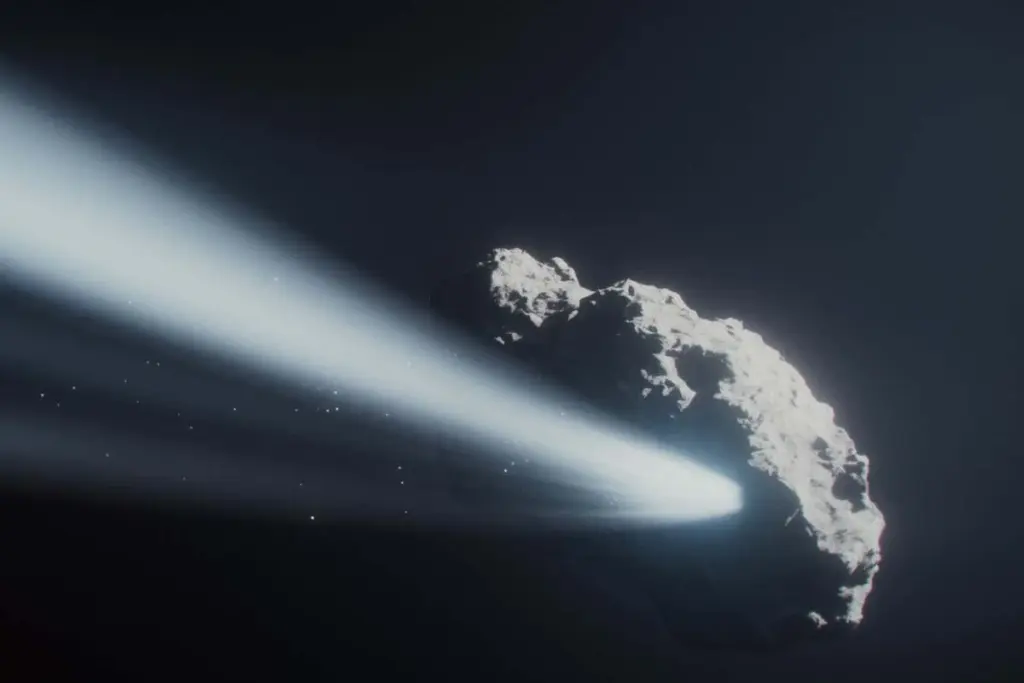
Astronomers have observed what appears to be the first instance of a comet altering its direction of rotation. This phenomenon offers a novel avenue for understanding the internal structure and composition of comets. Insights gained from such studies could potentially illuminate the conditions of the early solar system.
The celestial body in question is Comet 41P/Tuttle-Giacobini-Kresák, commonly referred to as 41P. This comet measures approximately 1 kilometer in diameter and completes a full orbit around the sun approximately every 5.4 years. Its visibility to Earth is limited to periods when it ventures into the inner solar system and its orbital path brings it relatively close to our planet. Its most recent appearance was in 2017.
During observations in March 2017, Comet 41P was recorded rotating at a rate of roughly one full revolution every 20 hours. However, just two months later, subsequent observations revealed a significant deceleration, with its rotation slowing to between 46 and 60 hours per spin. Further analysis of data from the Hubble Space Telescope, collected in December 2017 by David Jewitt at the University of California, Los Angeles, indicated an acceleration back to a rotation period of approximately 14 hours.
The most straightforward explanation for this observed behavior is that the comet’s rotation gradually slowed to a standstill before reversing its spin. This reversal is theorized to be driven by the sublimation of ice on the comet’s surface due to sunlight. As ice turns into gas and escapes, it acts like a jet. If this jet is expelled in a direction opposing the comet’s original rotation, it would exert a braking force, slowing its spin and eventually inducing rotation in the opposite direction.
“This marks the first detected ‘fast’ change in rotational direction for a celestial body,” stated Dmitrii Vavilov of the University of Washington in Seattle. He noted that substantial alterations in the rotation of celestial objects, even small comets, typically take decades or centuries to manifest.
Future observations of Comet 41P are anticipated with great interest. John Noonan at Auburn University in Alabama expressed eagerness to observe the comet’s next appearance, scheduled for late 2027 or early 2028. He highlighted a particular curiosity regarding whether such comets are more prone to fracturing under stress, a potential consequence of rapid rotation.
“I expect this nucleus will very quickly self-destruct,” Jewitt remarked in a statement, indicating that the comet might have already disintegrated. Should this disintegration have occurred, it would present a valuable opportunity to examine the interior of a comet that formed during the solar system’s early stages. The chemical composition of this ancient ice could offer crucial insights into the primordial conditions of the solar system and serve as a reference point for understanding subsequent chemical evolution.
The research detailing these findings was published in The Astronomical Journal with the DOI: 10.3847/1538-3881/ae4355.