
The iconic Chain Bridge, spanning the Danube and connecting the historic Buda with the vibrant Pest districts of Budapest, is usually a prime spot for tourist photographs. However, this past Sunday saw a different kind of illumination. Following an election that marked the end of Prime Minister Viktor Orbán’s sixteen-year tenure, the bridge was bathed in the green, white, and red of the Hungarian flag.
Supporters of Péter Magyar and his Tisza party voiced a sentiment of national reclamation, a feeling mirrored by Magyar himself in his victory speech. “We did it,” he declared, “We brought down the Orbán regime—together we liberated Hungary. We took back our homeland! Thank you! Thank you all!” This moment felt steeped in history, amplified by record-breaking voter turnout.
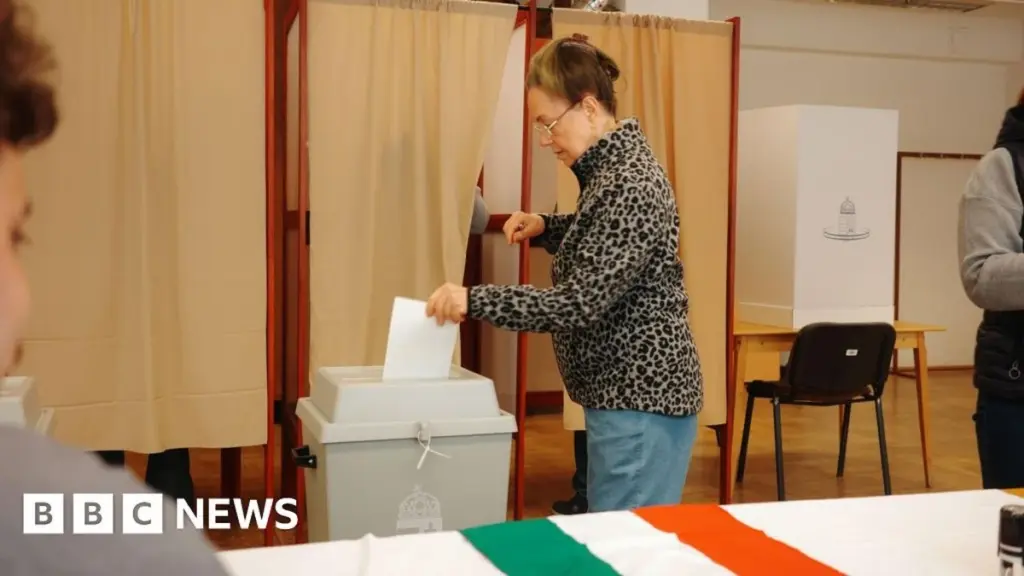
Despite Orbán’s firm control over state media, electoral system adjustments designed to favor his party, and the significant influence of his inner circle within Hungary’s self-proclaimed “illiberal democracy,” the Fidesz leader suffered a decisive defeat at the polls. Early Monday morning, crowds of first-time voters, a mix of hope and disbelief fueling their late-night celebrations, danced through Budapest’s streets. “I cried when I put the X on my ballot paper,” one voter, Zofia, shared. “I still can’t quite believe we did it. But we did!” Her companions echoed this sentiment with chants of “Russians Go Home!”
An Echo of History and a Shift in Alliances
This slogan resonates with a particular historical irony for Orbán. He first gained prominence in 1989, during the twilight years of the Soviet Union, calling for Russian withdrawal in a powerful speech in communist Hungary. The phrase itself harks back to Hungary’s failed anti-communist uprising in 1956.
Over time, Orbán’s political trajectory shifted significantly to the right, embracing an authoritarian style. Critics, increasingly irked by his sustained close relationship with Russian President Vladimir Putin, weaponized his own youthful slogan against him throughout the recent election campaign.
Orbán’s removal represents a considerable setback for Putin, who benefited from having a key ally within the European Union. Orbán had previously delayed the implementation of sanctions packages following Russia’s full-scale invasion of Ukraine and had actively blocked a crucial EU loan to Kyiv, deemed necessary for its survival.
Conversely, this development offers a positive turn for Ukraine. President Volodymyr Zelenskyy was among the first to congratulate Magyar, expressing an anticipation for “constructive work” together. While perhaps not overtly effusive, Zelenskyy is acutely aware of lingering Hungarian reservations regarding his country.
Navigating Delicate International Waters
During his campaign, Orbán employed posters and rallies to warn voters of potential dangers, suggesting that only he could ensure their safety and prevent the conflict in Ukraine from spilling across the border. Magyar, now in a position to govern, is expected to proceed with caution. A reversal of Orbán’s policy against sending military aid to Ukraine is unlikely, given the potential to alienate Hungarian citizens. However, he has assured Brussels that Hungary will cease obstructing the substantial €90 billion (£79 billion; $105 billion) loan to Kyiv, a measure previously blocked by Orbán.
Few European leaders will likely mourn Orbán’s departure. In Brussels, he was notoriously known as “the Obstructor.” More broadly, he was perceived as a disruptive force within European unity when confronting perceived threats from Moscow, Beijing, and, more recently, the United States.
In response to the election results, UK Prime Minister Sir Keir Starmer hailed it as a significant moment for European democracy. European Commission President Ursula von der Leyen commented that Hungary had “chosen Europe.”
A Loss for Trump and a Shift in the Nationalist Landscape
Across the Atlantic, U.S. President Donald Trump is likely to view the outcome with less enthusiasm. Hungary’s voters have removed his closest European ally. Trump had repeatedly endorsed Orbán, even sending his Vice President to Budapest during the Iran war to attend a pro-Orbán rally. Both leaders shared an admiration for the outgoing Hungarian Prime Minister as a prominent figure of the Christian nationalist, “anti-globalist” right. Steve Bannon, a former Trump strategist and advocate for European populist nationalist movements, had previously lauded Orbán as a “hero.”
While some analysts interpret Orbán’s electoral defeat as a potential sign of a plateau for populist nationalism in Europe, caution is warranted. It is true that Marine Le Pen’s National Rally party underperformed expectations in recent French local elections, and Italy’s Prime Minister Giorgia Meloni faced voter judgment in a referendum on judicial reforms that effectively became a referendum on her leadership. However, these instances are marked by specific national contexts.
Erosion of Support and Shifting Priorities
Orbán had long alienated significant segments of Hungarian society, including the left, the LGBTQ+ community, and many women who felt their rights were diminished by his government’s “pro-family, pro-traditional gender roles” agenda. Ultimately, even many of his traditional supporters abandoned him.
A visit to Orbán’s home village of Felcsút, the day before the vote, revealed substantial investment in the community, including his personally funded football stadium and academy. His son-in-law is associated with a local luxury golf course, while his father has been involved in the reconstruction of a private estate reportedly costing around $30 million (£22 million).
Orbán consistently denied allegations of corruption. During periods when Hungary’s economy was stronger, many in the village were willing to overlook such concerns. In recent years, however, soaring inflation and declining living standards contrasted with the apparent increasing wealth of Orbán’s inner circle. Gyárfás Oláh, a former Orbán supporter and ex-local mayor, expressed disillusionment, stating, “He failed us. He failed his country. He hoodwinked us.”
A considerable number of those who voted for Magyar did so primarily as an act of opposition to Orbán, rather than out of strong conviction for Magyar himself. He remains untested in a governmental role, leaving questions about his future leadership style, both domestically and internationally.
A New Leader’s Path Forward
Péter Magyar is a 45-year-old telegenic and energetic figure, formerly a member of Orbán’s Fidesz party. He identifies as a conservative nationalist, often seen carrying a Hungarian flag at political events.
It is plausible that Hungarian voters sought a center-right candidate to rally behind before definitively turning away from Orbán. Hungary remains a socially conservative nation, and it is anticipated that the new government will likely maintain a stance similar to Orbán’s on issues like migration.
Nonetheless, Magyar has pledged extensive reforms aimed at dismantling the “Orbán regime,” including a recalibration of ties with Russia and a renewed engagement with Europe. For the immediate future, the stated priorities for most Hungarians revolve around domestic concerns: revitalizing the struggling economy, enhancing public services, and mitigating inflation and the cost of living.
Grinning with joy amidst his jubilant supporters late Sunday, Magyar addressed the crowds: “Tonight we celebrate. Tomorrow, we get to work!” Magyar is expected to officially assume the role of Prime Minister after Hungary’s President formally invites him to form a government, a process anticipated to occur in approximately one month.