
An Orthodox Easter truce, initiated by Russia and Ukraine, commenced on Saturday afternoon. However, reports of air raid sirens in the Kharkiv region of northeastern Ukraine emerged just 38 minutes after its start. Since then, officials and military personnel have documented numerous ceasefire violations along the front lines, though no long-range missile or drone strikes have been recorded.
This temporary cessation of hostilities is intended to last until Easter Monday, offering a much-needed respite to the population after more than four years of Russia’s full-scale invasion. “Easter should be a time of safety, a time of peace,” stated Ukraine’s President Volodymyr Zelensky on X, emphasizing that Ukrainian forces would respond “strictly in kind” to any provocations from Moscow.
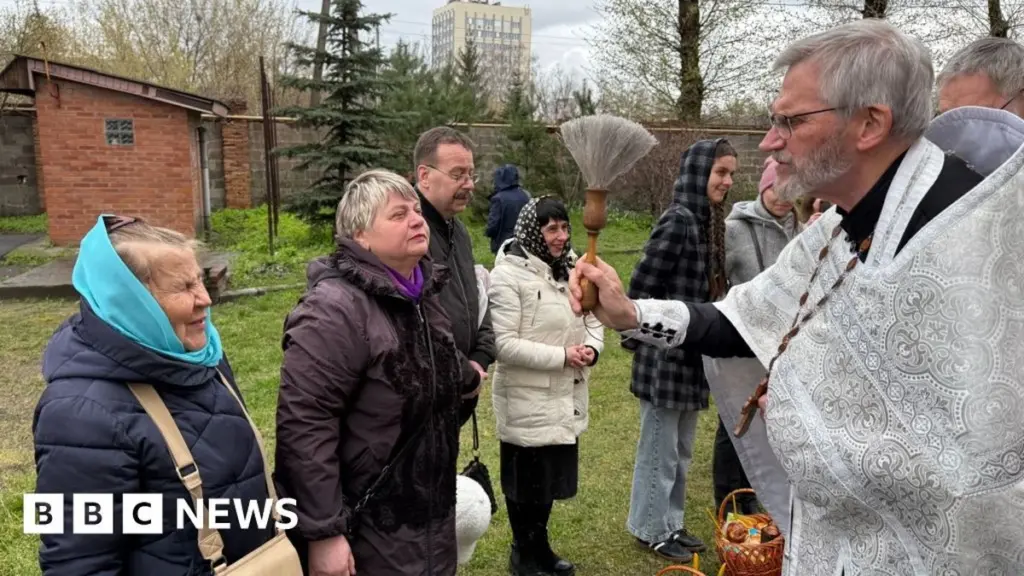
Expectations and trust remain exceptionally low among those enduring the conflict. Shortly before the truce’s scheduled start at 4:00 PM (2:00 PM BST), families gathered at St. John the Theologian Church to have their Easter baskets, filled with traditional cakes, painted eggs, and sausage, blessed. They formed a queue around the building to receive holy water from the parish priest. Traditionally, this service takes place just before midnight with a procession. This year, however, it was moved to mid-afternoon due to the existing curfew.
“Do you believe them?” Father Viktor asked, referring to the significance of a Russian ceasefire when questioned. St. John’s church itself sustained damage early in the full-scale war, and some of its windows on one side remain boarded up. “Maybe there will be a pause,” suggested Larisa, a parishioner, “But then Russia will only launch even more intense attacks. We’ve seen that before.”
Readiness on the Front Lines
At a military training ground approximately 12 miles from the Russian border, members of the Yasni Ochi strike UAV unit, part of the Khartia corps, are dedicating their weekend to testing new equipment destined for the front lines. They equip new kamikaze drones with explosives and practice targeting exercises. Their commander, Heorhiy, has instructed his troops to remain on alert during the 32-hour ceasefire unless directly attacked, though he anticipates an attack will occur. “Russia says one thing, then does the other. So you have to be ready,” he stated.
During this period, soldiers on rotation have been using drones to deliver Easter cakes and non-alcoholic wine to their comrades at the front. The village where the unit conducts its training was occupied by Russian forces in 2022 before being retaken by Ukraine. The surrounding houses have been reduced to rubble. Serious discussions about reclaiming significant swathes of territory, like the Donbas region just to the south, are no longer prevalent.
Heorhiy believes Ukraine cannot afford to cease fighting until it can negotiate better conditions with Russia from a position of strength. “We need real peace talks,” the commander asserted. He draws encouragement from the fact that the war in the Middle East has prompted countries to seek drone technology and expertise from Ukraine, which it possesses in abundance. However, the peace process, initially launched by the US, has since stalled, with former President Donald Trump’s envoys reportedly diverted to deal with a separate conflict involving Iran.
Ukraine continues to press its allies for robust security guarantees, specifically concerning what actions the US would take if Russia were to re-invade in the future. “It’s not our choice. I don’t like war, my guys don’t like it. We used to have good civilian life,” Heorhiy explained, recalling that several members of his unit were DJs before the war, active in Dnipro’s underground electronic music scene. “Now we do what we need to do.”
The Constant Threat in Kharkiv
Returning to Kharkiv, the route taken is along a ring road now covered with netting. This infrastructure is designed to intercept and disable Russian drones, preventing them from hitting vehicles underneath. Nevertheless, these measures offer little protection against missiles that can strike residential buildings. Russia’s proximity means air defense systems have minimal reaction time.
In a Kharkiv suburb, several five-story apartment buildings have been devastated, while others nearby remain boarded up and uninhabitable. Last month, a missile strike in the early hours claimed 11 lives and obliterated an entire section of a residential block. Amidst the wreckage, a single red rug remains affixed to a living room wall. Close by, photographs of two of the deceased lay on the ground.
Olha, a neighbor, recounted sheltering in a corridor with her elderly mother that night. She shared a video on her phone depicting the building opposite engulfed in flames and her own apartment reduced to debris. It is understandable why Olha yearns for an end to the conflict. “This truce is only 1.5 days. But at least we can rest a bit, because here, you expect to die every second,” she said, her voice etched with emotion. “We really want peace. Not for 1.5 days. For good.”
With quiet, angered tears, she expressed that the remaining sliver of the Donetsk region under Ukrainian control is not worth the immense loss of life. “There were children killed in that strike, wonderful people. Will it ever stop?” she implored.
President Zelensky has proposed extending this temporary truce, despite its fragilities, into a lasting ceasefire. He also advocates for continued talks with Russia aimed at achieving a genuine peace. The Kremlin, however, has already rejected this proposal, stating that its attacks will resume in full on Monday.