
Hungarians are heading to the polls on Sunday in an election that could unseat long-serving Prime Minister Viktor Orbán. The outcome carries significant implications for Europe, the United States, and Russia.
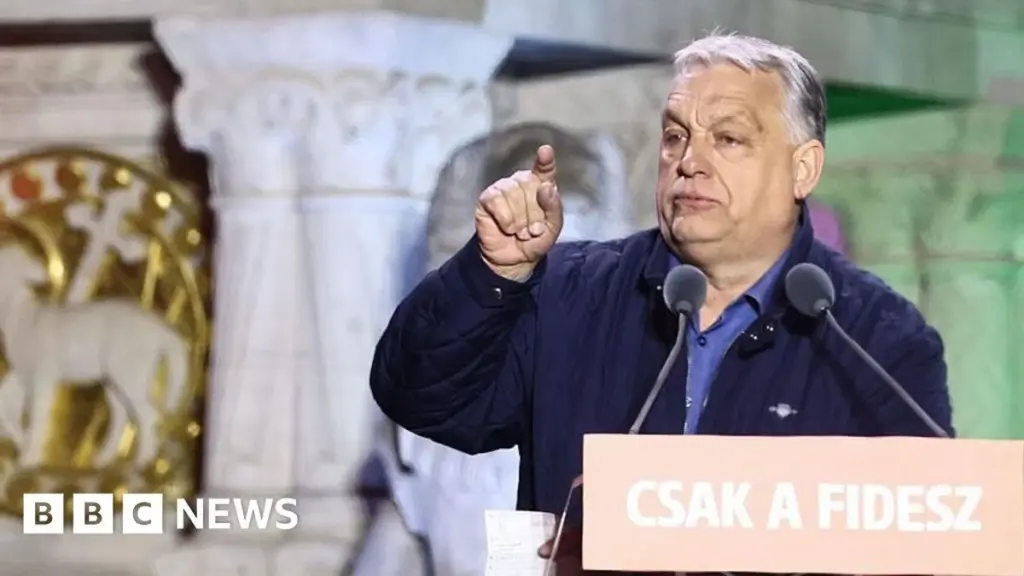
Most surveys indicate a favourable outlook for Péter Magyar, who established a grassroots movement after departing from the ruling Fidesz party. However, on the eve of the vote, Orbán expressed a defiant stance. “We are going to achieve such a victory that will surprise everyone, perhaps even ourselves,” he declared to thousands of supporters gathered in Budapest’s Castle Hill.
The voting period spans from 06:00 to 19:00 local time, with initial results anticipated to emerge later in the evening.
Orbán intensified the pre-election rhetoric, alleging that the opposition would resort to any means to gain power. In response, Magyar urged voters to resist “Fidesz pressure and blackmail.”
Following 16 years of Orbán’s governance, which the European Parliament has characterized as a “hybrid regime of electoral autocracy,” Magyar and his Tisza party are advocating for a fundamental shift. Their platform includes a recalibration of relations with the European Union and an end to close ties with Russia.
Magyar’s final rally in Debrecen attracted a larger crowd than Orbán’s event in Budapest, suggesting a shift in public engagement.
Despite this, Orbán retains strong support from figures like US President Donald Trump, who encouraged Hungarians to vote for his “true friend, fighter, and WINNER.”
During his Saturday night address, Orbán focused on his core campaign themes: criticizing Brussels and conveying a message against military aid to Ukraine. “We don’t give our children, we don’t give our weapons and we don’t give our money,” he stated. This sentiment resonated with the assembled crowd, who chanted their agreement. One supporter, Johanna, highlighted her alignment with Orbán’s policies on family protection and particularly his stance on the conflict in Ukraine.
While Orbán has secured victory four times previously, a fifth consecutive term appears less certain. The Hungarian economy is experiencing difficulties, and the government has faced scrutiny over several scandals, including revelations about Foreign Minister Péter Szijjártó’s frequent communications with his Russian counterpart around EU summits, a fact he has acknowledged.
Hungary is a member of both the EU and NATO. Orbán’s repeated vetoes of aid packages to Ukraine, amounting to €90 billion, have strained relations with European allies.
Election Landscape and Expert Analysis
According to Róbert László, an election specialist at the Budapest think tank Political Capital, Hungary’s three most reliable pollsters predict a substantial lead for Magyar’s Tisza party. Analysts had anticipated a narrowing of this gap as the election approached, but László notes this has not materialized.
Magyar has emphasized the need for his party to secure not only an absolute majority of 100 seats but also a two-thirds super-majority in the 199-seat parliament. This would empower them to reverse numerous constitutional changes made by Fidesz, which have affected judicial independence, media ownership, and other societal aspects. Hungary consistently ranks low on Transparency International’s Corruption Perceptions Index.
“The most likely scenario is that Tisza will achieve a comfortable, absolute majority, but not a two-thirds majority. However, a two-thirds majority cannot be entirely ruled out,” stated László.
Recent statements from figures within the police, military, and business sectors have expressed dissent towards Fidesz, which László interprets as an indicator of a public shift against Orbán.
Hungary’s Electoral System Explained
Hungary operates a complex electoral system for its parliamentary elections:
- Out of the 199 seats available, 106 are filled through direct elections in individual constituencies.
- The remaining 93 seats are allocated based on national party lists, with voting open to both domestic and expatriate Hungarians.
- In constituency races, votes for losing parties are transferred to their respective national lists.
- Excess votes for winning parties are also transferred, a mechanism that has frequently benefited Fidesz.
- To secure parliamentary representation, parties must attain at least 5% of the national vote.
Viktor Orbán himself has acknowledged that the electoral system has provided advantages to his party.
Nézőpont Institute, one of the few polling organizations suggesting a potential Orbán victory, points to 22 key “battleground seats” among the 106 constituencies. If Fidesz secures these seats, institute head Ágoston Mráz foresees a path to victory. However, as 5% of votes in these specific constituencies are not immediately counted, the final results may take several days to become definitive.
Mráz also suggests that Fidesz voters might be less vocal than their Tisza counterparts. “Conservative voters are not normally as enthusiastic, or their self-confidence is probably limited. They are more hidden voters; they are not ready to answer pollsters’ questions, and percentage-wise, there are more blue-collar voters among Fidesz supporters than in the Tisza party voter base.”
Key Electoral Contests and Local Dynamics
For Magyar and the Tisza party to achieve victory, they will need to win in several significant towns and cities, including Györ, Hungary’s sixth-largest city, situated in the northwest near the Slovak border.
Orbán himself brought attention to Györ last month during a campaign event, where he reacted heatedly to booing protesters, accusing them of advancing “Ukrainian interests.”
Conversely, Magyar led a substantial rally in a central square in Györ just last Thursday.
Gergely Németh, a 20-year-old student planning to attend the rally with his mother, described how government policies have led to financial struggles for his family. While Orbán’s pro-family initiatives have increasingly exempted mothers with two or more children from income tax, not all citizens have experienced these benefits.
Echoing the sentiments of many first-time voters interviewed, Németh stated that his primary goal is to see Fidesz defeated. “I think it’s not the man, Péter Magyar, who’s most important. More important is that someone changes these politicians in the parliament,” he remarked.
Györ has been led by an independent mayor and deputy mayor for the past two years, although Fidesz retains a majority on the local council.
“I know what Fidesz brings, I know what Fidesz does, I live in it,” said Deputy Mayor Roland Kósa, who spoke of an arrogance stemming from Fidesz’s prolonged hold on power. “When we got elected, what we faced even before and after is that Fidesz basically looked through us and said and thought we do not exist – this is still their city, this is still their country.” Kósa believes that by disengaging from traditional party politics, a more effective challenge to Fidesz can be mounted.
Magyar’s Political Trajectory and Campaign Strategy
Although Magyar built his political career as a center-right conservative under Orbán, he dramatically broke with his party two years ago and now draws support from across the political spectrum.
This broad appeal allows voters who may personally dislike him to support him, knowing they are contributing to a widely supported movement.
Magyar made a deliberate choice to eschew alliances with other parties, opting instead to build his Tisza party from the ground up. He established “Tisza-islands,” often small groups of activists operating within predominantly Fidesz-dominated areas. This approach bears resemblance to Orbán’s earlier strategy of forming “citizen circles” during his time in opposition.
These “islands” have since evolved into the foundation of a national movement and form the core of his election campaign. His candidates are not career politicians but include specialists such as surgeons, teachers, and business professionals with intimate knowledge of their local communities and the challenges facing Hungarian healthcare and education.
The Election’s Unconventional Nature
This election’s conclusion is proving to be quite different from typical European contests. The two leading figures are not engaging in televised debates, with the campaign largely unfolding on social media and in public squares.
While Fidesz officials outwardly express confidence in victory, political director Balázs Orbán has suggested that the opposition might contest the results if they do not prevail.
Ágoston Mráz also voiced concerns about the potential for Tisza voters to reject an Orbán win and allege electoral fraud. “I’m really afraid of getting violence on the streets because tension is in the air. I hope very much that every politician will be smart enough to help voters avoid violence on the street,” he stated.
The atmosphere was peaceful at an anti-Fidesz concert in Budapest’s Heroes’ Square on Friday night, attended by an estimated 100,000 people. During this event, Magyar cautioned attendees “not to fall for any kind of provocation.”