
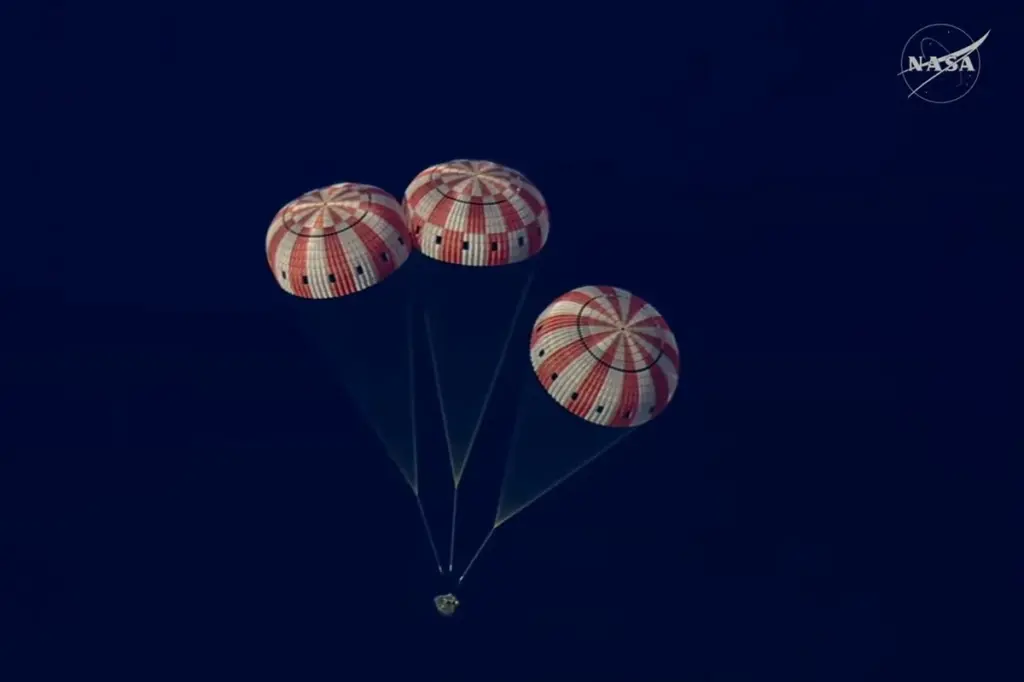
The astronauts of the Artemis II mission have successfully returned to Earth. Their voyage, commencing from Cape Canaveral, Florida, on April 1st, encircled the moon and ventured further from our planet than any humans had traveled previously. The crew’s capsule made its splashdown off the coast of California on April 10th.
Upon landing, Mission Commander Reid Wiseman confirmed a positive status for all crew members, stating, “four green crew members,” indicating that he, NASA colleagues Victor Glover and Christina Koch, along with Canadian astronaut Jeremy Hansen, were in good health following their reentry into Earth’s atmosphere. Wiseman reflected, “What a journey.”
This significant flight represented the return of humans to the vicinity of the moon for the first time since the Apollo 18 mission in 1972. At its furthest point, the Orion capsule achieved a distance of 406,771 kilometers from Earth, surpassing the previous distance record set by the Apollo 13 mission crew in 1970.
Scientific Observations and Technical Tests
While the primary objective of Artemis II was to serve as a crucial test flight for subsequent lunar missions, a standard it clearly met, the crew also pursued several scientific research goals. A notable area of focus involved the colors observed on the lunar surface. From a distance, the moon appears uniformly grey. However, upon closer inspection, the astronauts reported noting shades of green, brown, and even orange. These detailed observations hold the potential to assist scientists in understanding the composition and historical evolution of the moon’s surface, particularly its far side, where the astronauts witnessed regions never before seen directly by human eyes.
The intense brightness of sunlight reflected off Earth, a phenomenon known as earthshine, sometimes overshadowed these subtle color variations when both the Earth and moon were simultaneously visible. Koch described this effect, noting, “The moon turned into a sponge of light.” She elaborated, “As soon as the Earth got close enough to be in my field of view to take them both in at the same time, [the moon] dulled, it turned into a sponge, it’s almost like it went matte.” The persistent brightness of earthshine through one of the capsule’s windows was so pronounced that the crew resorted to covering the window with a spare shirt, leading to calls for future missions to incorporate dedicated sunshades.
The astronauts also engaged in extensive photographic documentation and voice recordings as they observed the moon passing by. These included precise descriptions of the terrain below. Kelsey Young, NASA’s Artemis science lead, explained the value of such observations during a press conference on April 7th: “It’s those kind of nuanced observations that could ultimately inform future landed missions, future crewed missions, to understand where [we can] go to maximise the scientific value.” She added, “These ultimately get at chronology of the solar system, at how the inner solar system has evolved over time, which connects to the moon being the witness plate for our planet and for the inner solar system.”
Unique Celestial Views and Future Implications
While their spacecraft was positioned behind the moon, the Artemis crew had the opportunity to witness a solar eclipse unlike any observable from Earth. During this event, the sun appeared smaller than the moon in the sky as it was obscured by the lunar horizon. Wiseman shared his experience: “The eclipse occurred, and then we had 5 minutes of human emotional reaction to staring at that orb floating in the vastness of space.” He continued, “Then right after that, somebody in the cabin said, ‘Let’s look for impact flashes,’ and immediately we saw one or two or three.”
The detection of impact flashes, brief flashes of light resulting from meteorites striking the moon’s darkened surface, was among the mission’s scientific targets. Observing these phenomena can provide insights into the potential hazards posed by meteorite impacts for future surface missions.
The subsequent mission, Artemis III, will not involve a lunar landing or even a direct visit to the moon. This adjustment, stemming from recent changes designed to enhance program flexibility and practicality, will primarily focus on testing the Orion capsule’s capability for docking with lunar landers in Earth orbit. Artemis III is anticipated for 2027, with the next lunar landing scheduled for 2028 as part of the Artemis IV mission.
All these missions are integral to a broader objective: establishing a sustainable human presence on the moon. NASA recently announced a shift in its strategy, moving from an orbital space station to a surface-based habitat. China’s space program harbors similar ambitions. The long-term vision is that within several decades, journeys to the moon will become as commonplace as current trips to the International Space Station, and eventually, perhaps as routine as international air travel. Regardless of the ultimate outcome, the imagery generated by Artemis II has captured the public’s imagination, revitalizing contemporary perceptions of the moon.