
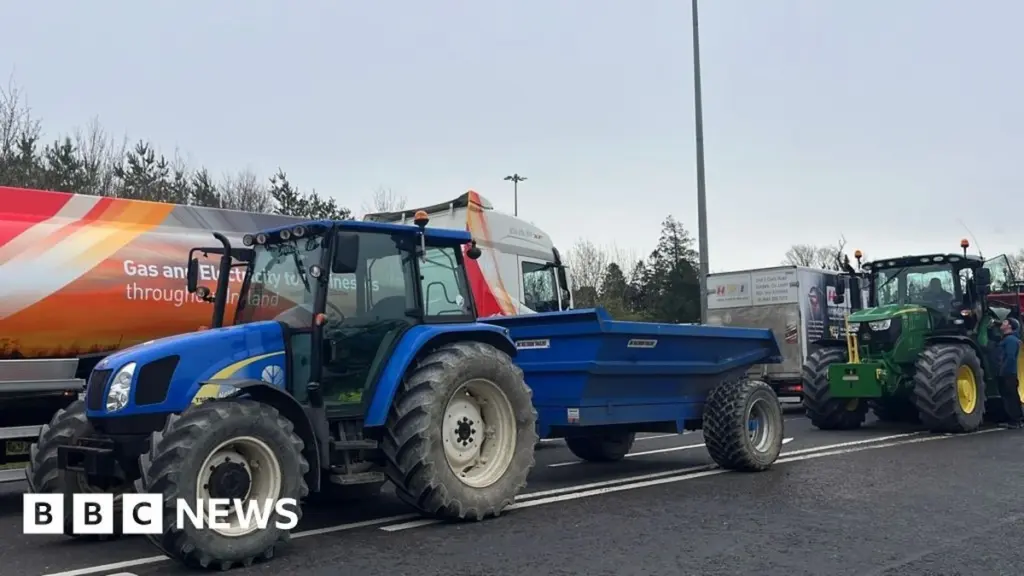
Hundreds of petrol stations across the Republic of Ireland are experiencing fuel shortages. This situation has emerged during ongoing protests, now in their fifth day, highlighting sharp dissatisfaction with high fuel prices. The demonstrations primarily involve the organized movement of slow-moving convoys, frequently comprised of agricultural machinery like tractors.
Reports indicate that approximately 500 forecourts have depleted their supplies of both petrol and diesel. These disruptions stem directly from protests focused on the elevated cost of fuel, a situation exacerbated by global events, specifically the conflict involving the US and Iran. The Irish government has acknowledged the unfolding crisis and confirmed that a fuel support package is in the final stages of preparation. This development follows what officials described as “constructive engagement” with representatives from the haulage and farming industries.
Widespread Transportation Disruption
The impact of the protests extends significantly to transportation networks. Several key routes within Dublin city center remain inaccessible. O’Connell Street and South Quay, central thoroughfares, are closed to vehicular traffic. Further afield, the disruptions are substantial:
- A significant blockade is in effect on the M50 motorway, leading to partial road closures.
- The M7 at Portlaoise is entirely blocked in both directions.
- On the M8, specifically at Cashel South, northbound traffic is impeded by a blockage.
- Road blockades have also been reported in Monaghan town and along its N2 bypass.
- In County Clare, the M18/N18 junction is affected.
- In County Limerick, the M20/N20 between Patrickswell and Raheen is subject to obstruction.
Public transport services have not been spared. Several services have been suspended, contributing to major disruption within Dublin. Bus Éireann has stated its intention to continue serving passengers traveling to Dublin Airport where feasible. Travelers heading to Shannon and Dublin Airports are strongly advised to allocate considerable extra time for their journeys.
In response to the severity of the situation, An Garda Síochána, Ireland’s police service, has designated the fuel protests as an “exceptional event.” This classification empowers the police force to double the number of officers available for deployment, aiming to manage the escalating disorder.
Government Engagements and Calls for Resolution
Meetings involving Irish ministers and key sector representatives are scheduled to continue throughout the weekend. The Tánaiste and Minister for Finance, Simon Harris, stated on Friday that a “substantial and significant” support package was being developed for “key sectors of the economy.” He characterized the ongoing discussions as progressing positively, though he emphasized that further “intensive engagement” into the weekend would be necessary.
Despite the ongoing dialogue, Harris reiterated a critical demand: “The blockade has to end.” The Taoiseach, Micheál Martin, voiced concerns about the country’s vulnerability during a global oil supply crisis, warning that the blockades placed the nation “on the precipice of turning oil away from the country.”
Earlier on Friday, the M1 motorway, leading towards the border with Northern Ireland, experienced extensive queues. This congestion was a direct result of protesters obstructing the motorway at Dundalk, with vehicles blocking both lanes at the Carlingford turnoff. The National Emergency Coordination Group (NECG), an inter-agency body coordinating emergency responses, has reported that fuel supplies for essential services—including ambulance and fire brigades—are facing “increasing pressure.”
Root Causes of the Protests
The current protests are a direct consequence of rapid price increases for both petrol and diesel. These surges are linked to ongoing international conflicts in the Middle East. A significant portion of global oil trade, estimated at 20%, is impacted by the closure of the Strait of Hormuz, a crucial shipping route and the primary ingredient for producing petrol and diesel. In recent weeks, the price of diesel in the Republic of Ireland has climbed from approximately €1.70 per litre to €2.17 on many forecourts. Petrol prices have also seen an increase, with many pumps now charging up to 25 cents more per litre.