
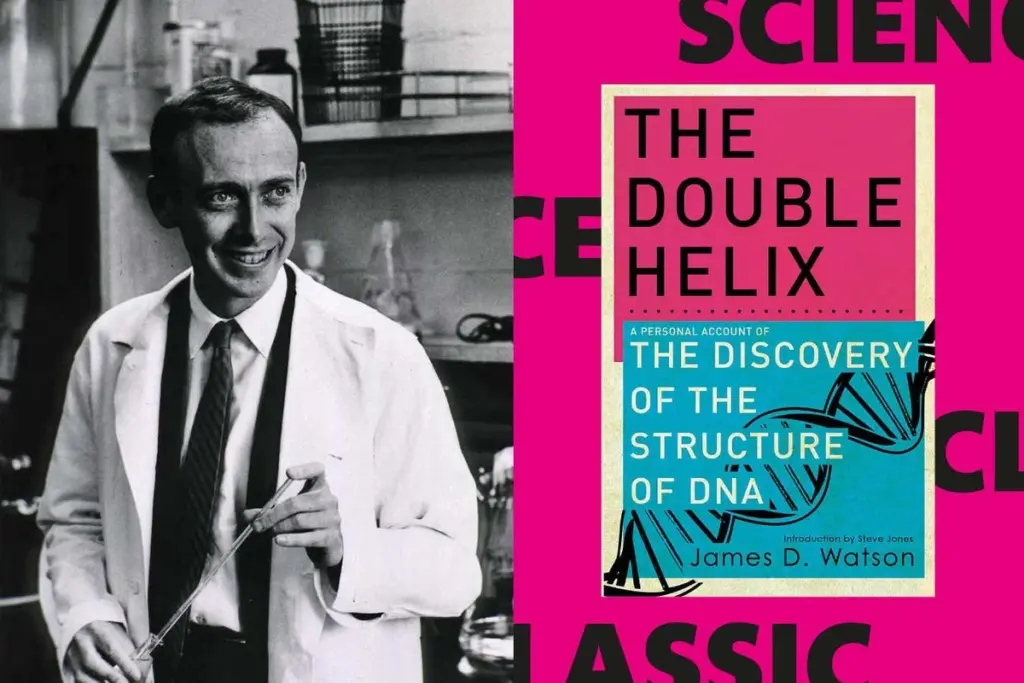
James Watson’s “The Double Helix” is often lauded as one of history’s most significant scientific books. However, a closer examination reveals problematic elements, particularly when considering Watson’s later life and public persona.
Nathaniel Comfort, a Johns Hopkins University professor and Watson biographer, notes that “The Double Helix” revolutionized the scientific memoir. He explains, “Watson portrayed science not as a sterile progression of facts, but as an exciting, dynamic journey shaped by the scientists’ individual personalities.” This fresh perspective, Comfort adds, “inspired countless young individuals, both men and women, to pursue scientific careers, a significant goal Watson intended with the book.”
The Narrative of Discovery
“The Double Helix” chronicles Watson’s involvement with Francis Crick from 1951 to 1953, culminating in their work on the DNA structure. Their breakthrough was aided by data from Rosalind Franklin and her supervisor, Maurice Wilkins. According to Watson’s account, however, his own brilliance was the primary driver of this achievement.
Yet, as science historian Matthew Cobb, author of a recent biography on Crick, states, “Watson’s account should not be taken at face value.” Cobb emphasizes that “The book is a blend of fact and fiction, a characteristic Watson fails to disclose.” He suggests that Watson was influenced by Truman Capote’s “In Cold Blood” (1966), a work notable for its dramatized portrayal of a crime, often considered the first “non-fiction novel.” This influence, Cobb posits, led Watson to create a villain for his narrative.
Rosalind Franklin: The Chosen Villain
“Wilkins was likely the true antagonist,” Cobb suggests, contrasting this with Watson’s focus on Rosalind Franklin, whom he refers to dismissively as “Rosy.”
Upon its release in 1968, Watson’s disparaging and sexist remarks about Franklin aligned with the prevailing social attitudes of the time. Patricia Fara, a historian of science at the University of Cambridge, recalls reading the book as a student and accepting its gender bias as commonplace in the scientific environments she encountered. Today, however, such attitudes are likely to be met with strong disapproval.
Beyond the sexism, contemporary readers may find the book’s overall tone to be gratuitously offensive. Cobb describes Watson’s demeanor as “amazingly immature,” noting that Watson began university at 15. He characterizes Watson as “particularly obnoxious as a young man— and became obnoxious in different ways as he grew older,” referencing Watson’s racist remarks that led to his dismissal in 2007.
A Misunderstood Comedy?
Comfort offers a different interpretation, arguing that the book has been widely misinterpreted. “What people overlook in Watson’s book is its comedic nature,” he says. Comfort points to the opening line, “I have never known Francis in a modest mood,” and the closing statement, “I was twenty-five and too old to be unusual,” as evidence of its intended humor.
Comfort’s perspective might explain certain jarring passages, such as an alleged confrontation with Franklin where Watson expressed fear of being struck. Viewed as an attempt at humor, this scene might gain some context, though its comedic value remains questionable.
“I should be clear that none of the jokes land effectively,” Comfort admits. “Many fall flat.”
An Unreliable Narrator
Crucially, Watson’s self-portrayal in the book is largely unflattering. Comfort notes, “The Jim character is lazy, vain, clumsy, dishonest, deceptive, horny—an unreliable narrator in every sense.” Watson’s original title intention, “Honest Jim,” was meant to be ironic, highlighting this unreliability.
This unreliability may extend to the depiction of his team’s acquisition of Franklin’s data. Cobb and Comfort have found evidence suggesting a more collaborative relationship between Crick, Watson, Franklin, and Wilkins than Watson’s book suggests.
Impact and Legacy
Despite its significant flaws, “The Double Helix” achieved remarkable success as a gripping narrative, a notable accomplishment for a book concerning chemistry. It became a bestseller, with estimated sales exceeding one million copies.
“It was an incredibly influential book at the time,” Cobb states.
Fara concurs, acknowledging its substantial sales and impact. “However, it can hardly be called ‘great’ when it openly advocates an ethical stance contrary to scientific principles and presents a distorted view of research practices,” she argues.
Cobb advocates for reading the book, albeit with a specific approach: “I encourage everyone to read it, but to read it as a novel. You may find yourself quite annoyed with the characters, as they are not very likable.”