
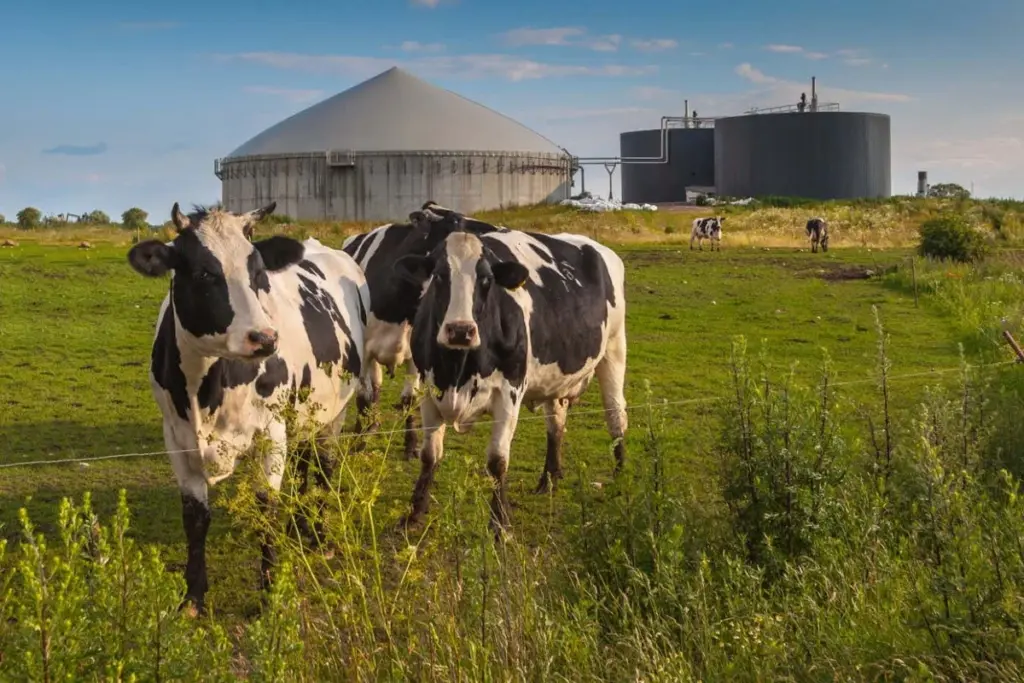
During World War II, farmers in Germany and France resorted to creating their own fuel. They achieved this by covering cisterns containing manure and capturing the methane gas released in the process.
Today, governments are backing an advanced version of this technology. Known as anaerobic digesters, these systems are promoted as a means to reduce greenhouse gas emissions from dairy farms.
However, some researchers voice concerns. They suggest that investing in these digesters might lead to unintended consequences for both the climate and human health. Rebecca Larson from the University of Wisconsin-Madison questioned the cost-effectiveness of digesters compared to other climate mitigation strategies. “Is this money more effective in climate reduction than other strategies like building solar panels?” she posed. “That’s something that should be examined… but in terms of livestock it’s one of the highest performing mitigation measures that we have.”
Agriculture contributes approximately one-third of human-caused emissions. Within the United States, cows contribute about a third of this sector’s total through belching, while manure accounts for an additional 14 percent. Modern industrial dairy operations constantly manage vast quantities of manure from crowded barns, often flushing it into large lagoons.
Commercial-scale digesters began appearing in the 1970s, designed to cover these lagoons or replace them with tanks. Europe has since seen over 17,000 digesters installed, primarily on farms. The US and the UK each host around 400 such facilities. China, by contrast, has millions, though these are largely simple brick digesters on smaller farms.
When organic material is stored without oxygen, anaerobic microbes decompose it, releasing both carbon dioxide and methane. This natural process occurs in sewage at wastewater treatment plants or when manure accumulates in lagoons and slurry pits.
Covering this waste with plastic or confining it in a closed tank allows for the capture of the resulting biogas, a mixture of CO2 and methane, through a pipe. Anaerobic digesters typically maintain a heated environment to accelerate biogas production. This biogas can be utilized for heat or electricity generation, purified into natural gas, or compressed for use as vehicle fuel. Although carbon dioxide is still emitted, this process prevents the release of methane, a significantly more potent greenhouse gas.
Following digestion, the remaining manure is repurposed as fertilizer and animal bedding. Manure processed through a digester emits 91 percent less methane during storage. However, a recent study analyzing methane plumes from 98 dairies in California revealed a more complex overall picture.
California, home to 1.7 million dairy cows on factory farms—more than any other US state—has allocated $389 million in grants over the past decade for digester construction, representing its largest initiative to combat methane emissions.
The installation of digesters reduced point-source methane emissions by an average of 23 kilograms per hour, from 91 kg/h to 68 kg/h, effectively cutting emissions at two-thirds of these dairies. Yet, average emissions showed a temporary surge during the digester construction phase. While the exact cause remains unclear, one potential explanation involves the rerouting of manure slurry, which could agitate it and consequently increase emissions.
Due to their heated internal environment, digesters can produce methane more rapidly than open lagoons. In some cases, leaks from these systems have resulted in higher methane emissions than those observed previously. The California study documented leaks exceeding 1000 kg per hour.
“At the rates that they’re leaking in those very large cases, that’s absolutely a cautionary tale for how something can come from a solution to a main emitter,” stated Alyssa Valdez of the University of California, Riverside, a co-author of the study. She highlighted the potential for a supposed solution to become a primary source of emissions.
Nevertheless, a California program initiated in 2023, which alerted farms to leaks, led to repairs at 20 percent of them. The majority of research still suggests that digesters can achieve approximately a 50 percent reduction in manure emissions. Angela Bywater from the University of Surrey in the UK noted, “If you’re running a digester, and you’re losing gas, you’re losing money, so it behoves digester operators to minimise emissions.”
Digesters also accelerate the conversion of ammonia from manure. This development has raised concerns about a “pollution swap,” where methane emissions are exchanged for ammonia. Furthermore, if the produced biogas cannot be sold and is instead flared, it may, in certain circumstances, lead to the emission of hydrogen sulfide.
A central question is the extent to which governments should actively promote digesters. California’s support for these systems appears to be encouraging the expansion of factory farms. Its Low Carbon Fuel Standard, a program designed to lower automobile emissions, provides marketable credits for biogas generated by digesters.
A preprint study indicated that receiving such incentives led to an average increase of 860 cows per dairy herd. Brent Kim of Johns Hopkins University in Maryland remarked, “Taxpayer dollars are being used to inflate the value of manure so it begins to compete with the value of milk, and that creates a perverse incentive structure. We could and should be looking at more proven, more effective approaches to climate change mitigation that don’t prop up an industry with a body of literature documenting the harms.”