
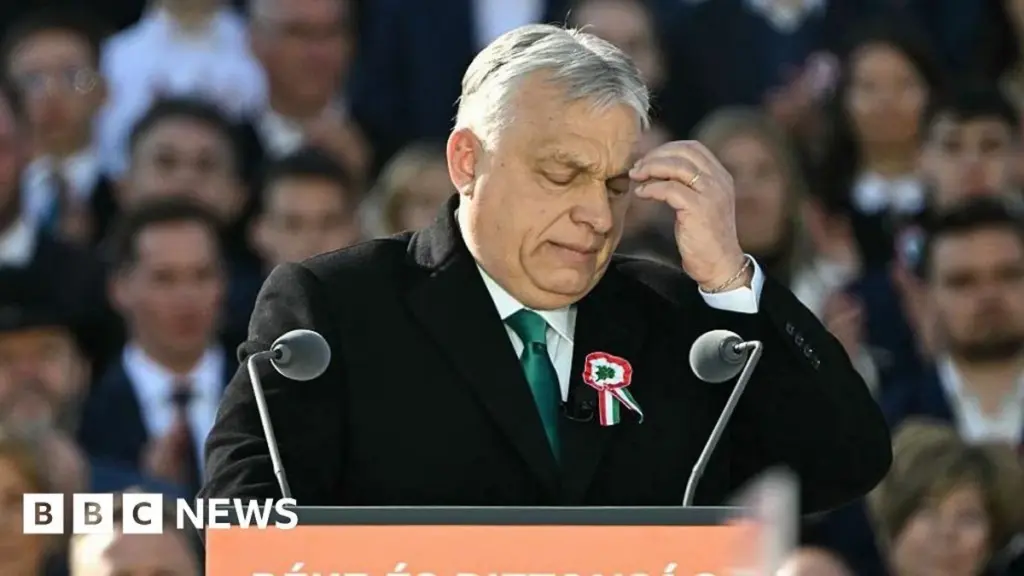
Viktor Orbán holds the distinction of being the longest-serving current leader within the European Union. His tenure, now spanning 16 years, faces its most significant test yet in the upcoming April 12 elections. Most opinion polls indicate a potential defeat for Orbán, with his former party insider, Péter Magyar, positioned as the favored challenger.
Since assuming office in 2010, Orbán has fundamentally reshaped Hungary, leading to its designation by the European Parliament as a “hybrid regime of electoral autocracy.” Orbán himself has sought various labels for his political system, experimenting with terms such as “illiberal democracy” and “Christian liberty.” His supporters within the US MAGA movement refer to it as “national conservatism.”
Orbán has frequently engaged in disputes with his European Union counterparts, notably concerning the conflict in Ukraine. He has blocked critical funding for Kyiv, asserting that Ukraine is attempting to draw Hungary into a conflict with Russia. Despite these internal EU tensions, he maintains significant international backing.
He is widely considered Vladimir Putin’s most crucial ally within the EU and has received an endorsement from former US President Donald Trump for his pursuit of a fifth consecutive term. His closest allies among EU member states tend to originate from the radical and hard-right political spectrum.
While his opposition to Brussels resonates with a segment of the Hungarian population, Orbán’s stance has increasingly isolated him among EU leaders striving for a unified European response to the war in Ukraine. Péter Szijjártó, Orbán’s Foreign Minister, has openly acknowledged sharing details of EU meetings with his Russian counterpart, Sergei Lavrov, characterizing these interactions as “everyday diplomacy.” Poland’s Prime Minister Donald Tusk remarked that “Orbán and his foreign minister left Europe long ago.”
Orbán’s personal charisma has undeniably been a cornerstone of his political success. However, recent polls suggest that a considerable number of his long-term supporters are growing weary, particularly due to persistent allegations of corruption surrounding his party. A moment of apparent discomposure for Orbán occurred when he was booed during a campaign speech in Győr in March, a stark contrast to his earlier reputation for dynamic leadership.
This current presentation marks a departure from the image of a leader who, according to his former football trainer, possessed a remarkable ability to “think on the ball.” It contrasts with the leader who once rolled up his sleeves and worked alongside firefighters and volunteers to contain toxic red sludge from a bauxite mine that threatened the Danube shore in 2010.
Early Life and Political Beginnings
Now 62, Orbán first gained prominence in the late 1980s, during his university years in Budapest, as the Soviet Union’s influence began to wane. He co-founded Fidesz, initially known as the Alliance of Young Democrats. In a notable speech delivered to an estimated quarter of a million people at Budapest’s Heroes’ Square, he declared, “If we believe in our own power, we are able to finish the communist dictatorship.” This address occurred during the reburial ceremony for Imre Nagy, a key figure in Hungary’s 1956 uprising.
Reflecting on that speech a decade later, Orbán stated that it had articulated the “silent desire for free elections, and an independent and democratic Hungary.” The democratic system that emerged after decades of authoritarian Soviet rule has undergone a significant transformation under Orbán. Hungarian-born journalist Paul Lendvai has described Orbán’s trajectory as moving “from one of the most promising defenders of Hungarian democracy into the chief author of its demise.” Professor András Bozóki, a former culture minister, characterizes present-day Hungary as the “only former consolidated liberal democracy in the EU that has reached the level of a non-democratic system as a hybrid regime.”
Viktor Orbán was born in 1963, west of Budapest. He is the eldest of three sons; his father was an agricultural engineer and a member of the Communist Party, while his mother worked as a special needs teacher. The family lived in Felcsút, a village of approximately 2,000 people, where Orbán still maintains a residence. He has spoken of experiencing physical discipline from his father, Gyozo, whom he described as a violent man, recounting these instances as “a bad experience.” His upbringing did not initially foreshadow his later opposition to the communist regime. He attended grammar school and was involved in the Young Communist League.
Football was his primary passion during his youth, and he played for his local club, FC Felcsút. He remains an enthusiast of the sport. In 2014, he inaugurated the controversial Pancho Arena in Felcsút, a stadium that hosts matches for the top-flight team Puskás Akadémia, often to sparse crowds.
Prior to commencing university, Orbán completed his mandatory military service. He has stated that during this period, he declined an offer from the communist secret services to become an informant.
At the age of 23, he married Anikó Lévai, a fellow student he met at university. They have five children: four daughters and one son, Gáspár, who underwent training at the British Army’s Sandhurst and served as an officer in the Hungarian army in Chad.
Academic Pursuits and Ideological Shifts
Following his 1989 speech in Heroes’ Square, Orbán pursued studies in liberal political philosophy at Oxford. His scholarship was supported by Hungarian-born billionaire philanthropist George Soros, a figure he would later vocally oppose.
Within months, Orbán withdrew from his studies to campaign in the 1990 elections. Fidesz secured 22 seats, with Viktor Orbán leading the party’s list. Close associates from his university days became prominent figures in Fidesz. István Stumpf, his former college director, served as his chief of staff during Orbán’s first premiership from 1998 to 2002.
As a young Member of Parliament, Orbán and Fidesz joined the global Liberal International movement in 1992. Political scientist Zoltán Lakner suggests that Orbán’s ideological direction shifted in the latter half of the 1990s. Observing the governance of Hungary by a liberal-socialist coalition, he reportedly concluded that “to gain political success he had to turn his back on liberalism and transform his party into a nationalist, anti-liberal political force.”
It is possible that the foundations for this ideological shift were laid during his time at Oxford. While attending Pembroke College, he developed a friendship with conservative philosopher Roger Scruton. Alternatively, his evolution may have been driven by political pragmatism.
Orbán assumed leadership of Fidesz in 1993. By the time the conservative MDF party lost power in 1994, Orbán was already steering Fidesz toward the center-right, effectively filling the void left by the weakened conservative bloc. Péter Róna, an economist based in Oxford and a former presidential candidate in Hungary, recalls a meeting in the early 1990s where Orbán expressed his ambition to create a “modern conservative party.” When Róna cautioned that previous attempts at this had seen the “modern” element abandoned under pressure, Orbán responded, “Then so be it.”
In 1998, Orbán led Fidesz to an electoral victory, becoming Europe’s youngest prime minister at 35 and overseeing Hungary’s accession to NATO in 1999. He subsequently faced electoral defeats in 2002 and 2006, lessons that he reportedly absorbed. The 2002 loss, in particular, seemed to profoundly affect him, leading him to tell supporters, “The nation cannot be defeated,” as he contemplated the outcome.
Following the 2002 election, Orbán began a close association with Árpád Habony, a martial arts instructor and businessman, who became a trusted advisor and an integral part of the business network that supported Fidesz.
Return to Power and Transformation of Hungary
Orbán returned to power amidst the global economic crisis in 2010 and has remained in office since. He has since implemented extensive changes to Hungary’s legal framework and constitution, securing four consecutive election victories with significant parliamentary majorities amounting to two-thirds of seats. In an effort to solidify his legacy, over 40 “cardinal laws” were enacted, fundamentally altering state institutions, the economy, electoral regulations, and media oversight.
The economy experienced stabilization, public finances were secured, and Hungary benefited from EU funding. However, substantial state-funded projects were awarded to Orbán’s close associates, including a childhood friend and his son-in-law. Hungarian media monitor Mertek reports that Fidesz and its allies gradually gained control over the Hungarian media landscape, displacing foreign investment.
By 2018, a significant portion of “Orbán-friendly media” had transferred ownership rights to a foundation named Kesma. According to Mertek, the board of this foundation comprised Fidesz Members of Parliament and the head of a think tank aligned with Fidesz.
For several years running, Transparency International has identified Hungary as the most corrupt country in the EU. The European Parliament has issued warnings regarding persistent threats to the rule of law in both 2018 and 2025, leading to the freezing of billions of euros in EU funds allocated to Hungary.
The EU represents one of several key targets for Orbán’s opposition in recent years. His most recent confrontation with EU leaders resulted in a Hungarian veto that has halted approximately €90 billion in aid intended for Ukraine.
Sándor Csintalan, a former ally and now critic of Orbán, has spoken of a “constant need to radicalise himself,” a trait that distinguishes him from other European conservative leaders. Ukraine has emerged as a central campaign issue for the long-serving Hungarian leader, who previously focused on George Soros and migration.
In 2013, political consultants George Birnbaum and Arthur Finkelstein proposed the strategy of creating Soros as an antagonist. Birnbaum explained, “Soros was a good target because enough people in Hungary didn’t like the idea of this billionaire… like the Wizard of Oz, controlling politics and policy, from behind the curtain.” Orbán accused George Soros’s civil society organizations of attempting “secretly and with foreign money to influence Hungarian politics.” A poster campaign targeting the philanthropist, widely condemned by critics as antisemitic, was launched. Orbán, however, has countered such accusations by highlighting his support for Israel and Prime Minister Benjamin Netanyahu.
The Central European University, founded by Soros in 1991 as Hungary embraced democracy, was compelled to relocate the majority of its operations to Vienna in 2019.
In July 2015, as the EU experienced a significant influx of refugees and irregular migrants across its borders, including Hungary’s, Orbán established a “clear link between illegal immigrants coming to Europe and the spread of terrorism.” His proposed solution was unambiguous: “We would like to keep Europe for Europeans… also we want… to preserve Hungary for Hungarians.” This stance led to the construction of a fence along the Serbian border and the introduction of new laws criminalizing migrants. The “Stop Soros” law enacted in 2018 criminalized assistance to irregular migrants. The EU’s highest court subsequently ruled that Budapest had not met its legal obligations under EU law.
As the April 12th vote approaches, Ukraine has become Orbán’s primary campaign focus. He alleges that Ukrainian President Volodymyr Zelensky is obstructing Hungary’s oil supply and accuses his domestic opponents of intending to divert Hungarian funds to Kyiv. Despite previously securing support from both Vladimir Putin and Donald Trump, Orbán’s narrative of protecting Hungary from warring factions is facing increasing scrutiny. He has not experienced electoral defeat since 2006, but he now confronts the most significant challenge of his political career.