
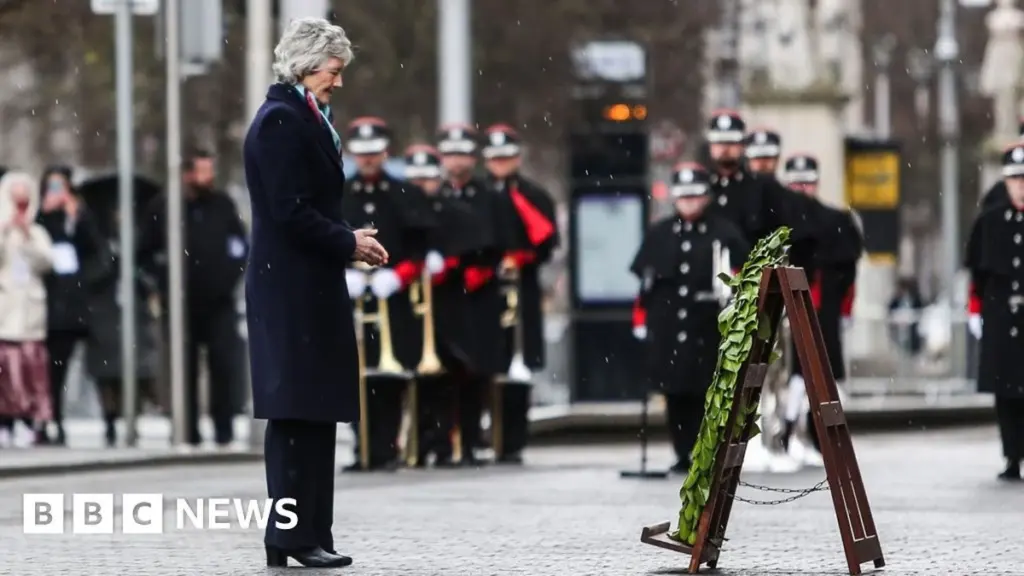
Across Ireland, observances were held marking 110 years since the Easter Rising. This 1916 uprising aimed to end British rule, a move many historians now recognize as a catalyst for the eventual establishment of an independent Irish republic.
In Dublin, Irish President Catherine Connolly placed a wreath at the General Post Office (GPO). Meanwhile, Belfast witnessed a significant turnout, with thousands participating in a parade through the western part of the city. Spectators lined the Falls Road to watch bands proceed toward Milltown Cemetery.
Key Figures Attend Dublin Observances
The Dublin event saw prominent figures such as Northern Ireland’s First Minister Michelle O’Neill and Irish Taoiseach (Prime Minister) Micheál Martin in attendance. The proceedings were further enriched by the participation of over 200 members of the Irish Defence Forces.
Captain Eva Houlihan read the proclamation, echoing Pádraig Pearse’s act nearly 110 years prior at the same historic location. Among the other dignitaries present were Tánaiste (deputy Prime Minister) Simon Harris, Minister for Defence Helen McEntee, Lord Mayor of Dublin Ray McAdam, and Sinn Féin leader Mary Lou McDonald.
Context of the Easter Rising
The Easter Rising was fundamentally an act of defiance against British governance in Ireland. It was orchestrated by a coalition of groups: the Irish Republican Brotherhood, the Irish Citizen Army, and Cumann na mBan, an organization for women.
On Easter Monday in 1916, shortly after midday, Pádraig Pearse emerged onto the GPO steps, accompanied by armed guards. There, he read a proclamation that declared the establishment of an Irish republic, effectively initiating the Easter Rising.
The ensuing conflict primarily took place within Dublin’s confines. British troops managed to suppress the rebellion within six days. Despite its immediate military failure, the Easter Rising is widely regarded as a crucial precursor to the Republic of Ireland’s eventual formation and the partition of the island.
The fighting resulted in considerable casualties, with over 450 individuals losing their lives and approximately 2,500 sustaining injuries.
Aftermath and Shifting Public Opinion
In the wake of their surrender to British forces in 1916, fourteen leaders of the Easter Rising were executed by firing squad. These executions took place in the stonebreakers’ yard at Kilmainham Gaol.
Two other rebel leaders faced execution in different locations. Thomas Kent was shot by a firing squad in Cork, and Roger Casement was hanged at Pentonville Gaol in London.
The way these leaders met their deaths is considered by many historians to have been a turning point. It is believed to have influenced public sentiment in Ireland. Initially, the populace had been largely unsupportive of the rebellion. However, the executions are thought to have fostered widespread sympathy and support for the republican movement’s pursuit of independence.