
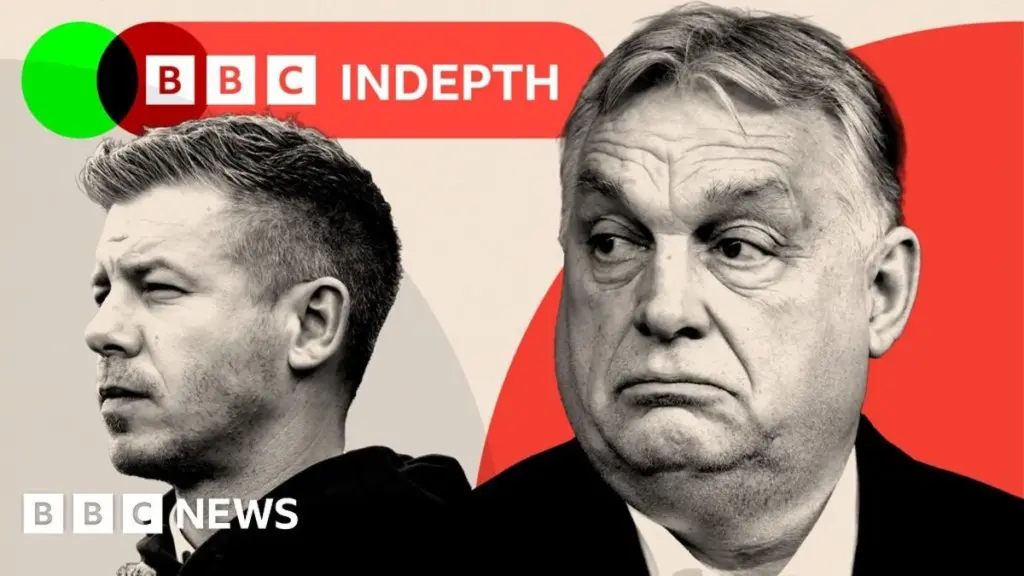
Riled and hoarse, Hungarian Prime Minister Viktor Orbán delivered a forceful message on March 27th at a large election rally in Győr, western Hungary. He directed his strong words towards opposition protesters, who had chanted insults like “Filthy Fidesz” during his address. This rare moment of visible agitation momentarily disrupted his carefully crafted persona as a steady hand guiding Hungary through turbulent times. His uncharacteristic outburst revealed a different facet of a leader typically known for his wit and ability to disarm even his detractors.
Current opinion polls indicate a significant lead for the opposition Tisza party and its leader, Peter Magyar, over Orbán’s Fidesz. One recent poll places Tisza at 58% against Orbán’s 35%. Faced with this challenge, Orbán is deploying all available resources to narrow the gap. After 16 years of largely unchallenged governance, the Prime Minister is once again actively campaigning. In previous election cycles, rallies were less frequent, but now Europe’s longest-serving leader is actively working to rally his supporters and appeal to undecided voters. With just one week remaining, he faces the critical task of salvaging his government and the international populist movement he represents from a potential significant defeat.
Orbán’s Political Landscape and International Standing
Since assuming power in 2010, Orbán has benefited from the support of both former US President Donald Trump and Russian President Vladimir Putin. He has consistently presented challenges to the European Union and is notably one of the few EU leaders who has not fully aligned with Ukraine’s interests. For nationalist parties across Europe, whether currently in power or on the verge of gaining it, Orbán’s approach serves as a model. Consequently, the Hungarian parliamentary election scheduled for April 12th is being closely observed on a global scale.
“We are observing a substantial shift in public sentiment,” noted Endre Hann, a representative from the public opinion research firm Median. In January, 44% of respondents believed Fidesz would win the election, compared to 37% for Tisza. By March, this perception had reversed, with 47% expecting a Tisza victory and 35% anticipating a Fidesz win. Hann elaborated, “This signifies a profound change in trust. People now believe that a change of leadership is possible.”
The Rise of “Corrupt Ruling Elite” Sentiment Against Orbán
A compelling dynamic is unfolding in this election: the same voter frustration with perceived “corrupt ruling elites” that has swept across Europe now appears to be working against Orbán. In Hungary, it is Orbán and his Fidesz party who are increasingly viewed, particularly by younger generations, as embodying this “corrupt ruling elite.”
The Orbán administration has faced persistent accusations of mismanaging state funds and directing state contracts to companies controlled by his close associates. The government, however, characterizes this concentration of wealth as a strategic effort to transfer assets into national, rather than foreign, hands. Notable projects have included the construction of bridges, football stadiums, and highways. His son-in-law, Istvan Tiborcz, holds ownership in several prominent hotel chains. Furthermore, his childhood friend, Lörinc Meszaros, a former gas fitter, has ascended to become the wealthiest individual in the country. Orbán has consistently declined to address inquiries regarding the personal finances of his family and friends, all of whom deny any wrongdoing.
The strategic question remains: can Orbán deflect blame by attributing Hungary’s challenges to Ukraine and its European Union allies? And can the articulate lawyer challenging him persuade Hungarian voters, especially those in the rural Fidesz strongholds, that he can deliver the “more humane, better-functioning country” he promises?
Under Pressure: Allegations and Opposition Claims
Evidence suggesting Orbán’s administration is facing difficulties emerges daily, ranging from claims of voter intimidation tactics to a highly unusual Russian proposal concerning a staged assassination attempt on Orbán. Nevertheless, Fidesz maintains that the perception of trouble has been manufactured by the opposition. Zoltan Kiszelly, a political analyst associated with the government think tank Szazadveg, stated, “These scandals are simply the usual suspects attempting to construct a narrative. When the opposition loses an election, it provides them with a justification to allege ‘fraud.'”
Political analyst Gabor Török, one of the few figures respected by both sides in Hungary’s deeply polarized political environment, commented on his blog: “This does not align with the image of ‘calm strength’ or ‘strategic composure,’ nor with the persona meticulously cultivated over years and displayed on ‘Prime Minister of Hungary’ advertisements.” He concluded, “If the remaining two weeks continue in this manner, it bodes ill for the government.”
A Global Referendum on Illiberal Democracy
The repercussions of an Orbán defeat would extend significantly beyond Hungary’s borders. Michael Ignatieff, former rector of the Central European University, which was compelled to relocate from Budapest in 2019, argued, “Budapest serves as the global headquarters for illiberal democracy. This is more than just an election; it is a referendum on the entire model of authoritarian governance that Orbán represents.”
Ignatieff refers to a network of think tanks, fellowship programs, and gatherings of right-wing influencers who collaborate across the Atlantic. Just last month, consecutive days saw major events in Budapest hosted by the American Conservative Political Action Conference (CPAC), a forum for right-wing political discourse, and Patriots for Europe, a European Parliament group representing right-wing interests. The absence of any prominent US politicians at this year’s Hungarian CPAC event drew attention within Fidesz. However, Republican engagement continues, with US Secretary of State Marco Rubio visiting in February and Vice President JD Vance expected in Budapest shortly before the vote. A Fidesz victory would invigorate the prospects of far-right parties in France, Germany, Poland, Spain, and Portugal. Conversely, a defeat for Fidesz could diminish their momentum. A senior Tisza official commented, “While the rest of Europe is being drawn into the radical nationalist current, we have the potential to show a way out.”
Mobilizing the Vote: Fidesz’s Strategy
Despite unfavorable poll results, Orbán’s allies assert that there is no cause for panic within Fidesz. According to Zoltan Kiszelly, the decisive factor will be Fidesz’s ability to effectively mobilize its supporters on election day. “We are very optimistic. Nobody truly believes the opinion polls, neither our own nor those of the opposition,” he stated. “The majority of voters support Fidesz: pensioners, women, the Roma population, the poor, blue-collar workers, and those in rural areas. The crucial question is whether they will cast their ballots.”
To ensure voter turnout, Fidesz has invested considerable effort in updating its supporter database. Approximately 4.5 million of Hungary’s 8.2 million eligible voters reside in small towns and villages, considered Fidesz’s traditional strongholds. Since 2002, Fidesz has established a robust system of local patronage in these villages, where the mayor often controls access to employment and essential resources like firewood during winter. An investigative documentary released recently detailed allegations that village mayors have been instructed on the number of votes each settlement must deliver for Fidesz. Interviewees in the film claim that incentives have included cash payments of €120 (£104) per vote, food vouchers, prescription medications, and even illicit substances in exchange for voting for Fidesz. Those who refuse are reportedly denied opportunities to participate in public works programs, which often represent the only available local employment.
On election day, transportation via cars and minibuses is reportedly organized. Individuals described as “companions” are said to accompany voters, who feign illiteracy or illness, into the polling booth to ensure their vote for Fidesz and facilitate the payment process, according to claims made by individuals interviewed for the film. The government has remained officially silent on these allegations. One minister informed the BBC that any alleged misconduct should be dealt with by the appropriate authorities. While rival parties in past elections have offered items like potatoes or small financial sums for votes, individuals with decades of election experience suggest that the scale of such practices in the current election is unprecedented.
Nikki, a 32-year-old resident of Tiszabö, a village of 2,000 inhabitants with a significant Roma majority in the northern Great Plain region, stated, “Everyone here votes Fidesz.” She credited the Fidesz mayor with renovating local infrastructure, including roads, the kindergarten, and the sports center. Nikki believes that on April 12th, votes will not need to be purchased, as Fidesz will secure victory “because of the war.”
The Russian Connection and “Peace or War” Narrative
Orbán has framed the election for voters as a straightforward choice between peace and war. Fidesz’s narrative posits that only Orbán can prevent “warmongers” in Brussels from drawing the EU, and by extension Hungary, into a conflict with Russia over Ukraine. Peter Magyar, the leader of the opposition Tisza party, is portrayed as a proxy for Brussels. The Fidesz message warns that a vote for the opposition could compel Hungary, as a NATO member, to deploy troops in either a future NATO peacekeeping mission or a full-scale war with Russia, resulting in young Hungarian men perishing on the eastern front. This message is designed to resonate deeply in a country that experienced significant losses in both World Wars. Since 2022, Orbán has contended that Russia cannot be defeated and that, instead of providing military and economic support to Ukraine, the West should exert pressure on Kyiv to negotiate peace with Moscow, even on Russian terms.
Endre Hann, a veteran pollster from Median, observed that “the Fidesz anti-Ukraine, pro-Russian message is flagging.” His recent data indicates a growing majority of 52% of respondents agree that “Russia committed a serious and unprovoked act of aggression against Ukraine” with its full-scale invasion in 2022. Conversely, only 33% concur with the Fidesz assertion that “Russia acted legally, to defend its interests and security.” Orbán stands as the most pro-Russian leader within the EU. His government has resisted joining the efforts by Germany, the Czech Republic, and Poland to reduce their reliance on Russian oil. In the current campaign, Fidesz has identified Ukraine and its leader, Volodymyr Zelensky, as adversaries. Large billboards feature a smiling Ukrainian president with the accompanying slogan: “Don’t let Zelensky have the last laugh!”
Since January 27th, Hungary has received no crude oil from Russia via the Druzhba pipeline, which translates to the “Friendship pipeline.” A critical hub and pumping station in Brody, western Ukraine, was damaged by a Russian attack on that date. Hungarian refineries depend on this pipeline, and Orbán has accused Zelensky of deliberately obstructing the restoration of oil flow to negatively impact his election prospects. Zoltan Kiszelly, the Fidesz analyst, argues that the “peace or war” message is more nuanced than it initially appears. “The government aims to link the current situation, specifically the threat of oil shortages, with practical issues such as the cap on utility bills,” he explained. Since 2013, the government has imposed caps on all household heating and electricity costs, resulting in the lowest consumer prices in the EU. The government asserts that this is made possible by affordable oil and gas supplies from Russia.
An Unlikely Challenger Emerges
Peter Magyar, 45, is a former insider of Fidesz. He joined the party as an enthusiastic student, married the former Fidesz justice minister, and served as a Hungarian diplomat in Brussels. In February 2024, he abruptly resigned from the party and all his positions in state-owned companies. He then granted an interview that garnered two million views within days, accusing the government of cowardice and corruption. Subsequently, he founded the Tisza party, named after a tributary of the Danube River.
Magyar, a slender figure who favors neat shirts and jackets, initially appeared too polished and urban to connect with rural voters. However, he has proven to be a formidable challenger. Orbán, 62, hails from a rural background and speaks in a manner that resonates with village life, while Magyar is a lawyer by training from Budapest. Cognizant that his status as a member of the metropolitan elite might hinder his appeal to rural voters, Magyar has tirelessly toured the countryside for the past two years, attracting large gatherings. In contrast to Orbán, who often focuses on global politics, Magyar concentrates his speeches on domestic issues such as healthcare, education, transportation, and rural depopulation.
His approach to Russia also differs. He has pledged that if his party wins, “we will study and where needed change the existing contracts with Russia, [and] diversify our energy resources in every possible way.” He has also committed to “restore Hungary’s seat at the EU and NATO tables.” Magyar stated that he learned quickly during his six nationwide tours. He abandoned his prepared notes early on after criticism for sounding unnatural and began speaking “from the heart,” as he explained in an interview earlier this year. “After the first few days, I read the criticism and learned… to get closer to the people, to let them ask questions and reply openly and honestly, which is rare in Hungarian politics.” He has transitioned from an outsider to the individual widely expected to unseat Orbán. While Orbán typically visits one city per day on the campaign trail, Magyar visits between three and six, aiming to reach all 106 individual constituencies before election day.
Magyar himself has faced controversy. After entering politics, his ex-wife described him as emotionally unstable, prone to fits of anger and domestic violence. Anti-Tisza protesters once displayed banners featuring a shoe, which he allegedly threw at her. More recent Fidesz efforts to discredit him include allegedly persuading a former girlfriend to secretly record his conversations and luring him to a party where cocaine was being used. Magyar vehemently denies any history of domestic abuse and speaks favorably of his ex-wife in public. He also denies ever using drugs and recently published the results of a negative drug test, challenging certain Fidesz politicians to do the same. A poll released by 21 Research Agency, a pro-democracy think tank, earlier this week indicated that the Tisza candidate is leading in most of its 20 swing districts. Magyar has spoken of a “tipping point” in the countryside, and if this poll proves accurate, he has already reached it.
While Orbán and Fidesz possess a media empire to disseminate their message, Magyar primarily relies on broadcasting his rallies live on Facebook. Previous opposition leaders struggled to draw crowds of more than a few dozen outside of Budapest, but Magyar attracts hundreds in villages and thousands, even tens of thousands, in provincial urban Fidesz strongholds. A senior Fidesz official reluctantly acknowledged that Magyar possesses “a brutal energy” that their own camp often lacks. Magyar’s promise to build “a more humane, efficient country” resonates with voters disillusioned with the ruling party, particularly the youth.
Consequences of Victory or Defeat for Hungary
“What we have now is a state fully captured by a single party,” stated Andras Baka, former president of Hungary’s supreme court. He warned that a Fidesz victory would lead to “an ever more rigid autocracy.” If Tisza were to win, a substantial agenda would require addressing, including the restoration of independence for the courts, the state prosecution service, the state audit office, public media, and intelligence services from governmental control. The extent to which a Tisza government could achieve these goals, and how rapidly, would depend on the margin of their electoral victory.