
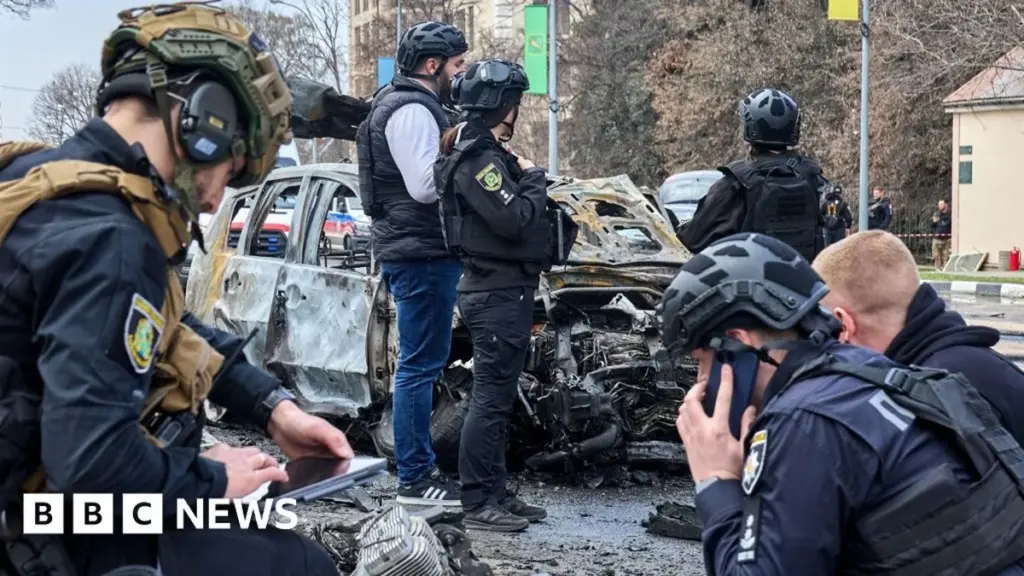
Ukrainian President Volodymyr Zelensky has asserted that Moscow deliberately selected a path of “Easter escalation” in lieu of observing an Easter ceasefire. This accusation follows a large-scale drone and missile assault launched by Russia across Ukraine, resulting in significant casualties and damage. The attack claimed the lives of six civilians and left forty others injured.
Recent developments indicate an increase in major daytime assaults, an occurrence that was once considered rare. These intensified attacks coincide with a stalemate in peace initiatives, which were previously spearheaded by the United States. The impetus for this standstill reportedly stems from a shift in focus by former US President Donald Trump and his associates towards the conflict in the Middle East. Concurrently, President Zelensky has indicated agreement with a British intelligence assessment suggesting that the frontline situation in eastern Ukraine has become the most advantageous for Ukrainian forces in the past ten months, with the advancement of Russian troops appearing to have decelerated. Despite this, aerial bombardments have continued unabated.
In the Zhytomyr region, situated to the west of Ukraine’s capital, Kyiv, rescue efforts were hampered as survivors were sought from beneath the rubble of their homes, many of which were entirely destroyed. The Kyiv region also experienced a direct impact, with footage capturing a drone descending towards a residential building before crashing into its side, igniting a fire. In Kharkiv, located in northeastern Ukraine, the city endured a day of strikes described by the mayor as among the most severe to date, leading to the death of one woman and critical injuries to several others.
President Zelensky characterized these widespread bombardments as Russia’s reaction to his proposal for a temporary truce during the holiday period. Orthodox Christians observe Easter on the upcoming weekend, a celebration shared by both Ukraine and Russia. “The Russians have only intensified their strikes, turning what should have been silence in the skies into an Easter escalation,” Zelensky stated via the social media platform X.
In preceding days, Ukraine has undertaken its own series of deep strikes, primarily targeting energy infrastructure along Russia’s northern coastline. The port at Ust-Luga, for instance, has been targeted by drones on multiple occasions, compelling Russia to temporarily halt exports. Zelensky reiterated that the offer of a holiday truce remains viable should Moscow agree to it. This proposal was conveyed during a discussion with Trump’s envoys, Steve Witkoff and Jared Kushner.
Plans for further in-person negotiations with Russia, facilitated by the US, have been postponed on two separate occasions. Moscow’s official stance is that these talks are currently “on hold.” President Zelensky extended an invitation to Trump’s team to visit Kyiv and subsequently travel to Moscow, underscoring their potential role in sustaining the peace process. However, prevailing doubts exist regarding Moscow’s genuine interest in reaching an agreement, particularly given the evolving global dynamics that appear to favor Russia.
For Ukraine, the potential scarcity of fuel and consequent price increases, exacerbated by the conflict in Iran, present a significant concern. Frontline Ukrainian troops require substantial quantities of diesel for their tanks and vehicles. Conversely, this situation offers an advantage to Russia, which may be able to generate increased revenue from energy exports, thereby financing its arms production and sustaining its military personnel. Furthermore, there are apprehensions regarding a potential deficit of US defensive missiles capable of intercepting the ballistic missiles that Russia frequently deploys against Ukraine. A contributing factor to this concern is the substantial deployment of US Patriot systems in the ongoing conflict with Iran.
“The longer the war in the Middle East continues, the greater the risk that we will receive less weaponry,” Zelensky communicated to journalists in Kyiv through recorded messages. “This is extremely difficult – perhaps one of the most challenging tasks.” Despite these difficulties, he described the frontline situation as “stable,” noting minor territorial gains in some areas and losses in others, and suggested that the immediate threat of a significant Russian breakthrough had diminished. The current focus for Ukraine appears to be on maintaining defensive lines rather than pursuing major offensive advances.